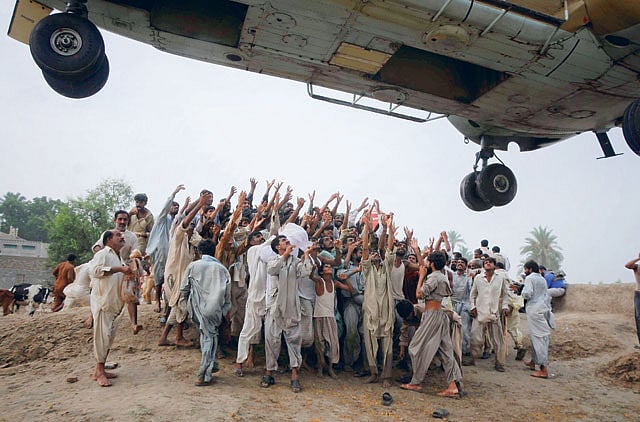
Islamabad: Authorities reeling from the devastating floods will not be comforted by the fact that the monsoon is far from over.
"It is not the last spell of rain, we are only in the middle of the monsoon," Dr Qamaruz Zaman, Director-General of the Met Office told Gulf News yesterday. He added that the monsoon spell would bring at least 100mm of rain over the next 24-36 hours before weakening and transforming into scattered rainfall.
Central Punjab and northwest of Balochistan are expected to be spared the deluge.
Meanwhile, Prime Minister Yousuf Raza Gilani visited flood-hit areas of Sindh province, reiterating his plea for international aid. He said the disaster had exceeded the government's capacity.
"Millions of people have suffered and there is more rain and further losses are feared. I appeal to the world to help us, we are doing what we can," Gilani told reporters, as he urged those threatened by the "unprecedented" floods to move to safer areas.
"The government has done everything possible but it is beyond our capacity, we are facing an extremely difficult situation," he added.
Pakistan will need billions of dollars to recover from the worst floods in its history, further straining a country already dependent on foreign aid to prop up its economy and back its war against militants, the United Nations said yesterday.
Jean-Maurice Ripert, UN special envoy overseeing the flood relief operations, said foreign aid could be difficult to procure given the global financial crisis.
The UN is still calculating specific figures, but Ripert said in an interview with The Associated Press that "the emergency phase will require hundreds of millions of dollars and the recovery and reconstruction part will require billions of dollars".
Much of that money will be needed in the northwest province of Khyber Pakhtunkhwa, which faced the worst damage from the floods that hit two weeks ago after extremely heavy rain. But as the floodwaters rushed south, they also brought death and destruction to the central and southern provinces of Punjab and Sindh.
Even those Pakistanis whose cities and towns were left relatively unscathed by the floods felt the pain yesterday as fruit and vegetable prices skyrocketed. Vast stretches of crops have been destroyed by the floods.
The prices of basic items such as tomatoes, onions, potatoes and squash have in some cases quadrupled in recent days, putting them out of reach for many Pakistanis. At least 570,000 hectares of crops were destroyed in Punjab, the breadbasket for the rest of Pakistan, the UN said.
Many more crops were devastated in the northwest, where many residents were still trying to recover from intense battles between the Taliban and the army last year.
In southern Punjab and south-eastern Balochistan region, hill torrents started causing renewed human and material damage.
— With inputs from agencies
Sign up for the Daily Briefing
Get the latest news and updates straight to your inbox
Network Links
GN StoreDownload our app
© Al Nisr Publishing LLC 2026. All rights reserved.