Who gets richer in a war? Follow the money in escalating Iran-US conflict
Energy exporters, refiners and defense firms gain as conflict topples global markets
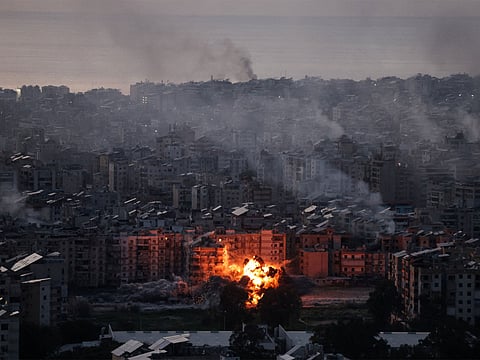
Dubai: Oil tankers stalled outside the Arabian Gulf, traders bidding up alternative crude supplies and defense contractors preparing new contracts — wars rarely leave markets unchanged.
The escalation between Iran and the United Statesthis month has triggered sharp swings across energy, defense and financial markets, redistributing wealth toward countries and companies positioned to supply what the crisis has made scarce.
The disruption has centered on the Strait of Hormuz, the narrow corridor linking the Arabian Gulf to global markets through which roughly one-fifth of the world’s oil supply normally flows. When shipments through that chokepoint become uncertain, the ripple effects reach far beyond the battlefield.
Stay updated: Get the latest faster by downloading the Gulf News app - it's completely free. Click here for Apple or here for Android. You can also find it on the Huawei AppGallery.
Energy exporters outside the Gulf, sophisticated refining hubs, defense contractors and certain investors are among the groups seeing the clearest financial gains. These five groups are among the biggest financial beneficiaries of global crises or wars:
1. Safe-haven oil exporters
Oil producers with export routes outside the conflict zone are often the first to benefit from supply shocks.
When Middle Eastern shipments face disruption, refiners look for crude that can reach market without passing through the Strait of Hormuz. That shift has increased the value of oil produced in regions such as North America, the North Sea and Russia.
Countries benefiting most include:
Russia, whose crude exports to Asian refiners have become more valuable as Gulf supply tightens
United States, the world’s largest oil and gas producer
Canada and Norway, which export large volumes to Atlantic Basin markets
Analysts say Russian oil has seen one of the most dramatic price shifts. Before the escalation, Russian Urals crude traded at a discount of roughly $13 per barrel to Brent crude.
By early March, analysts at J.P. Morgan said the relationship had flipped, with Russian barrels trading at a $4–$5 premium to Brent — an unusual swing reflecting the sudden scarcity of accessible supplies.
Research from Goldman Sachs suggests geopolitical tensions have added roughly $14 per barrel to oil prices as traders price in the risk of prolonged disruptions in Gulf shipping.
2. Refiners capture fuel shortages
Oil producers gain when crude prices rise. Refineries often gain even more when shortages of refined fuels push product prices higher.
Refining profitability is measured by the 'crack spread' — the difference between the price of crude oil and the price of fuels such as gasoline, diesel and jet fuel produced from it.
During the current crisis, refining margins have widened sharply in several global hubs. Examples include:
Singapore, where complex refining margins climbed close to $30 per barrel in early March, the highest in nearly four years
India, where refiners have purchased discounted crude and exported refined fuels to tighter markets in Europe
US Gulf Coast, home to complex refineries that convert heavy crude into high-value fuels
Jet fuel and diesel have been the biggest drivers of refining profits as aviation and freight companies compete for limited supply.
However, refinery gains can depend heavily on crude type. In its latest monthly report, the Organization of the Petroleum Exporting Countries said excess heavy crude on the U.S. Gulf Coast had pressured margins for certain products, illustrating how refining profitability shifts with the balance of crude grades and fuel demand.
3. Defense, security contractors
Conflicts also generate large financial gains in defense and security industries.
Governments typically increase military spending during periods of geopolitical tension, boosting demand for weapons systems, surveillance technology and intelligence infrastructure.
Companies benefiting from this trend often include those producing:
missiles, drones and advanced munitions
military surveillance and intelligence systems
cybersecurity and digital infrastructure
satellite communications networks
Higher defense spending often translates into long-term procurement contracts, creating steady revenue streams for contractors supplying military hardware and services.
4. Billionaires with war-linked assets
Individual fortunes can also rise during geopolitical turmoil when billionaires hold assets tied to sectors that benefit from the disruption.
One example is Donald Trump, whose wealth has become increasingly linked to cryptocurrency ventures. According to Forbes, Trump’s net worth stood at roughly $6.5 billion in March 2026, with an estimated $550 million in gains over the past year driven largely by crypto tokens tied to World Liberty Financial.
Another figure whose wealth is closely linked to crisis-sensitive sectors is Elon Musk. Musk’s companies operate in industries that can become strategically important during conflicts, particularly satellite communications.
Starlink — the satellite internet network operated by SpaceX — has become an important communications platform in conflict zones and remote regions, reinforcing the strategic value of Musk’s space-technology holdings.
Meanwhile Michael Saylor has seen his personal fortune track movements in Bitcoin, which fell sharply when the conflict began before rebounding above $70,000 as investors sought alternative assets during market volatility.
5. Traders, investors exploiting flux
Beyond billionaires and corporations, financial traders also profit from crisis-driven volatility.
Some investors maintain large cash reserves to buy assets when market panic pushes prices lower. Others reposition portfolios toward sectors historically resilient during geopolitical shocks.
Common strategies during crises include:
buying undervalued shares during market sell-offs
rotating investments into energy, defense or infrastructure stocks
short selling companies vulnerable to higher fuel costs
Airlines and transport companies, for example, often become targets for short sellers during oil shocks because rising fuel prices weaken profit margins.
Broader shifts in global wealth
Wars rarely generate broad economic prosperity. Instead they redistribute wealth toward those controlling scarce resources, infrastructure or strategic technologies.
In the current crisis, the main beneficiaries include:
oil and gas exporters outside the Gulf
sophisticated refining hubs processing scarce fuels
defense and cybersecurity firms supplying military demand
investors holding assets linked to energy or digital stores of value
At the same time, energy-importing countries and fuel-intensive industries face higher costs.
The International Energy Agency expects emerging economies led by China to account for the entire increase in global oil demand in 2026, underscoring how energy markets remain central to economic growth even as geopolitical tensions reshape supply chains.
In conflicts like the Iran-U.S. crisis, the biggest gains rarely occur where the fighting takes place. They emerge where markets are forced to turn next — toward the producers, refiners, contractors and investors positioned to fill the gap.