Iran oil exports collapse: Down 89% as US blockade, sanctions pressure intensify — what happens next
Tightened sanctions and shipping curbs slash Tehran’s crude flows to six-year low
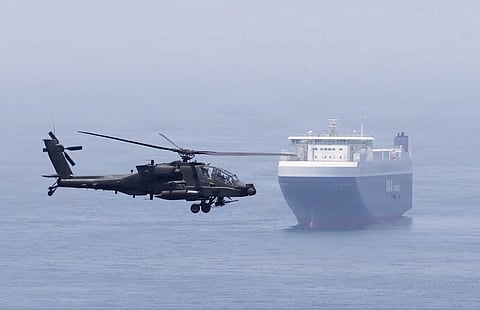
Iran's crude oil exports fell to their lowest level in at least six years in May, according to industry tracking firms.
This comes amid tighter US sanctions enforcement and blockade — shipping restrictions sharply reduced the flow of Iranian barrels to international markets.
'Dual blockade'
The US Central Command said the objective was to restrict Iran's maritime commerce without fully closing the Strait of Hormuz, one of the world's most important oil chokepoints.
The US escalated its maritime pressure campaign against Iran on April 13, by launching what officials described "counter-blockade" in the Arabian Gulf and Gulf of Oman, targeting vessels entering or leaving Iranian ports — resulting in what energy industry officials call a "dual blockade".
The move came after months of disruption in the Strait of Hormuz, where the IRGC had continued to exert influence over commercial shipping and threatened global energy supplies.


_resources1_16a30b30499_medium.jpg?w=320&auto=format%2Ccompress&fit=max)
Get updated faster and for FREE: Download the Gulf News app now - simply click here.
Shipping analytics firm Vortexa estimated Iran exported 209,000 barrels per day (bpd) of crude oil and condensate in May, down from 1.34 million bpd in April and nearly 1.9 million bpd in March.
The May figure represents an 84.4% decline from April and an 89.0% drop from March, underscoring the scale of the disruption to Iran's oil trade.
Offshore inventories
Energy intelligence firm Kpler estimated May exports at 260,000 bpd, slightly higher than Vortexa's assessment — but still the lowest monthly level since the height of the US "maximum pressure" sanctions campaign in 2019-2020.
Analysts initially expected Iran to rely heavily on floating storage after export restrictions intensified in April.
However, Kpler data indicates offshore inventories have also begun shrinking.
Floating storage declined from approximately 190 million barrels in late April to about 147 million barrels currently, a reduction of roughly 43 million barrels, or 22.6%.
Limited shipments to China
The drawdown reflects continued, though limited, shipments to China as well as slower Iranian production.
At the same time, demand from Iran's largest customer appears to be weakening. Chinese imports of Iranian crude averaged approximately 1.1 million bpd in May, the lowest level since January 2025, according to Kpler.
Independent Chinese refiners have reduced processing rates amid weaker profit margins and ample fuel inventories, lowering demand for discounted sanctioned crude.
Market conditions have also pressured pricing. Iranian Light crude has shifted from trading at a premium to trading at a discount relative to Brent crude, reflecting softer demand from buyers.
Despite the decline in exports and inventories, substantial volumes remain at sea.
Kpler estimates roughly 67 million barrels of Iranian crude and condensate are currently stranded in the Persian Gulf and Gulf of Oman awaiting buyers or transportation opportunities.
Homayoun Falakshahi, Kpler's head of crude oil analysis, warned that prolonged restrictions could further strain Iran's export capacity.
Under the operation, US naval forces intercept, divert, or turn back ships linked to Iranian trade while allowing neutral vessels bound for non-Iranian destinations to continue transiting the strategic waterway.
What's next
If current conditions persist for another two months, Falakshahi reckons that Tehran could face a shortage of readily available oil supplies for shipment to China, as per OilPrice.com.
The decline in Iranian exports comes amid broader disruptions to Middle Eastern energy flows, adding pressure to global oil markets already facing reduced regional supply.
Analysts say that while fewer tankers departing Iranian ports immediately translates into fewer exports reaching consumers, prolonged restrictions could eventually force a reduction in upstream production as storage capacity and available export volumes continue to diminish.
Conflict approaches 100th day
As the US-Israel conflict against Iran nears its 100th day since erupting on February 28, 2026 hopes for a comprehensive peace agreement remain elusive.
At the center of the diplomatic deadlock is not only Iran’s nuclear programme but also control of the Strait of Hormuz, the strategic waterway through which roughly a fifth of the world’s oil and gas supplies normally pass.
What was once viewed as a secondary issue has evolved into the Gordian knot of negotiations, with Washington demanding freedom of navigation and Tehran seeking recognition of its security and economic interests in the Gulf.
While negotiators have reportedly made "progress" on interim arrangements involving shipping and sanctions relief, the intertwined disputes over Hormuz and IRGC's’s nuclear ambitions threaten to block a final settlement.


