India’s NEET protests: From Bollywood to BTS, how students found solidarity and hope through song and dance
From protest chants to K-pop beats, a new generation rewrites resistance
The kids are doing fine.
And neither do they need anyone to tell them otherwise.
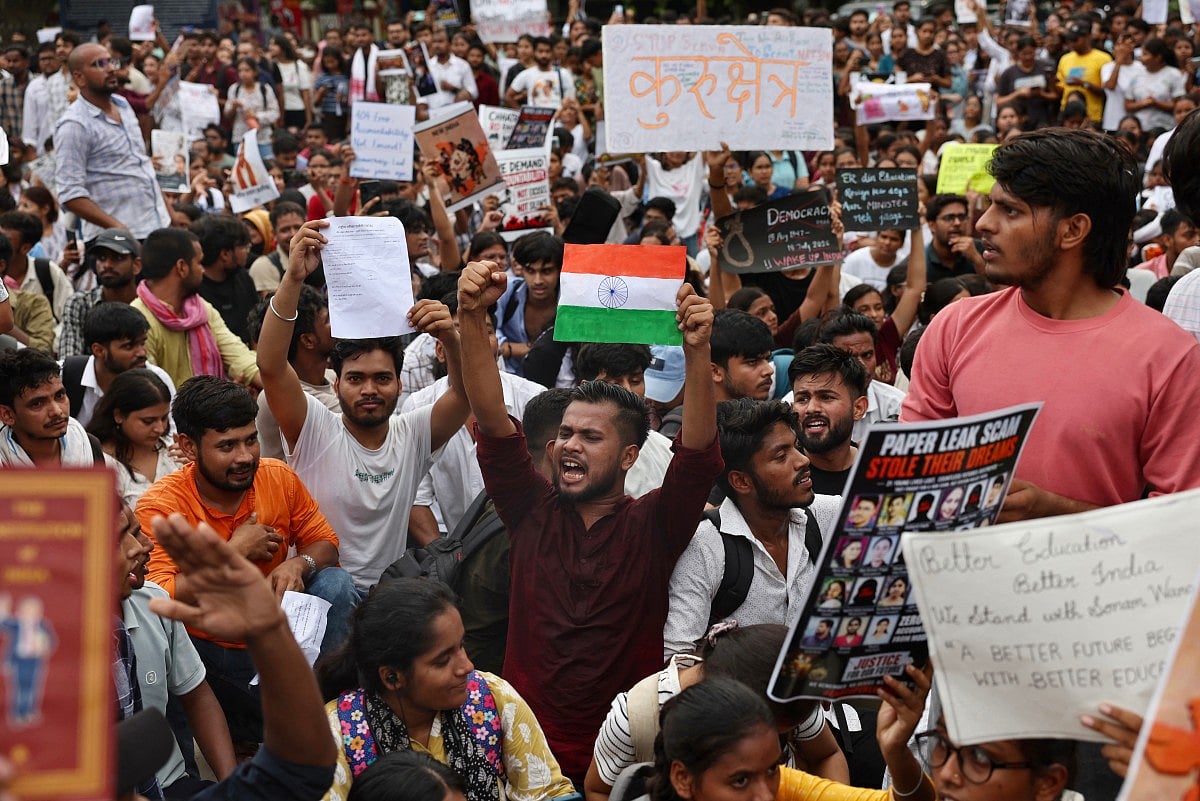
As protests spread across India over the NEET paper leak in May, eventually prompting the resignation of Education Minister Dharmendra Pradhan, each day, and each protest site, seemed to offer something new.
There were the familiar visuals of police detentions, lathi charges and tear gas. But there were also protesters refusing to back down, gathering and marching through Jantar Mantar, Mumbai, Kochi and Chennai.
As it is the generation of the Gen Z, memes are inevitable, going by the cheeky placards.
Yet, songs and dance have always been the soundtrack to resistance and dissent. Across India, the NEET protesters sing for their demands.
Protests always have a rhythm
In some places, A.R. Rahman’s Maa Tujhe Salaam echoes through the crowds, the familiar patriotic notes taking on a new meaning amid the anger and frustration. A video of the crowds singing in the Delhi heat, Vande Mataram has gone viral. New Delhi folk-metal band Bloodywood also joined the crowds at Jantar Mantar earlier this week, with Karan Katiyar and Raoul Kerr making an appearance. The band has built much of its identity around music that confronts social and political issues. Enough said.
One of their most powerful statements is “Gaddaar”, the 2021 single released alongside the announcement of their widely acclaimed debut album, Rakshak. The track sees vocalists Jayant Bhadula and Raoul Kerr deliver a blistering attack on the political forces and ideologies that seek to divide people.
Meanwhile, in Mumbai, protesters have been seen doing the Viking Row, complete with the chant calling for the resignation of the Education Minister.
Elsewhere, protesters march in masks and cosplay costumes. Batman appears, and Spider-Man dances. The costumes are playful, but the message is not. The protesters remain unafraid, even as police personnel watch, detain and, in some instances, move in to disperse them.
The protests become reels. The reels become songs. And the songs become anthems.
Azadi, created by rapper DIVINE and producer Dub Sharma, was inspired by a slogan used in a 2016 speech by student activist and later politician — Kanhaiya Kumar. The song, which featured in Gully Boy, echoes through protest videos, becomes the soundtracl to reels. Rang De Basanti appears in different corners.
There is iron-clad determination to bring joy in the midst of exhaustion, even at 12 am, Jantar Mantar. People singing, and encouraging others to sing Baari Barsi. In another video, a masked girl dances to BTS member J-Hope’s Killin’ It Girl, as she prepares for protest.
A million umbrellas in Mizoram
In Mizoram, a million umbrellas appeared to fill the streets as people gathered in solidarity with the protesters. And together, they sang: “Give me some sunshine, give me some rain.”
The song, from 3 Idiots, has acquired a particular resonance in the current moment. The film has long been associated with activist Sonam Wangchuk, who himself went on a hunger strike to protest the NEET paper leak, a connection Aamir Khan has denied.
Nevertheless, the song needs no explanation. “Give me some sunshine, give me some rain.” For the unversed, in the film, the song focused on Ali Fazal's character, a brilliant student, and yet, it still wasn't enough for him.
The songs India already knows by heart
At Jantar Mantar, protesters have also gathered to sing Hum Dekhenge, the poem written by Pakistani poet Faiz Ahmed Faiz in 1979 and immortalised by Iqbal Bano’s rendition. It has long been one of South Asia’s defining songs of resistance.Then there is Sandese Aate Hain, the Border classic composed by Anu Malik and sung by Sonu Nigam and Roop Kumar Rathod, which protesters have also sung collectively.
Saadda Haq, the Rockstar anthem, has featured in social media videos from the protests.
And in Aizawl, Mizoram, students sang the Black Eyed Peas’ Where Is the Love? during a solidarity protest, one of several demonstrations held in support of the movement outside Delhi.
The songs may be different, but the questions remain the same.
And then there is Taare
There is also Taare, by artists Farak, 10A, and Saswat Balan released last month, which has found its way into the emotional landscape of the protests. The lyrics speak of a long familiarity with hardship, of fear, despair and a battered spirit:
“Humara thokaron se kuch purana khaas naata hai...”
Loosely translated, the song speaks of an old and special relationship with life’s hardships. It asks not to be questioned about the state of the heart because sometimes even speaking about it is frightening. It pleads: don’t plunder this empty home; this cowardly soul is already beating its head in despair.
The protest anthem belongs to whoever needs it
It's still a movement that began with anger over a leaked examination paper. And, it is also a movement that has found expression through songs from Bollywood films, Pakistani poetry, global pop, rock anthems, patriotic music and K-pop. The songs can change on different days and in different cities, and the protests can change.
If music is the sound of protest, India’s students have made sure it is heard.
The kids are doing fine.
Also In This Package
Network Links
GN StoreDownload our app
© Al Nisr Publishing LLC 2026. All rights reserved.