Historic SS United States ocean liner sunk off Florida to create world’s largest artificial reef
Legendary ship transformed into diver's paradise in Gulf of Mexico
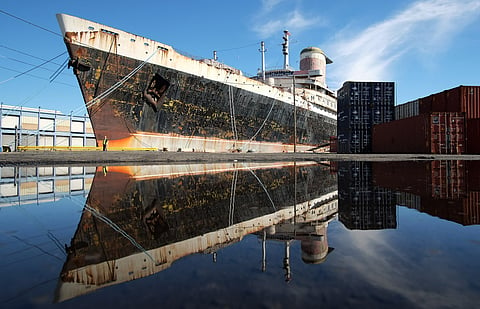
Dubai: The historic SS United States, once the world's fastest ocean liner and a vessel that carried presidents, royalty and Hollywood stars across the Atlantic, has been deliberately sunk off Florida's Gulf Coast to become the world's largest artificial reef.
The nearly 990-foot (302-metre) vessel completed its final journey on Wednesday, November 11, settling on the seabed of the Gulf of Mexico near Destin, Florida.
The sinking marks the end of an extraordinary chapter in maritime history, giving the celebrated ocean liner a new purpose as an underwater habitat for marine life and a destination for divers and fishing enthusiasts.
The ship is expected to rest in approximately 180 feet (55 metres) of water, around 22 to 25 nautical miles southwest of Destin. Its upper decks will remain roughly 50 to 60 feet below the surface, making parts of the wreck accessible to recreational divers.
From record-breaking liner to artificial reef
Launched in 1952, the SS United States made history during its maiden transatlantic voyage by setting a speed record that remains unbeaten by an ocean liner.
During its 17 years of passenger service, the ship completed more than 800 Atlantic crossings, carrying thousands of passengers between the United States and Europe.
Its distinguished passengers included Hollywood stars such as Marlon Brando, Cary Grant, Judy Garland and Walt Disney, as well as prominent political figures. Former US presidents Harry Truman, Dwight Eisenhower and John F. Kennedy also travelled aboard the vessel. A young Bill Clinton was among its passengers.
The liner was retired in 1969 as commercial air travel transformed transatlantic journeys.
Decades of uncertainty
After its retirement, the SS United States went through several ownership changes as proposals to transform it into a museum, hotel or other attraction failed to materialise.
It remained docked in Philadelphia for nearly three decades before being moved to Mobile, Alabama, in February 2025 for preparations ahead of its conversion into an artificial reef.
Florida's Okaloosa County purchased the vessel in 2024 for around $1 million. The overall reef project, including towing and preparation work, is estimated at $13.5 million.
Before the sinking, crews removed fuel, hazardous materials and other non-metal components. Crews also cut openings into the hull and decks to allow seawater to enter and help the vessel settle on the seabed. The operation was carried out without explosives.
The project is expected to create a marine habitat for species including tuna, marlin and swordfish, while boosting underwater tourism along Florida's Gulf Coast.
Although preservation groups' efforts to save the ship as a museum were unsuccessful, parts of its legacy will be preserved on land. Its removed funnels and other historic artefacts are intended to feature in a planned museum dedicated to the liner's history.
With inputs from Agencies


