This handout natural-colour image acquired with MODIS on NASA’s Terra satellite taken on February 5, 2025 shows the Gulf of Oman and the Makran region (C) in southern Iran and southwestern Pakistan, and the Strait of Hormuz (L) and the northern coast of Oman (bottom).
US power vs Iran leverage: The real battle in the war
Military might meets economic pressure as Hormuz disruption drives global risks
Last updated:
4 MIN READ
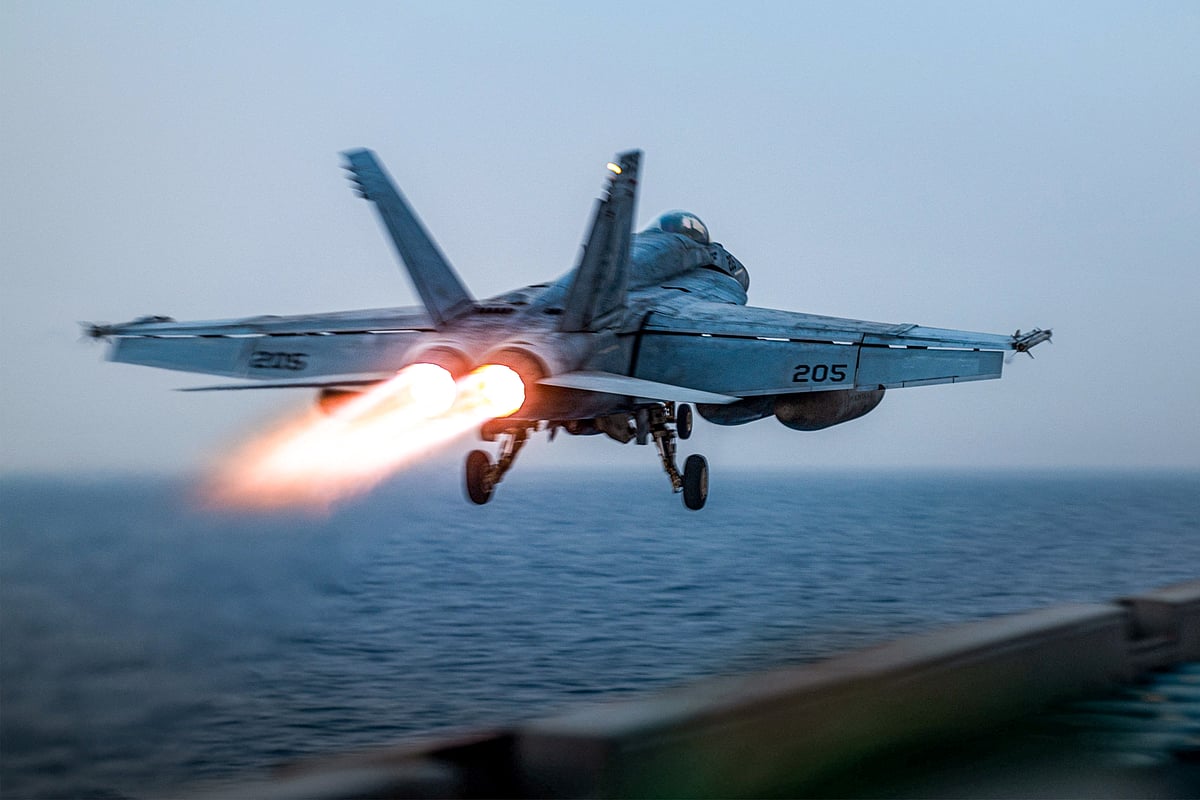
A US F/A-18 Super Hornet attack fighter jet taking off from the US Navy's Nimitz-class USS Harry S. Truman aircraft carrier at sea on March 16, 2025.
AFP
Dubai: The war with Iran is exposing a hard truth for Washington — overwhelming military power does not always translate into control.
On paper, the United States and its ally Israel hold a decisive advantage. With unmatched military capability, global reach and economic weight, the balance of power appears firmly tilted against Tehran.
But one month into the conflict, the war has evolved into what analysts describe, in CNN analysis, as a “contest of leverage” — where the side that can impose the highest costs may ultimately shape the outcome.
Iran’s chokehold strategy
Iran cannot defeat the United States militarily. But it has turned geography into a weapon.
By effectively shutting the Strait of Hormuz — a chokepoint that carries about one-fifth of global oil supply — Tehran has created pressure far beyond the battlefield.
The waterway is widely described by the BBC as the world’s most critical energy corridor.
The impact is already being felt.
Oil markets have reacted sharply, with prices surging amid uncertainty over how long disruptions could last, according to Reuters. The International Energy Agency has also warned that prolonged disruption in Hormuz could trigger one of the largest supply shocks in modern energy markets.
In that sense, Iran has, as CNN analysis puts it, “seized the strategic initiative” — not through firepower, but by exploiting global vulnerabilities.
Trump’s dilemma
For US President Donald Trump, the challenge is not capability — it is consequence.
The United States has the military means to reopen the Strait. But doing so would carry significant risks. A direct naval operation could expose US vessels to Iranian retaliation, handing Tehran a propaganda victory if even a single ship were struck.
Power vs leverage — Who holds what?
United States: Power
World’s most powerful military and global strike capability
Naval dominance, including ability to reopen sea lanes
Economic sanctions that can cripple Iran’s economy
Backing from allies, including Israel
Iran: leverage
Control over the Strait of Hormuz — ~20% of global oil flows
Ability to disrupt shipping with missiles, drones, mines
Capacity to target Gulf energy infrastructure
Willingness to absorb economic and civilian costs
The dilemma
US can escalate — but at high political and economic cost
Iran can’t win militarily — but can prolong and raise costs
Bottom line: Power wins battles. Leverage decides wars.
Reasserting control could also require ground operations, raising the prospect of American casualties — a political cost Trump may be unwilling to bear.
At the same time, Trump has escalated rhetoric, warning that the US could “completely obliterate” Iran’s energy infrastructure if a deal is not reached.
Such a move would almost certainly trigger retaliation across the Gulf, targeting critical infrastructure in allied states and potentially pushing global markets into crisis.
A hollow diplomatic win
The limits of US leverage were underscored in a recent White House briefing, where officials pointed to Iran allowing a limited number of tankers through Hormuz as a diplomatic success.
But the reality is less convincing.
Before the war, more than 100 tankers passed through the Strait daily. Allowing a small fraction of that flow now only partially reverses disruption caused by the conflict itself.
In effect, what is being framed as progress is, at best, a partial undoing of the damage already inflicted.
Escalation or off-ramp?
The arrival of additional US forces in the region — including thousands of Marines and airborne troops — has fuelled speculation that Washington may be preparing for a more direct intervention.
“That’s very far from an off-ramp. That looks almost certainly like a period of escalation is coming,” said Ian Bremmer, speaking to CNN.
At the same time, diplomacy appears constrained.
Washington’s demands include strict limits on Iran’s missile programme and control over key waterways — conditions Tehran is unlikely to accept. Meanwhile, Iran’s strategy of prolonging the conflict continues to increase pressure on the US and its allies.
“Once he loses that capability, his incentives for an off-ramp… will then shift again in the wrong direction,” warned Trita Parsi.
A dangerous balance
Ultimately, both sides hold cards that could prove decisive.
The United States retains overwhelming military superiority. Iran, however, has demonstrated its ability to impose disproportionate costs through disruption, particularly in global energy markets.
The longer the war drags on, the more that balance may shift.
This is no longer just a war of firepower — it is a war of pressure.
And unless both sides find a way to step back, the risk is not just a prolonged conflict, but a broader crisis with consequences far beyond the region.

A Senior Associate Editor with more than 30 years in the media, Stephen N.R. curates, edits and publishes impactful stories for Gulf News — both in print and online — focusing on Middle East politics, student issues and explainers on global topics. Stephen has spent most of his career in journalism, working behind the scenes — shaping headlines, editing copy and putting together newspaper pages with precision. For the past many years, he has brought that same dedication to the Gulf News digital team, where he curates stories, crafts explainers and helps keep both the web and print editions sharp and engaging.
Sign up for the Daily Briefing
Get the latest news and updates straight to your inbox
Network Links
GN StoreAbout Gulf NewsTerms & ConditionsReach by GNSitemapContact usPrivacy PolicyGN FocusHave your sayWork with usAdvertise with usGulf News epaperPrinting Services
Download our app
© Al Nisr Publishing LLC 2026. All rights reserved.