Could the Hormuz crisis eclipse the 1970s oil shock?
Supply losses may outpace 1970s crisis as prices rise, Hormuz disruption tests buffers
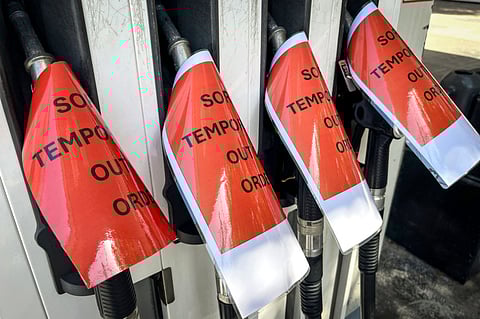
Dubai: As the US-Iran conflict disrupts flows through the Strait of Hormuz, the question echoing across markets is stark: Could this become a bigger shock than the oil crises of the 1970s?
The comparison is not just historical — it is a benchmark for global economic stress.
The 1973 oil crisis, triggered by an Arab embargo, is widely seen as one of the most severe energy shocks in modern history. Oil prices quadrupled, fuel shortages spread across Western economies, and inflation surged — tipping many countries into recession.
Today’s crisis, however, may be unfolding on an even larger scale.
At the centre is the Strait of Hormuz — often described as the world’s most critical oil chokepoint — through which roughly a fifth of global oil supply normally passes. Disruptions here have immediate global consequences.
Early estimates suggest that if the current restrictions persist, 13–14 million barrels per day could be affected, far exceeding the roughly 4–5 million barrels per day lost during the 1973 embargo.
Bigger disruption — but more buffers
In pure supply terms, the current crisis has the potential to be significantly larger.
But as the BBC has often highlighted in its analysis of past oil shocks, the impact depends not just on the scale of disruption, but on how prepared the global system is to absorb it.
1970s vs 2026 — what’s different?
1973 oil shock:
Trigger: Arab oil embargo after Middle East war
Supply loss: ~4–5 million barrels/day
World population: ~4 billion
Impact: Prices quadrupled, fuel shortages, recession
System weakness: Heavy dependence, no reserves
2026 crisis:
Trigger: War, Hormuz disruption, infrastructure strikes
Potential loss: 13–20 million barrels/day
World population: ~8 billion
Impact: Oil above $100, inflation risks rising
System strength: Reserves, diversified supply
Key takeaway:
Then: Smaller shock, weaker system
Now: Bigger shock, stronger system — but faster global impact
In the 1970s, many economies were heavily dependent on Middle Eastern oil, with limited alternatives and almost no coordinated emergency reserves. The sudden supply cut left governments scrambling.
Today, the landscape is different.
The United States is now a major oil producer. Strategic reserves held by major economies can be released in coordinated fashion. Energy efficiency has improved, and economies are somewhat less oil-intensive than they were five decades ago.
These factors could soften the blow — at least initially.
Why this crisis could still be worse
Despite these buffers, there are strong reasons to believe the current crisis could prove more damaging:
A wider geographic threat
Unlike the 1970s, the risk is not confined to one region. Tensions are rising not just in Hormuz, but also in the Red Sea — raising fears of simultaneous disruptions to multiple global trade routes.
A faster, more connected global economy
Modern supply chains are tightly interlinked. A shock to oil prices now feeds almost instantly into shipping costs, food prices, aviation, and manufacturing — amplifying the impact.
Limited spare capacity
Years of underinvestment mean global oil markets have less slack. This reduces the system’s ability to compensate for sudden losses.
Speed of escalation
Oil markets today react in real time. Prices have already surged sharply within weeks — a pace of change rarely seen even during past crises.
The key variable: Time
Analysts say oil shocks tend to follow a simple pattern: short shocks hurt — prolonged disruptions reshape the global economy.
If the Strait of Hormuz reopens quickly and flows resume, the current crisis could remain a severe but temporary spike.
But if disruptions persist for weeks or months — or expand to other chokepoints — the world could face a shock that not only rivals the 1970s, but exceeds it in scale and speed.
In that scenario, the consequences could extend far beyond energy — triggering inflation, slowing growth, and potentially pushing parts of the global economy toward stagflation.
For now, one question dominates: How long the disruption lasts — and how far it spreads.


