The amphibious assault ship USS Boxer (LHD 4) receiving a vertical replenishment-at-sea from the fast combat support ship USNS Arctic (T-AOE 8) in the Arabian Sea. The United States is deploying additional Marines to the Middle East.
From storming WWII beaches to Iraq’s streets: How Marines fought America’s toughest battles
Trump orders 2,500 more Marines, force built for speed, adaptability and frontline combat
Last updated:
3 MIN READ
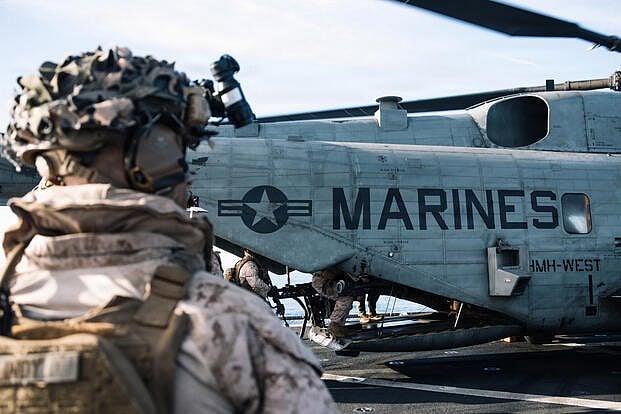
The deployment of Marines — designed to operate from the sea and respond rapidly to crises — signals Washington’s intent to keep fast, flexible military options on the table as the conflict evolves.
Source: Marines.com
Dubai: From storming World War II beaches to spearheading urban combat in Iraq, the US Marines have long served as America’s first force into battle, built for speed, adaptability and frontline fighting.
That role is back in focus as the United States moves additional Marine forces into position amid a widening conflict with Iran, even as President Donald Trump insists he has not yet decided to deploy ground troops.
US officials told The Associated Press that Washington is sending three more amphibious assault ships and roughly 2,500 additional Marines to the Middle East.
The deployment follows a decision just days earlier to redirect another group of amphibious ships carrying about 2,500 Marines from the Pacific to the region. Together, the reinforcements will join more than 50,000 US troops already stationed across the Middle East.
Other reports point to an even broader military posture taking shape at sea. The Wall Street Journal said between 2,200 and 2,500 Marines from the California-based USS Boxer Amphibious Ready Group and the 11th Marine Expeditionary Unit are being deployed, while CNN reported that thousands of Marines and sailors could be sent to the region.
Capture of Kharg Island
Axios separately said the Trump administration is considering more aggressive options, including the possible seizure of Iran’s strategic Kharg Island — a move that could potentially involve Marine forces.
Asked about the deployments, the Marine Corps confirmed that the USS Boxer group and the 11th Marine Expeditionary Unit are “deployed at sea,” while the US 3rd Fleet described their activities as “routine operations,” offering no details on their destination.
Marines patrol Acapulco, Mexico, Thursday, March 12, 2026.
The movements come as a fast-moving conflict continues to escalate. The United States and Israel launched a large-scale air campaign against Iran on February 28, targeting military infrastructure and leadership. US and Israeli officials say the strikes have significantly weakened Iran’s military capabilities, killing several senior figures.
Tehran, however, has responded with waves of drones and missiles, as well as attacks on shipping in the Strait of Hormuz — a critical global chokepoint through which roughly a fifth of the world’s oil passes during peacetime.
Iranian officials have also pushed back against claims of military degradation. A spokesman for the Islamic Revolutionary Guard Corps said Iran continues to produce missiles despite Israeli assertions that its capabilities had been destroyed, though Iranian state media later reported he was killed in an airstrike.
Against this backdrop, the deployment of Marines — designed to operate from the sea and respond rapidly to crises — signals Washington’s intent to keep fast, flexible military options on the table as the conflict evolves.
What exactly makes the US Marines the force Washington turns to in moments like this — and what role have they played in America’s past wars?
US Marines: key questions answered
When were the US Marines first deployed?
The US Marine Corps was established in 1775 during the American Revolutionary War. From the outset, it was designed as a sea-based fighting force, able to launch operations from naval ships. One of its earliest overseas missions came in Tripoli in 1805, setting the foundation for its expeditionary role.
What have the Marines achieved in major wars?
Marines have been at the forefront of some of the US military’s toughest battles:
World War II: Amphibious assaults at Iwo Jima and Guadalcanal
Iraq War: A central role in the Battle of Fallujah, one of the most intense urban battles
Afghanistan: Long-running combat and counterinsurgency operations
These missions cemented their reputation for high-intensity frontline combat.
What exactly do Marines do?
Marines are structured for speed and flexibility:
Deploy rapidly from ships anywhere in the world
Lead amphibious assaults and early-stage combat operations
Operate as self-contained units with infantry, air and logistics support
Fight across terrains — from coastlines to cities to deserts
Why are Marines important in the current crisis?
Their deployment gives Washington rapid-response options without immediate full-scale escalation:
Can respond quickly to fast-moving developments
Do not require immediate ground bases
Act as both a deterrent and a combat-ready force
Allow the US to scale operations up or down depending on the situation
When speed, uncertainty and risk define a conflict, the Marines are often the first force the United States turns to.

A Senior Associate Editor with more than 30 years in the media, Stephen N.R. curates, edits and publishes impactful stories for Gulf News — both in print and online — focusing on Middle East politics, student issues and explainers on global topics. Stephen has spent most of his career in journalism, working behind the scenes — shaping headlines, editing copy and putting together newspaper pages with precision. For the past many years, he has brought that same dedication to the Gulf News digital team, where he curates stories, crafts explainers and helps keep both the web and print editions sharp and engaging.
Sign up for the Daily Briefing
Get the latest news and updates straight to your inbox
Network Links
GN StoreAbout Gulf NewsTerms & ConditionsReach by GNSitemapContact usPrivacy PolicyGN FocusHave your sayWork with usAdvertise with usGulf News epaperPrinting Services
Download our app
© Al Nisr Publishing LLC 2026. All rights reserved.