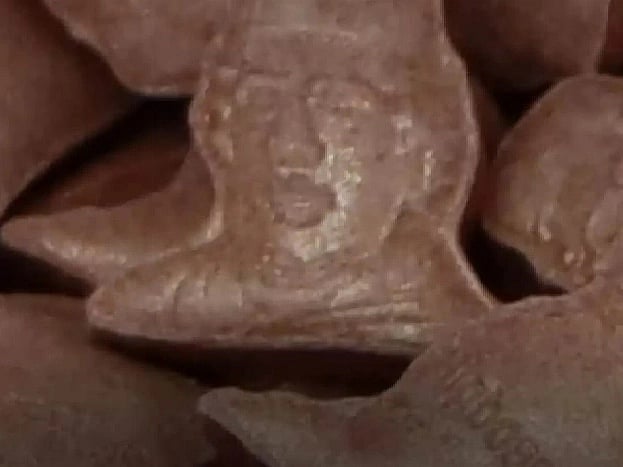
Dubai: Libyan authorities have seized about 100,000 ecstasy pills smuggled into the country from Europe, with each tablet moulded in the likeness of former Libyan leader Muammar Gaddafi.
Images released by a security agency in Tripoli showed bags filled with brown tablets shaped to resemble Gaddafi’s head and shoulders, with his facial features and clothing pressed into the surface.
Get updated faster and for FREE: Download the Gulf News app now - simply click here.
The unusual shipment was discovered after Al Rada for Combating Terrorism and Organised Crime received information that a trafficking group was preparing to bring narcotics into Libya through a European country.
Investigators began tracking the shipment and followed it until it entered Libya through a seaport, according to a statement carried by the Libyan News Agency.
Security officers intercepted the cargo after its arrival and conducted a detailed search of a Renault Master commercial van used to transport goods.
Inside concealed compartments, officers found large quantities of narcotics. The agency said the operation resulted in the seizure of about 100,000 XTC, or ecstasy, tablets. A number of suspects were referred to prosecutors for further legal action.
Neither the European country through which the drugs were shipped nor the Libyan port where they arrived was identified.
What immediately set the seizure apart, however, was the appearance of the pills.
Rather than carrying a conventional logo or symbol, the tablets bore a detailed likeness of Gaddafi, who ruled Libya for more than four decades before being overthrown and killed in 2011.
The reason for choosing his image was not disclosed by the security authorities.
The distinctive design prompted widespread discussion on social media over whether it was intended simply to make the shipment recognisable in the illicit market or to give the pills a distinctive identity among buyers.
There is, however, no official evidence that the Gaddafi image represented a particular level of purity, source or intended recipient. Authorities have not said that the markings were part of a coded communication system between traffickers.
The seizure comes against a wider backdrop of concern over Libya’s growing role in regional drug trafficking.
A report released by the United Nations Office on Drugs and Crime this year identified links between drug trafficking and Libya’s security environment and said the country’s role as a transit hub for narcotics destined for regional markets had expanded. It also highlighted the movement of synthetic drugs into North Africa and other parts of the continent.
The UN agency has said trafficking networks have exploited instability and gaps in security across the region, with illicit drug flows becoming increasingly connected across North Africa, the Sahel, Europe and the Middle East.
Network Links
GN StoreDownload our app
© Al Nisr Publishing LLC 2026. All rights reserved.