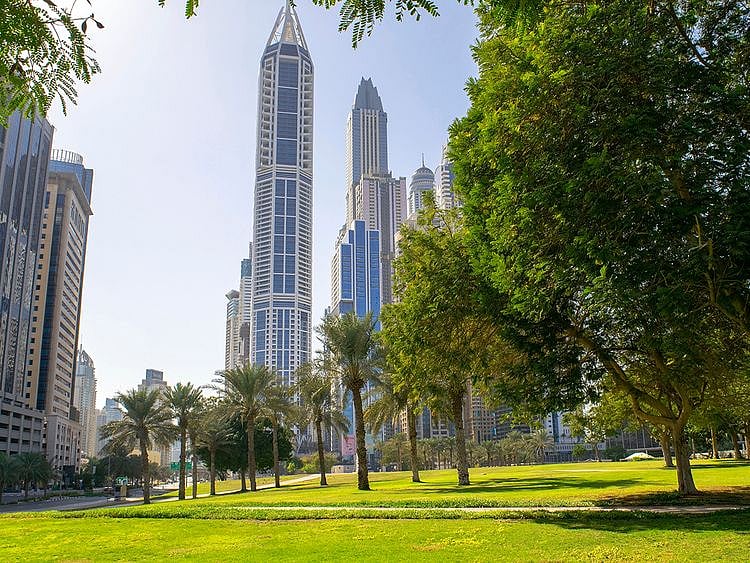
Dubai: It’s mid-spring in the UAE, yet the weather still carries a distinct winter feel. Cooler temperatures, fresh winds and recent rainfall have extended what many residents believe as an unusually long winter, but has it finally come to an end?
The short answer, experts say, is not just yet, but it’s close.
A spring that still feels like winter
Despite the calendar shift into spring, conditions across the UAE in recent weeks have remained milder than usual. Since last Thursday, the country has been influenced by a combination of atmospheric systems, a surface low-pressure extension from the east and a high-pressure system from the west, supported by an upper-level ridge.
This interaction has created relatively cool, stable conditions, with occasional cloud cover and rainfall, giving residents a continuation of pleasant weather well into April.
But the real explanation lies deeper in the atmosphere.
At this time of year, the UAE sits at the crossroads of cool northern air masses and warmer southern flows. The balance between the two determines how the weather behaves from one week to the next.
“When colder air masses dominate, temperatures drop and we can see unstable conditions, including rain,” meteorologists explain. “When warmer air takes over, temperatures begin to rise quickly.”
Get updated faster and for FREE: Download the Gulf News app now - simply click here.
Right now, the cooler air has had the upper hand, which is why it still feels closer to winter than summer.
Many residents are not imagining it; this year’s winter has felt longer than in previous years. Temperatures have remained below seasonal averages, extending the period of comfortable weather deeper into spring.
That said, this extended mild phase is still within the range of normal seasonal variability for the region.
From a meteorological perspective, winter has already ended, and the UAE is currently in spring, a transitional season that lasts until 21 June, when summer officially begins.
From that point onwards, temperatures rise sharply, with typical summer highs ranging between 40°C and 45°C, and occasionally exceeding 50°C in inland and desert areas.
But the question here: is more cool weather on the way? Possibly but only for a limited time.
According to Ibrahim Al Jarwan, Chairman of the Board of Directors of the Emirates Astronomical Society and a member of the Arab Union for Astronomy and Space Sciences, there remains a window for further weather fluctuations, including low-pressure systems, until around the first week of May.
This period is known for seasonal disturbances such as “Sarayat”, which can bring sudden changes in weather, including thunderstorms and rainfall.
Late April may also see what is locally referred to as “Thuraya rains”, which are often associated with brief but sometimes intense weather activity.
Al Jarwan also pointed to the likelihood of a brief early heatwave in the coming days, with temperatures potentially approaching 40°C, before settling again at more typical spring levels, above 35°C.
What happens after early May?
Once the first week of May passes, the transition becomes more decisive.
Temperatures begin to rise steadily, and the atmosphere stabilises as the influence of cooler northern air weakens. At the same time, a major seasonal driver begins to take shape, the Indian monsoon low-pressure system.
This vast thermal system starts forming over the Indian subcontinent in April and intensifies through June and July. As it expands, it draws in hotter air across the Arabian Peninsula, gradually establishing the UAE’s familiar summer pattern.
As of now, the UAE remains in a transitional window, a period where cooler days, clouds and even rain are still possible, but increasingly interspersed with warmer conditions.
So while winter has not disappeared overnight, its presence is fading.
The coming weeks are likely to bring a mix of lingering spring variability and a steady climb in temperatures. By the time May settles in, the shift will be unmistakable.
Network Links
GN StoreDownload our app
© Al Nisr Publishing LLC 2026. All rights reserved.