Cloud seeding is a weather modification technique that improves a cloud's ability to produce rain or snow.
UAE cloud seeding explained: How nanomaterials and AI are making more rain
Why smarter cloud seeding is key to the UAE’s long-term water security
Last updated:
4 MIN READ
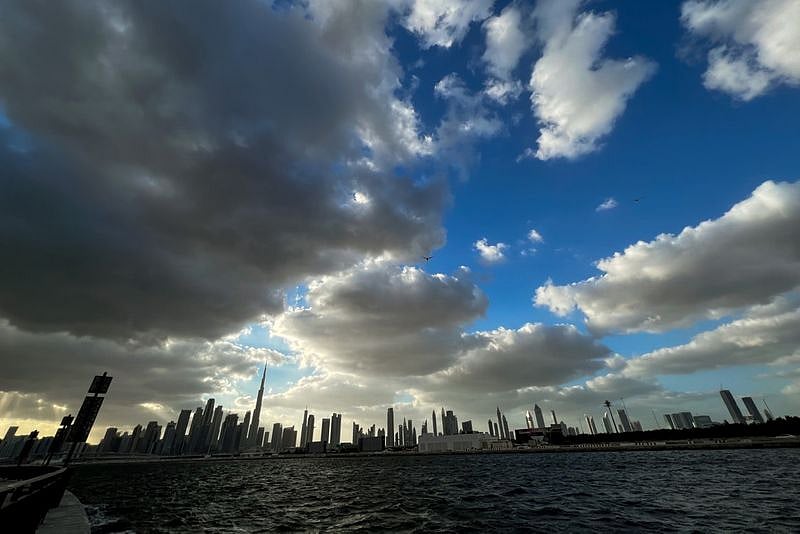
Since its inception, the UAE Research Program for Rain Enhancement Science has played a crucial role in advancing rain enhancement technology.
Ahmed Ramzan/Gulf News Archives
Dubai: Ever sprayed perfume and watched it spread through the air? That, according to the National Centre of Meteorology (NCM), is the simplest way to understand the science it is now using to make rain enhancement more effective.
Get updated faster and for FREE: Download the Gulf News app now - simply click here.
In a video marking ten years of the UAE Research Programme for Rain Enhancement Science (UAEREP), the centre explains that seeding agent dispersion, which refers to how tiny seeding particles distribute themselves through a suitable cloud, behaves much like that perfume mist. Just as fragrance drifts and spreads through a room, seeding materials scatter through a cloud once released. And cracking exactly how those particles travel has become central to improving the country's cloud seeding operations.
Why dispersion matters
Cloud seeding works by introducing particles into a cloud that act as condensation nuclei, or surfaces onto which water vapour can condense or freeze. These particles help small droplets grow into drops heavy enough to fall as rain, essentially giving clouds that might not otherwise produce rain the push they need.
But simply releasing the material is not enough. Where the particles go once inside the cloud, and how they behave when they get there, determines whether a mission succeeds. By studying how seeding particles spread and interact with cloud droplets and ice crystals, scientists can optimise how and where seeding materials are released, improving the conditions needed for rainfall to form.
The work is carried out in laboratories using specialised instruments that track these interactions in fine detail. Beyond sharpening individual missions, the research is deepening the broader understanding of how rainfall forms in the first place, knowledge that feeds back into every flight the NCM sends up.
From the lab to the sky
That research has already reshaped the tools the UAE uses. Seeding agents are now manufactured locally, and they come in two main forms.
The traditional option is the hygroscopic flare, produced in two sizes, one for aircraft and one for ground generators. When fired from a plane, the flare burns for a few minutes to release salt crystals mixed with magnesium, sodium chloride and potassium chloride into a cloud's updrafts. These materials attract water, accelerating the growth of small droplets into larger, rain-ready drops.
Hygroscopic (water-attracting) salt flares are seen released during a cloud seeding mission conducted by the UAE's National Center of Meteorology.
The newer breakthrough is nanomaterials, developed through UAEREP. The fine powder is up to three times more effective than hygroscopic flares and disperses the moment an ignitor opens its cap, with no lengthy burn required. It is a direct product of the dispersion research now guiding the programme.
The findings also inform how ground-based generators are deployed. Positioned in mountainous areas, the towers exploit local terrain and air currents to release seeding material into low-lying clouds, speeding up the collision and coalescence of droplets that produces rain.
Inside a seeding mission
The science only pays off when paired with precise operations. Each mission begins with data pulled from radars, satellites and ground stations, which meteorologists scan for cloud formations worth targeting. Weather surveillance radar monitors conditions around the clock, supported by live camera feeds from 26 locations across the country.
When a promising cloud starts to build, an aircraft first circles it to study its structure and pin down the optimal moment and location to act. Only then does the plane fly into the cloud and release its payload, typically 48 flares carried on a single three-hour flight.
The next frontier
The push to sharpen effectiveness does not stop there. The NCM is testing electric charging, where electrical charges are delivered straight into clouds to stimulate precipitation, and building numerical models that simulate the chemical, physical and electrical interactions inside a cloud with high accuracy. Artificial intelligence applications are being developed to read cloud conditions in real time and pinpoint the ideal moment to seed. Vertical air currents created by jet engines and lasers that stimulate cloud formation have been explored too, though both remain experimental.
Why the science matters
The stakes are practical. The UAE has flown around 80 cloud seeding missions since the start of 2026, targeting convective clouds with upward air currents and vertical development, with the aim of boosting rainfall by 10 to 25 per cent. Because the movement of those clouds cannot be controlled, rainfall can vary sharply from one area to another, which is precisely why getting the seeding right, at the right moment and in the right part of the cloud, carries so much weight.
The research sits at the heart of a national strategy to replenish groundwater and strengthen long-term water security, and the NCM says operations will continue through 2026 and beyond, whenever suitable clouds appear.
Network Links
GN StoreAbout Gulf NewsTerms & ConditionsReach by GNSitemapContact usPrivacy PolicyGN FocusHave your sayWork with usAdvertise with usGulf News epaperPrinting Services
Download our app
© Al Nisr Publishing LLC 2026. All rights reserved.