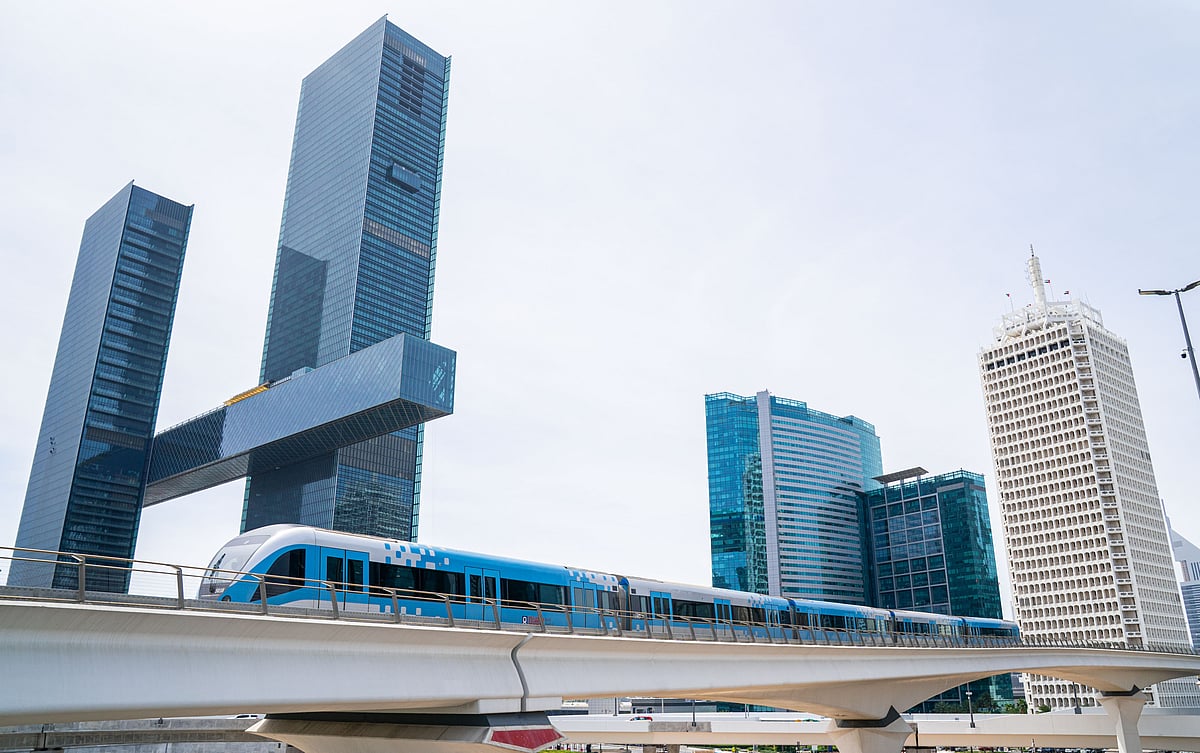
An average of 1.9 million people used public transport, taxis and shared mobility services every day during the first half of the year
Dubai: Dubai Metro has cemented its position as the emirate’s most popular mode of transport, carrying 136.5 million passengers in the first six months of 2026 and accounting for nearly four out of every 10 public transport journeys, as Dubai’s integrated mobility network recorded a total of 348.1 million passenger trips.
The latest figures released by Dubai’s Roads and Transport Authority (RTA) on Sunday show that an average of 1.9 million people used public transport, taxis and shared mobility services every day during the first half of the year, reflecting the city’s growing preference for sustainable and convenient travel.
Metro on top
The Metro alone accounted for 39.2% of all journeys, comfortably ahead of taxis (25.5%) and public buses (24.4%), making it Dubai’s busiest transport mode. Together, the Metro and buses carried 64% of all public transport users, underlining the central role of mass transit in the city’s mobility network.
Mattar Al Tayer, Director General, Chairman of the Board of Executive Directors of RTA, said the figures reflect the success of Dubai’s long-term vision to make public transport the first choice for residents and visitors.
“We are advancing a strategic vision that positions public transport as the first choice for daily mobility among residents and visitors, while cementing Dubai’s standing as a global model for sustainable mobility,” Al Tayer said.
He added that the share of journeys made through public transport and shared mobility has surged from 6% in 2006 to 22.3% in 2025, demonstrating a steady shift towards cleaner and more efficient transport.
Next transport revolution
The strong ridership comes as Dubai accelerates one of the world’s most ambitious transport expansion programmes.
Construction is progressing on the 30km Metro Blue Line, while the emirate has also approved the AED34-billion Gold Line, which will become Dubai’s first fully underground Metro line stretching 42km with 18 stations.
RTA has also begun introducing 637 new low-emission buses, including 40 electric buses – the largest deployment of electric buses in the UAE – while preparing to launch commercial air taxi services before the end of the year. Driverless taxis have already entered operation, signalling Dubai’s push towards next-generation mobility.
Around 3.8 million passpengers used Dubai Tram
Busiest metro station
Among Metro stations, BurJuman retained its position as Dubai’s busiest station with 8.4 million passengers, followed by Union with 6.5 million.
On the Red Line, Al Rigga recorded the highest ridership (6.4 million), ahead of Mall of the Emirates (5.2 million) and Business Bay (5 million).
On the Green Line, Sharaf DG topped the list with 4.9 million riders, followed by Baniyas Square (3.8 million) and Stadium (3.7 million).
2040 plan
RTA said its long-term goal is to raise the share of trips made by public transport and shared mobility to 25% by 2030, in line with the Dubai 2040 Urban Master Plan and the Dubai Economic Agenda D33.
Most popular modes of transport
Dubai Metro: 136.5 million riders (39.2%)
Taxis: 88.9 million riders (25.5%)
Public Buses: 85.1 million riders (24.4%)
Shared mobility: 25.7 million
Marine transport: 8.1 million
Dubai Tram: 3.8 million
Limousines: 5.7 million
Key highlights
348.1 million passenger trips in the first half of 2026.
1.9 million average daily riders.
Metro is Dubai’s most popular transport mode, carrying nearly 4 in 10 passengers.
Metro and buses together accounted for 64% of all public transport users.
Public transport’s share of total trips has jumped from 6% in 2006 to 22.3% in 2025.
Dubai is targeting 25% of all trips by public transport and shared mobility by 2030.
Blue Line: 30km, 14 stations.
Gold Line: 42km, 18 stations, AED34 billion investment.
637 new buses, including 40 electric buses, are being introduced.
Commercial air taxis are scheduled to launch before the end of 2026, alongside the expansion of driverless taxi services.
Network Links
GN StoreAbout Gulf NewsTerms & ConditionsReach by GNSitemapContact usPrivacy PolicyGN FocusHave your sayWork with usAdvertise with usGulf News epaperPrinting Services
Download our app
© Al Nisr Publishing LLC 2026. All rights reserved.