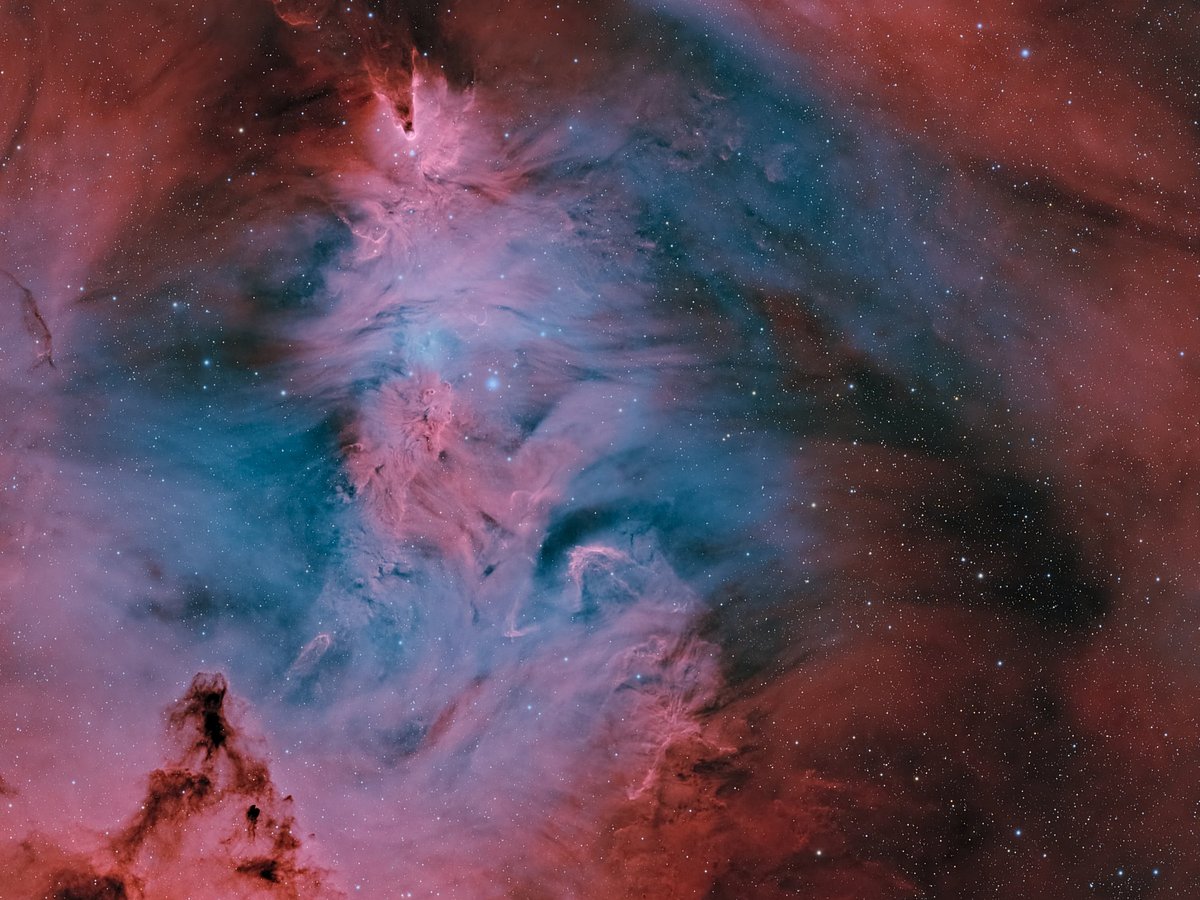
Dubai: Astronomers at the Seal Astronomical Observatory in the Abu Dhabi desert have released a detailed new image of the "Christmas Tree Cluster" and Cone Nebula following a month-long deep-space imaging project.
The final composite, which required 35 hours of exposure time to complete, captures NGC 2264, a complex region of stars and gas located in the Monoceros constellation. The cluster earned its colloquial name due to a distinct arrangement of stars that resembles the shape of a decorated Christmas tree, topped by the dark, pillar-like structure of the Cone Nebula.
Captured from a site with a Bortle 6.5 light pollution rating, the project involved the synthesis of 421 individual five-minute exposures. The resulting image highlights the vibrant red and pink hues of ionised hydrogen gas alongside the cooler blue tones of ionised oxygen.
According to the observatory team, the celestial objects sit approximately 2,300 light-years from Earth. The light captured by the telescope during the sessions in Abu Dhabi began its journey toward the peninsula in roughly 275 BCE.
The technical execution of the project was led by Mohammed Awada, who managed the imaging process using a 108mm aperture refractor telescope equipped with a specialised light pollution filter. The data was subsequently processed by Haitham Hamdi to reveal the finer details of the surrounding Snowflake Cluster and Fox Fur Nebula, as well as the dark nebulae—dense clouds of dust that appear as black voids by blocking background starlight.
Beyond the primary clusters, the image provides a clear view of the structural complexity of the Monoceros region, which remains a primary area of study for both professional and amateur astronomers tracking star formation.
The project was supported by observatory members Osama Ghanem, Anas Mohammed, and Khalfan Al-Naimi. Officials at the observatory noted that while the image is striking in digital formats, the intricate details of the ionised gases are best viewed on high-resolution displays to account for the subtle gradients produced during the 35-hour integration period.

Sign up for the Daily Briefing
Get the latest news and updates straight to your inbox
Network Links
GN StoreDownload our app
© Al Nisr Publishing LLC 2026. All rights reserved.