Last meteor shower of the year lights up Arab skies as winter begins
Ursid shower promises a quiet, dazzling end-of-year display
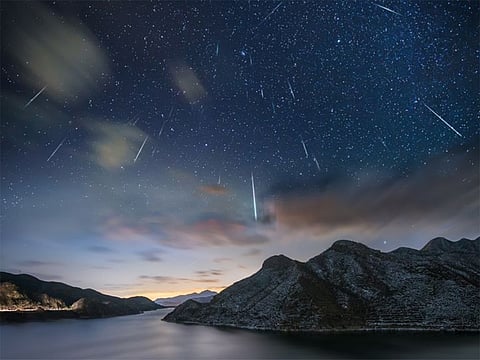
Dubai: The night skies over much of the Arab world are set to offer a quiet celestial finale to the year, as the Ursid meteor shower peaks late Monday night into the early hours of Tuesday, December 23, coinciding with the astronomical start of winter.
The Ursids, the final major meteor shower of the year, are expected to be visible shortly after midnight, with the best viewing conditions occurring just before dawn.
The display occurs annually as Earth passes through a stream of debris left behind by the periodic comet 8P/Tuttle. The comet’s dust particles burn up upon entering the atmosphere at high speed, producing brief streaks of light across the sky.
According to Majed Abu Zahra, head of the Jeddah Astronomy Society, the Ursid shower is active each year between December 17 and 25. As the particles strike Earth’s atmosphere at altitudes of roughly 80 to 120 kilometres, they ignite, creating swift, fleeting flashes.
Visibility improves as the shower’s radiant point, located in the constellation Ursa Minor, climbs higher above the northern horizon in the early morning hours. “The higher the radiant rises, the greater the number of meteors that can be seen,” Abu Zahra explained, noting that pre-dawn is typically when activity reaches its peak.
Under ideal dark-sky conditions, observers may spot between five and ten meteors per hour. This year, viewing prospects are enhanced by the lunar phase: the Moon will be a thin crescent and absent from the sky during the peak, minimising light interference and allowing for clearer observations.
Compared with other annual meteor showers, the Ursids are a relatively recent discovery. Astronomers identified them around a century ago after noticing that a number of late-December meteors appeared to originate from the same point in the sky, confirming the phenomenon as a recurring and predictable event rather than random activity.


