Nawaf Al Awadhi with Dr Joseph Alsousou at Sheikh Shakhbout Medical City following his full recovery from a life-threatening skydiving accident.
UAE skydiver crash: How man who fell from the sky made a miraculous recovery
6,000 jumps, one near-fatal fall: How Nawaf Al Awadhi defied death
Last updated:
4 MIN READ
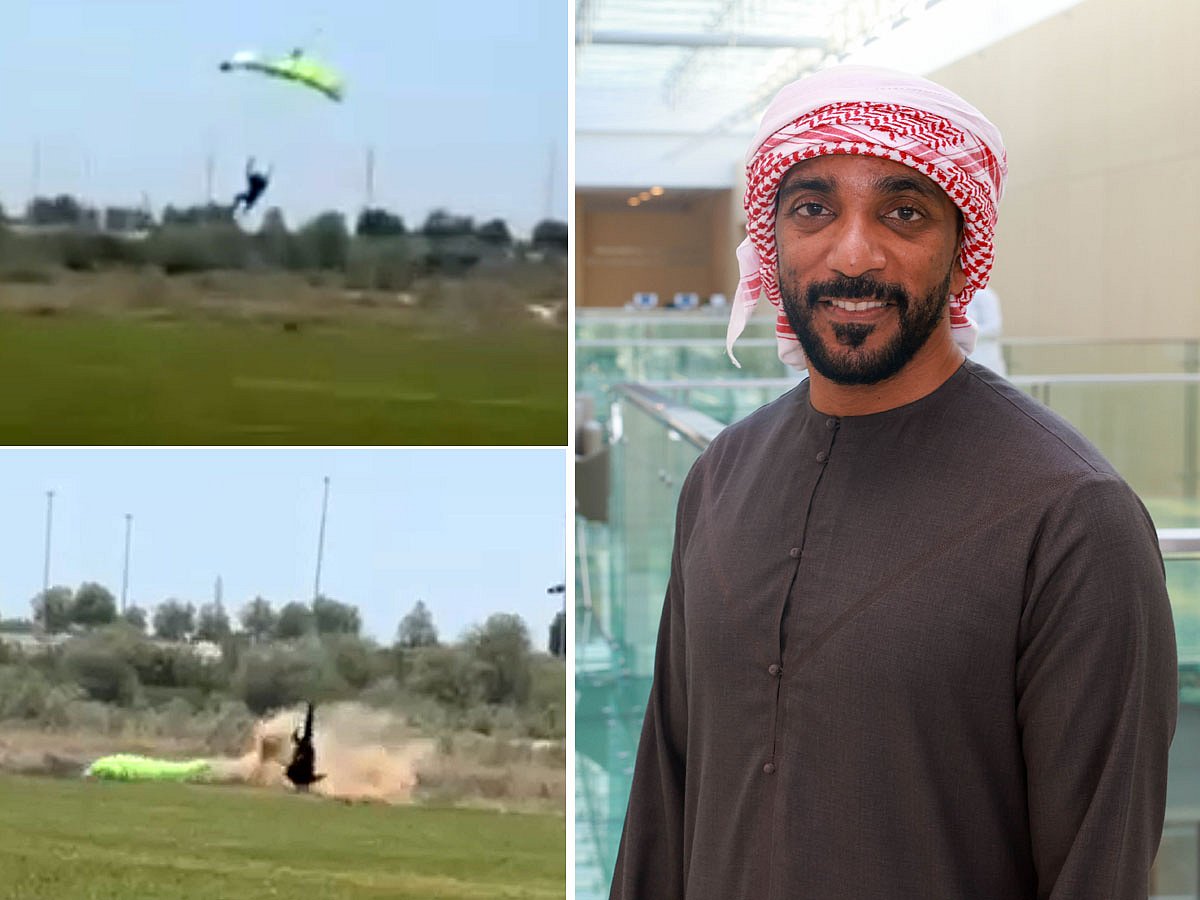
A combination photo shows Nawaf Al Awadhi’s devastating skydiving crash and his full recovery at Sheikh Shakhbout Medical City.
Photo: Ahmad Alotbi/ Gulf News
A 43-year-old Emirati skydiver in Abu Dhabi has made a remarkable recovery after surviving a life-threatening parachuting accident that left him with multiple fractures to his legs, pelvis and spine.
Nawaf Al Awadhi, a military man and experienced skydiver with more than 6,000 jumps, was rushed to Sheikh Shakhbout Medical City (SSMC) seven months ago after his canopy descended at high speed and struck the ground during a skydive in Abu Dhabi.
It is extremely rare to see someone survive a fall from the skyDr Joseph Alsousou
50-50 chance of survival
Medical teams said the severity of his injuries meant survival was far from guaranteed. “With the injuries he sustained, the survival rate is below 50 per cent, which means one in two patients may not survive,” Dr Joseph Alsousou, Acting Chair of the Division of Orthopaedics at SSMC, told Gulf News.
According to Al Awadhi, the accident occurred during canopy flight while he was performing down-formation manoeuvres and turns. As the sequence ended, the canopy began to dive rapidly, resulting in a high-impact landing.
“When I put my legs down, I broke both my legs, my hip and my spine,” he said.
Al Awadhi lost consciousness at the scene and was transported by ambulance to hospital, where emergency teams initiated immediate resuscitation.
Multiple fractures, critical injuries
Doctors said he arrived with multiple life-threatening injuries consistent with a high-velocity impact.
Dr Alsousou noted the patient sustained a severe vertical shear pelvic fracture, a catastrophic injury that causes massive internal bleeding. He suffered an open ankle fracture contaminated with soil and debris, vertebral fractures involving the spine, and multiple open wounds to his legs.
When I woke up, they told me they had finished the first surgery. I didn’t know what had happenedNawaf Al Awadhi
Race against time in the golden hour
Al Awadhi was managed by a multidisciplinary team involving emergency medicine, intensive care, orthopaedic and trauma surgeons, spine specialists, anaesthetists and plastic surgeons. Treatment focused initially on stabilising the patient and controlling bleeding during the critical “golden hour”, followed by definitive surgical management of his injuries.
From Al Awadhi’s perspective, the first days after the accident passed in a blur.
“I don’t remember anything,” he said. “When I woke up, they told me they had finished the first surgery. I didn’t know what had happened. Then they explained that my legs, hip and spine were broken. They told me everything would be okay, and that helped a lot.”
It took about three to four months. When I first started walking, I felt very happyNawaf Al Awadhi
Complex surgery, coordinated care
Photo: Ahmad Alotbi/ Gulf News
Doctors coordinated multiple life-saving, limb-saving and function-restoring procedures over several days, prioritising the pelvis, spine and lower limbs. Further surgeries were required in the weeks that followed to treat open fractures and perform skin grafting on his legs.
Months of rehabilitation
Photo: Ahmad Alotbi/ Gulf News
Once his condition stabilised, Al Awadhi began a lengthy rehabilitation programme that included physiotherapy and gradual mobilisation. Initially confined to a wheelchair, he later progressed to crutches before beginning to walk independently.
“It took about three to four months,” he said. “When I first started walking, I felt very happy, but it takes time to walk normally again.”
Mental recovery as tough as physical
Al Awadhi said the psychological impact of the accident was as challenging as the physical recovery.
“At first it was really hard mentally,” he said. “You start thinking about how your life is going to change – at work, with your family, with your friends. But you can’t let one accident change everything.”
Al Awadhi credited his family, friends and medical team for supporting him through recovery.
“The doctors were very good and always explained things clearly,” he said.
Skydiving is a beautiful sport, but you have to be very carefulNawaf Al Awadhi
Rare for someone to survive
Dr Alsousou said the patient’s outcome was unusual given the extent of his injuries.
“It is extremely rare to see someone survive a fall from the sky with a parachute impacting the ground at such speed,” he said, comparing it with falling from an aircraft and hitting the ground under a parachute.
“Early intervention, coordinated trauma care and rehabilitation all played a critical role in achieving this result.”
He added that the patient’s training and quick actions before impact may have reduced the severity of his injuries by lowering speed during the final moments of descent.
Lessons for extreme sports enthusiasts
Doctors said the case highlights both the risks associated with extreme sports and the importance of preparation, safety measures and access to specialised trauma care.
Al Awadhi, who is now walking again, said the experience has reinforced the need for caution in skydiving and other high-risk activities.
“Skydiving is a beautiful sport, but you have to be very careful,” he said. “Your equipment, your training and the people you jump with all matter. If something happens in the air, no one can help you.”
Ashwani Kumar is a journalist and storyteller with almost two decades of experience, including more than 10 years across the UAE and Oman. As Chief Reporter, he covers multiple beats, crafting engaging stories that resonate with readers across platforms. A rolling stone with a reporter’s curiosity, instinct and relentless drive, Ashwani has chased headlines at major events across the country – from ADIPEC, Formula One and Big Ticket in Abu Dhabi, to GITEX Global, AI Week and the Emirates Airline Festival of Literature in Dubai, and the Sharjah International Book Fair to Hatta Festival. Name the event, and he’s likely been on the ground, reporting with backpack, laptop, and pen on paper. His defining chapter? The Covid-19 pandemic, where he cut through the noise and misinformation with on-the-ground reporting, earning trust when it mattered most. Along the way, he’s sat down with a range of global figures: from heads of state like Sheikh Hasina, to Nobel Peace Prize winner Kailash Satyarthi, cricketing legend Brian Lara, Bollywood star Ranbir Kapoor, and author-politician Shashi Tharoor, to name just a few. Ashwani thrives on tight deadlines, tough calls, and turning chaos into clean copy. A natural team player and multitasker, he brings clarity and calm to every assignment, and is always on the lookout for news.
Sign up for the Daily Briefing
Get the latest news and updates straight to your inbox
Network Links
GN StoreAbout Gulf NewsTerms & ConditionsReach by GNSitemapContact usPrivacy PolicyGN FocusHave your sayWork with usAdvertise with usGulf News epaperPrinting Services
Download our app
© Al Nisr Publishing LLC 2026. All rights reserved.