Sankalp Sandeep Naik, one of the top scorers for Neet 2026, with his family during his graduation ceremony.
Meet the UAE students caught between NEET 2026 paper leak chaos and Gulf conflict
War, a paper leak and a nationwide retest: how NEET 2026 tested UAE students twice over
Last updated:
9 MIN READ
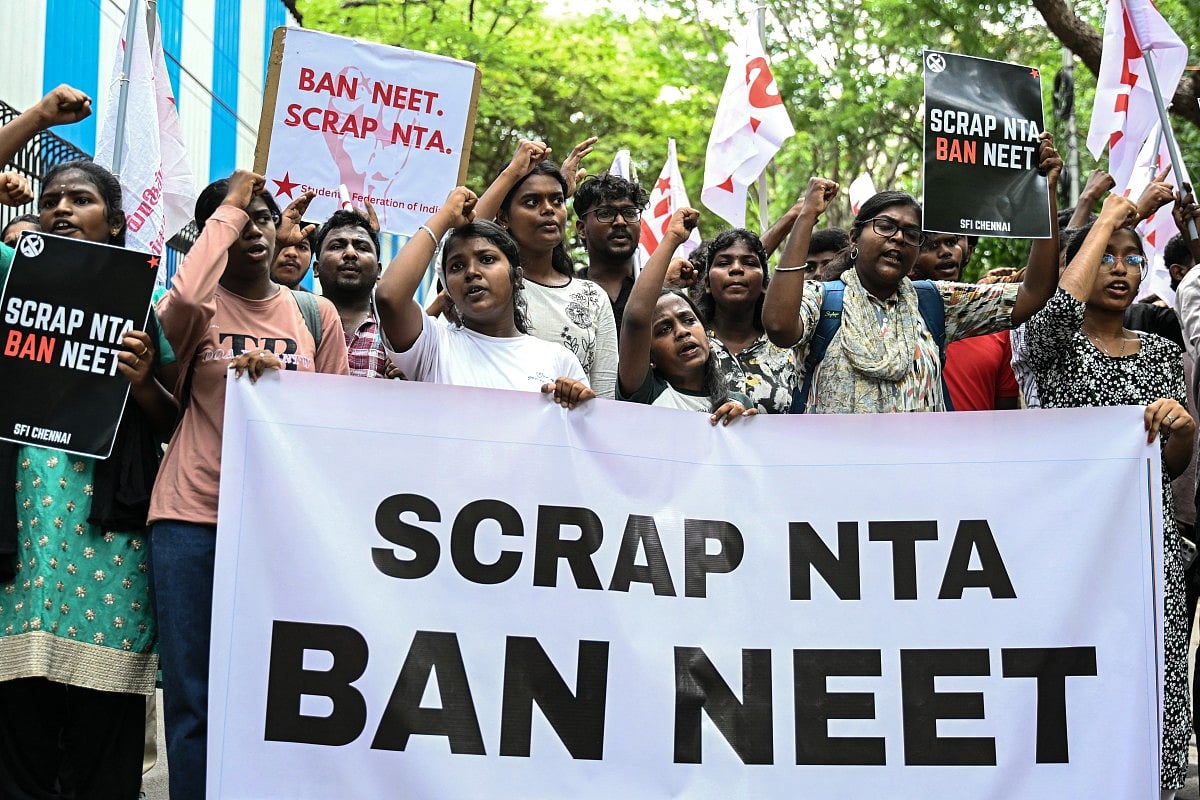
Members of the Students' Federation of India protest against the National Testing Agency (NTA) after the cancellation of the NEET examination over an alleged paper leak, in Chennai on May 14. Photo used for illustrative purposes.
AFP
That is what nearly 1,900 students across Dubai, Sharjah and Abu Dhabi, and million others in India, went through this year, after India’s National Eligibility cum Entrance Test (NEET-UG) — the gateway exam for every aspiring doctor in the country — was hit by a nationwide paper leak scandal.
The leak, the protests, the resignation
NEET-UG is sat by around 20 million students across India every year. This year, reports surfaced of exam sections circulating on Telegram, prompting government raids and cancellation of the examinations.
For students inside India, that meant one gruelling retest. For students in the UAE, it meant something messier: an exam schedule tangled up with school-leaving boards, cancelled and rescheduled papers, and — for many — a war breaking out mid-syllabus.
Many UAE students start preparing for the competitive tests that gains them admission to some of India's premium educational institutions, including the All India Institute of Medical Sciences, starting Grade 11.
They study several hours a day for two years straight. Some even start as early as Grade 7, which teachers and education experts say is bit of an overkill. All this to secure their future in an increasingly competitive world, further complicated by the insurgence of artifical intelligence across all walks of life.
News of the retest deepened an already fraught situation, with students across India reporting severe stress and uncertainty. The period also saw reports of several student suicides, prompting renewed debate about the mental health toll of high-stakes examinations.
The scale of the leak triggered a month-long, youth-led protest movement — the satirical Cockroach Janta Party, founded on May 16 by 30-year-old Boston University graduate Abhijeet Dipke — which grew online by the thousands each day.
The pressure told. Several education ministry officials were sacked, and on Saturday, the India's education minister Dharmendra Pradhan was forced to resign — a rare, tangible win for student protesters.
"I was so sad, I didn't want to do it"
Sankalp Sandeep Naik moved to the UAE from Goa as a toddler and has wanted to be a doctor, a neurosurgeon more specifically — the first in his family — since school. He sat his first NEET on May 3. Days later, it was cancelled.
The NEET controversy comes just weeks after thousands of UAE-based CBSE students saw their board examinations postponed and later cancelled as the US-Israel-Iran conflict disrupted the academic calendar, adding months of uncertainty to an already stressful admissions season.
"I didn't want to do it (write the re-test). I was so sad," he says. "Eventually my mum, my dad, my brother— they motivated me."
The second sitting came on June 21, after what he calls a "10-day break" that broke his study rhythm. "It's really hard to get back into the same flow," he says. Biology felt straightforward the second time, he says, but physics and chemistry were "really hard."
He is scathing about the format itself. "The paper leak is not something that should've happened at all," he says, pointing to JEE — the engineering entrance exam — which moved to a computer-based format years ago. "I have not seen any news of it getting leaked," he says. "Making NEET computer-based reduces the chances of leaks."
He scored a rank of 1,398 - among the highest for students who wrote the exams in the UAE, and is hoping for a seat at AIIMS Nagpur. But he wants more than an apology. "As long as there is a change, and leaks stop happening — that's what matters more," he says.
NEET, NTA decoded
"Once that flow is broken, it's ten times harder"
Sanjana Sampath Kumar has lived her whole life in the UAE and decided to pursue medicine after watching a stranger perform first aid on a man having a seizure in a Dubai restaurant. "I was just standing there, frozen," she recalls. "If I see another case like that in front of me, I want to be able to do something."
She had prepared for two years, training at Ascentria since Grade 10. Her first NEET score — which was projected at 620-625 (highest one can score is 750) — and the cancellation, in her words, "pretty devastating."
"I couldn't believe my ears or eyes," she says of the leak news. "We heard rumours — reports of leaks in Rajasthan and other places." She understood the decision, even if it upended her preparation. "It's a logistical nightmare — 22 lakh physical OMR sheets," she says. "But it was a countrywide nexus, not a minor, localised leak."
"The last few weeks before the exam are blood, sweat and tears. You stop thinking about anything else," says Sanjana.
The war compounded things. "First, I was coming home after writing the chemistry board exam when the news of the attacks came out," she says. Her board exams — the school-leaving papers she needed alongside NEET — were eventually cancelled outright, midway through the sequence. "Suddenly, exam after exam — it's not going to matter," she says of the disrupted marks sheet.
She and her mother had to fly to India briefly to collect documents, landing back in the UAE "one day before the issue restarted again" — a stroke of luck, she says, given the flight cancellations at the time.
By the second NEET sitting, her score had dropped by around 100 marks. "The real difference — the second NEET — widened the gulf," she says, between students who kept up their intensity and those, like her, who couldn't quite match it the second time. "One group gave up on prep altogether," she says. "I don't care anymore — throw in the towel — [but] you have to keep going through."
She credits her school and teachers for steadying her. "Teachers were so supportive. They checked in on us, continued giving mock exams," she says. She still expects to qualify for a medical seat in India, though not at the tier she once hoped for.
"I don't regret the choice — I regret trusting the system"
For 17-year-old Batool Fatima, a student at Abu Dhabi Indian School, Al Wathba, the toll has been more personal. "I don't regret making the choice to become a doctor," she says. "But I regret trusting the system to get me there."
Her first attempt yielded 400-500 marks, according to projections — a result she was pleased with at the time. Then came the retest, sat amid the same disruption. "Physics and chemistry was done — that was when [the war] broke out," she says. "There were attacks. That added to my stress."
She has since let go of her plan to pursue MBBS, and is now weighing dentistry (BDS) or a pharmacy degree instead — decisions shaped as much by cost as by score. "I don't think there's so much support in India," she says. "My health has taken a beating. Hairfall — cortisol is so high... not knowing is agony."
Her mother, Maryam Mazhar, a teacher in Abu Dhabi with three children moving through the CBSE system, watched the toll up close. "It's very sad to see the kids suffering emotionally, psychologically — there are a lot of trust issues happening," she says. "Nothing, as per child psychology, is being taken care of by the ministry."
How the NEET paper leak happened
The coaching centre view
Alka Malik, founder of Ascentria, has run the coaching institute for 14 years and has watched both exams — NEET and JEE — up close. Ascentria is an academic coaching academy based in Dubai, specialising in competitive entrance exam preparation like JEE, NEET, CAET, and school board curricula (CBSE/ICSE) for grades 9 to 12.
She is blunt about the scale of the leak. "The leaks should not have happened. Their (students’) entire career, their lives hinged on this. Some of them did manage to keep their morale up and write the second attempt, but many of them gave up.”
She contrasts NEET’s record with JEE's. "JEE moved to a computer-based mode seven years ago. It's been smoother — there hasn't been rigging," she says. "NEET has been a rampant problem. Why not for NEET?"
She also explains why NEET remains the default choice even for NRI families with other options on the table.
Studying in the US is largely out of reach for expat students pursuing MBBS, she says, given the cost and the negligible number of seats open to non-US students. The more realistic alternatives are the UK, Eastern Europe — "Georgia, Romania" — and Australia.
But even a good government college in India, while intensely competitive for the few seats available, offers "phenomenal grounding," she says, whereas private medical colleges are "prohibitively expensive," often running into the crores, and some restrict NRI applicants to separate, costlier seat categories altogether.
"If JEE can be conducted online for millions of engineering aspirants, there is no reason NEET cannot eventually move in the same direction," says Alka Malik.
International students
Many students sit NEET anyway, she said, simply to keep the option of returning to practise in India open later — a foreign medical qualification still requires proof of having cleared NEET in the year a student finished Grade 12.
The disruption caused by the leak and re-exam, she says, was as much logistical as academic for UAE-based families. Results are normally out within a month of the exam, with counselling and college allocation happening online — but students still need to be physically present at their college once allotted.
"Many had already moved to India, packed their bags, literally waiting for the kid to finish," she says. Some families were left unsure whether to stay on in India or return to the UAE while the new exam date was pending. Flights were also disrupted by the war in June, she adds, making an already messy period worse. Refunds for the first cancelled sitting are, she says, still being processed for some students.
She is unequivocal that the exam should never have been compromised in the first place. "The leaks should not have happened," she says.
But she believes change is under way, pointing to shifts already visible in how the exam and school curricula are being redesigned — a shift towards application-based, MCQ-style questions rather than pure rote learning. "I do see changes, positive changes do happen," she says.
Students celebrate the resignation of India's Education Minister Dharmendra Pradhan, in Amritsar on July 25, 2026 amid an ongoing protest by the Cockroach Janta Party (CJP) at New Delhi's jantar Mantar over alleged NEET examination irregularities.
'This should not happe'
Educational consultant Biju Parappuram, who has taught in UAE schools including DPS Dubai for over two decades, sees the disruption as part of a much older pattern. His own son sat NEET four years ago, and narrowly missed a government medical seat despite years of preparation.
"Watching your child quietly let go of a dream that had shaped his life for years is heartbreaking," he says.
He argues NEET 2026 has reopened a debate that predates this year's leak entirely — whether one exam should carry so much weight. "Can one examination truly measure a student's potential to become a compassionate and competent doctor?" he asks. "Medicine requires empathy, patience, communication skills, ethical values — no three-hour examination can fully measure these qualities."
For Gulf-based families specifically, he says the disruption reshaped plans in real time. "University applications were delayed while students waited for revised examination schedules," he says.
"I noticed a significant increase in enquiries from families who had initially planned to study medicine only in India, but suddenly began exploring universities across Europe."
So, what happens now
Dharmendra Pradhan’s resignation may have quieted the protests, but for the students who lived through two sittings of NEET, a war, and months of uncertainty, the reforms they are asking for — a shift to computer-based testing, chief among them — are still just promises.
As Naik puts it: "As long as there is a change... that's what matters more."
Network Links
GN StoreAbout Gulf NewsTerms & ConditionsReach by GNSitemapContact usPrivacy PolicyGN FocusHave your sayWork with usAdvertise with usGulf News epaperPrinting Services
Download our app
© Al Nisr Publishing LLC 2026. All rights reserved.