A handout picture obtained from the media office of the Barakah Nuclear Power Plant on February 13, 2020, shows a view of the power plant in the western Al Dhafra Region -- formally know as the Gharbiya region -- of Abu Dhabi on the Gulf coastline about 50 kilometres west of Ruwais.
IAEA chief: Barakah attack a ‘trial by fire’ that proved UAE nuclear safety systems work
Barakah incident underscores need to shield peaceful nuclear sites under global law
Last updated:
4 MIN READ
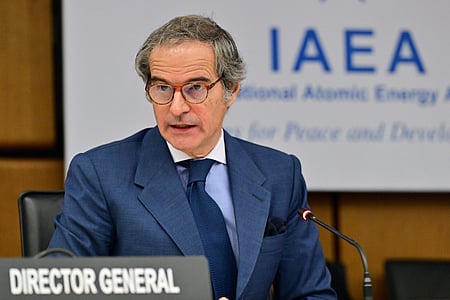
Rafael Mariano Grossi, Director General of the International Atomic Energy Agency (IAEA).
Abu Dhabi: Rafael Mariano Grossi, the Director General of the International Atomic Energy Agency (IAEA), has reiterated the agency’s unequivocal opposition to any attack on peaceful nuclear facilities, stressing that such installations are fully protected under international humanitarian law.
Grossi described the attack that targeted the vicinity of the UAE’s Barakah Nuclear Energy Plant on May 17, 2026 as a direct threat to nuclear safety.
Grossi made the remarks during a press conference held on Tuesday evening at the St. Regis Hotel in Abu Dhabi, following a site visit to the Barakah Nuclear Energy Plant as part of a regional tour.
Get updated faster and for FREE: Download the Gulf News app now - simply click here.
During the visit, he reviewed the measures implemented to ensure the continued safe operation of the facility in the aftermath of the incident.
UAE–IAEA cooperation
The IAEA chief commended the close cooperation demonstrated by the UAE authorities, noting that the agency received accurate, timely and regular technical updates regarding the consequences of the attack.
This, he said, enabled the IAEA to monitor developments in real time and maintain full situational awareness.
Any attack on a nuclear power plant is simply unacceptable. From what we have seen, this was a carefully planned operation. Whoever carried out this attack knew exactly what they were doing. This is extremely serious.Rafael Mariano Grossi, the Director General of the International Atomic Energy Agency (IAEA)
Grossi emphasised that continuous communication with the Agency’s Incident and Emergency Centre is a critical component in managing such events and ensuring the highest levels of transparency.
At the same time, he strongly condemned the attack.
'Any attack on a nuclear power plant is unacceptable'
“Any attack on a nuclear power plant is simply unacceptable,” Grossi said, stressing that such actions violate established international norms and legal frameworks.
While praising the professionalism with which the incident was handled, he warned that the event highlights the dangers posed by attacks on critical infrastructure supporting nuclear operations.
“From what we have seen, this was a carefully planned operation,” he stated, adding that those responsible were fully aware of the importance of the infrastructure being targeted.
In one of his strongest remarks during the press conference, Grossi said: “Whoever carried out this attack knew exactly what they were doing. This is extremely serious.”
Strengthening cooperation and learning from the incident
Grossi confirmed that the IAEA will continue working closely with UAE institutions, including the Emirates Nuclear Energy Corporation (ENEC) and the Federal Authority for Nuclear Regulation (FANR), to review lessons learned from the incident and support ongoing assessment and recovery efforts.
He noted that the event underscored the value of intensive training, emergency preparedness exercises and continuous readiness programmes that are routinely conducted at nuclear facilities.
“It was evident how valuable intensive training, drills and preparedness activities are,” he said.
“These are essential components of any advanced industrial infrastructure, particularly nuclear power plants.”
UAE officials also highlighted that lessons learned from the international ConvEx-3 emergency exercise, hosted by the UAE in cooperation with the IAEA in 2021, contributed significantly to enhancing national preparedness and resilience during the recent incident.
No radiological emergency
Grossi’s comments followed his visit to Barakah on Tuesday, where he said he wanted to assess the situation firsthand and demonstrate the IAEA’s support for the UAE.
“The primary reason for my visit is the incident that occurred on May 17 at the Barakah Nuclear Energy Plant,” he told reporters.
He noted that the IAEA has worked closely with the UAE since the launch of the country’s peaceful nuclear energy programme and has remained in continuous contact with national authorities and plant operators since the attack.
Barakah passed a 'trial by fire'
Grossi revealed that he met with senior UAE officials and toured the site to review how the incident was managed. He concluded that the plant’s safety systems and operational procedures functioned exactly as intended.
“This was a trial by fire for them, and they passed it with flying colours,” he said.
The IAEA chief added that he discussed the response in detail with the operational team that was on duty during the attack and found that all emergency protocols and procedures had been implemented accurately and professionally.
“I had the opportunity to discuss what happened with the shift team that was present at the time,” he said. “All protocols were applied perfectly, and within a very short period the situation was fully under control.”
Attack targeted external electrical infrastructure
According to Grossi, the attack was directed at external electrical infrastructure supplying power to systems that support plant operations, rather than the nuclear reactors themselves.
“This was an indirect attack on the plant,” he explained. “It was not aimed at the reactor, but at the electrical infrastructure that provides the power required for safety functions and other essential operational tasks.”
Despite the seriousness of the incident, Grossi stressed that it never evolved into a nuclear safety emergency.
“There was never any radiological emergency whatsoever,” he said.
Multiple layers of protection
Information presented during the visit confirmed that the Barakah Nuclear Energy Plant continues to operate safely and normally, with all safety and security systems fully functional.
UAE officials said the incident demonstrated the effectiveness of the country’s nuclear safety and security framework, as well as the high level of preparedness among personnel responsible for operating the facility.
Grossi explained that Barakah is equipped with multiple layers of safety systems designed to activate automatically under such circumstances, ensuring the highest standards of protection even in the event of a loss of external power.
“When professional competence and proper procedures are in place, a nuclear power plant becomes an extremely safe facility,” he said.
“There are multiple layers of protection that immediately come into operation whenever needed.”
The incident, while serious, has become a significant real-world test of the UAE’s nuclear preparedness framework.
According to the IAEA chief, the response demonstrated not only the robustness of Barakah’s safety architecture but also the maturity of the UAE’s nuclear governance, emergency preparedness capabilities and commitment to transparency with the international community.
Sign up for the Daily Briefing
Get the latest news and updates straight to your inbox
Network Links
GN StoreAbout Gulf NewsTerms & ConditionsReach by GNSitemapContact usPrivacy PolicyGN FocusHave your sayWork with usAdvertise with usGulf News epaperPrinting Services
Download our app
© Al Nisr Publishing LLC 2026. All rights reserved.