Dr. Khalid Ahmed Korai Baloch, medical doctor at NAS Neuron Health Services
AI-powered diagnosis: What it means for patients in the UAE
Experts explain how AI could improve diagnosis and why doctors must remain in control
Last updated:
5 MIN READ
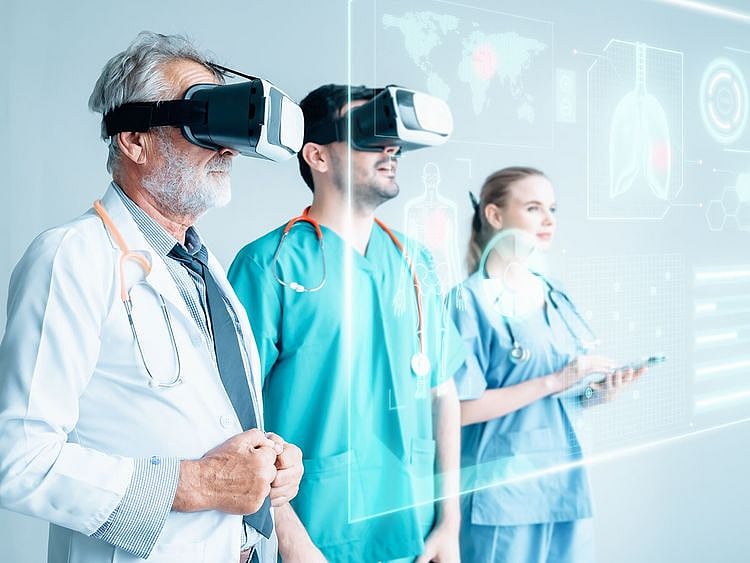
AI can provide valuable clinical insights but doctors must remain at the centre of every critical healthcare decision, says experts. Photo for illustrative purposes only
Shutterstock
Dubai: Artificial intelligence (AI) is opening new possibilities for disease detection in the UAE, helping doctors analyse medical scans, laboratory results, and patient records to identify potential health problems.
The technology is being used in areas such as breast cancer screening, diabetic eye examinations, and cardiovascular risk assessment, while it is also being explored to identify patients at risk of serious complications.
But experts say AI is not a substitute for a doctor’s assessment. Its findings must be checked, interpreted, and followed up with appropriate medical care.
Get updated faster and for FREE: Download the Gulf News app now - simply click here.
Finding a problem
Dr. Khalid Ahmed Korai Baloch, medical doctor at NAS Neuron Health Services, has noted that AI can help identify abnormalities in mammograms, chest scans, and retinal images, allowing doctors to investigate potential problems earlier.
However, he has cautioned that detecting an abnormality does not guarantee timely treatment.
“Early detection and early treatment are two different things. Identifying an abnormality is only the first step. The patient must still receive timely investigations, specialist assessment, and appropriate treatment,” Baloch told Gulf News.
He has warned against assuming AI is more accurate than doctors across all conditions. Baloch has cited a clinical trial of an AI system for diabetic retinopathy screening that reported 87.2 percent sensitivity and 90.7 percent specificity.
“We should learn AI, use AI, and question AI. We should welcome technology that helps us provide safer and more effective healthcare. But we must remember that healthcare is not simply about processing information. It is about understanding people, making responsible decisions, and being accountable for patient care.”
Early warnings
Zulekha Memon, holistic health coach at Nutriwellnessguide, has highlighted AI's potential to identify health risks before symptoms appear, including through retinal imaging and breast cancer screening.
She has cited a Swedish trial involving more than 105,000 women in which AI-supported mammography detected 29 percent more cancers than screening without AI assistance. The study has also reported a 44 percent reduction in radiologists’ reading workload, without an increase in false-positive results.
She has bared that findings from international studies need to be assessed for their relevance to the UAE population.
Zulekha Memon, holistic health coach at Nutriwellnessguide
“AI tools need testing on our own population, so results hold for Emirati, expatriate, and multinational patients alike. However, patient records must stay private and secure, and clinics also need time and training to use new tools well, especially to understand why a system has flagged a result,” shared Memon.
She has stressed that doctors must explain risk alerts and determine the appropriate medical response, while health coaching can help patients maintain healthier habits.
Improve patient care
According to Dr. Lalu Chacko, group chief operating officer of Medcare Hospitals and Medical Centres, AI can help doctors analyse scans, laboratory results, and electronic health records to identify patterns that may require further investigation.
He has emphasised that AI must complement established diagnostic methods, including physical examinations and laboratory tests.
“Its accuracy depends on the quality of the data it has been trained on, the condition being assessed, and how the technology is used in clinical practice,” explained Chacko.
Dr. Lalu Chacko, group chief operating officer of Medcare Hospitals and Medical Centres
He added, “AI should complement these approaches by providing additional information, rather than being viewed as a replacement for established medical assessments.”
Hospitals must also consider implementation costs, data protection, and staff training. Healthcare providers should choose clinically validated tools and regularly assess whether they deliver meaningful benefits for patients.
Earlier risk assessment
On the other hand, Dr. Prashanth Narayana Murthy, medical director and specialist in urology at Aster Cedars Hospital and Clinic Jebel Ali, has seen AI as an opportunity to analyse large volumes of medical information and identify patterns associated with potential health risks.
He has pointed to the potential of combining genomic research, detailed patient assessments, and health information exchange systems.
“AI is not replacing UAE physicians; rather, it is empowering them with unprecedented diagnostic precision,” exclaimed Murthy.
Dr. Prashanth Narayana Murthy, medical director and specialist in urology at Aster Cedars Hospital and Clinic Jebel Ali
He has identified data interoperability, excessive clinical alerts, and uncertainty over medico-legal liability as challenges for healthcare providers.
“The final diagnostic verdict and treatment plan rely entirely on the clinical nuance, empathy, and ethical accountability that only a human physician can provide.”
Flag critical illness
For his part, Dr. Adel Al Sisi, chief medical officer, consultant, and head of intensive care at Prime Hospital, has underscored AI’s potential to discover early warning signs of sepsis, respiratory failure, and acute kidney injury.
By analysing changes in vital signs and laboratory results, AI systems can alert medical teams when a patient’s condition may be deteriorating. Such alerts can prompt further assessment, but they do not confirm a diagnosis.
Al Sisi has warned that relying on automated recommendations without proper evaluation could lead to unnecessary investigations, false alarms, or missed diagnoses.
“Healthcare professionals must understand both the capabilities and limitations of these systems. Hospitals should establish clear clinical protocols, validate AI tools in their patient populations, and continuously evaluate their performance,” stated Al Sisi.
Dr. Adel Al Sisi, chief medical officer, consultant, and head of intensive care at Prime Hospital
Tested on UAE population
Meanwhile, Ajay Chaturvedi, a doctoral researcher in AI and machine learning, has mentioned that AI has potential applications in cancer detection, cardiovascular assessment, neurological imaging, diabetic screening. and respiratory disease detection.
However, he has cautioned that strong results in controlled studies do not automatically translate into better outcomes in everyday clinical practice.
“An important consideration is whether AI models developed using international datasets perform equally well across the UAE’s diverse, multicultural patient population,” said Chaturvedi.
Ajay Chaturvedi, doctoral researcher in AI and machine learning
He has called for local validation, continuous performance monitoring, and professional training. He has also considered data quality, cybersecurity, patient privacy, and implementation costs as important challenges.
“AI should function as a clinical decision support tool rather than an autonomous substitute for professional medical judgment.”
What patients need to know
AI could help doctors identify potential health problems earlier, but an alert does not necessarily mean a person has a disease.
The findings must be assessed alongside medical history, symptoms, examination results, and any further investigations required.
For UAE patients, the potential benefits include earlier screening, more timely referrals, and better-informed medical decisions. Achieving these benefits will depend on reliable technology, appropriate follow-up, and doctors retaining responsibility for patient care.
Network Links
GN StoreAbout Gulf NewsTerms & ConditionsReach by GNSitemapContact usPrivacy PolicyGN FocusHave your sayWork with usAdvertise with usGulf News epaperPrinting Services
Download our app
© Al Nisr Publishing LLC 2026. All rights reserved.