International Day of Charity: How $95 billion in UAE aid reached 190 countries
From Gaza to Sudan, UAE humanitarian efforts increasingly focus on long-term recovery
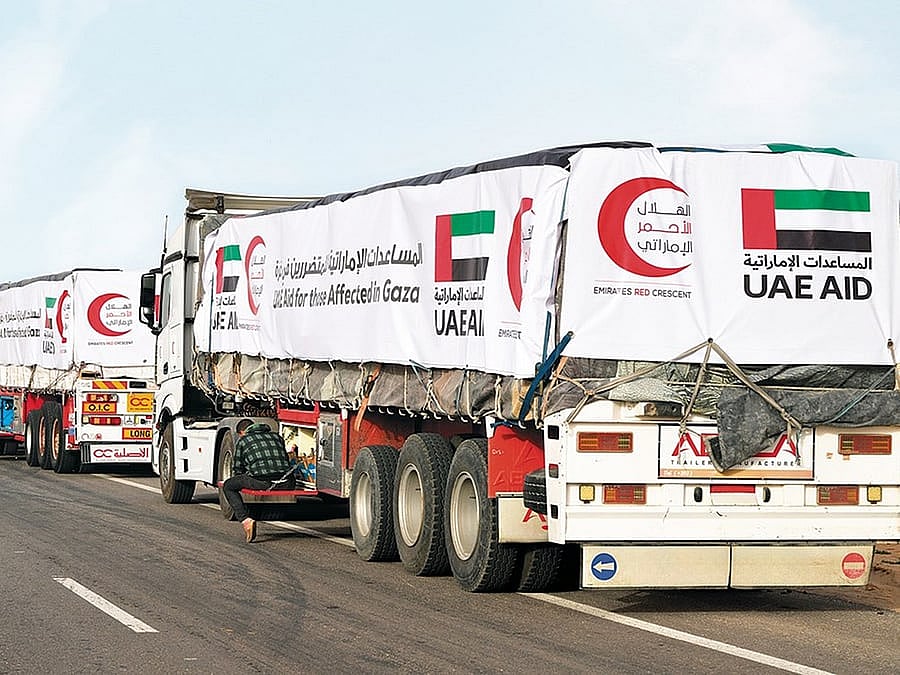
The UAE will tomorrow mark the International Day of Charity, a global occasion that highlights the country’s deeply rooted culture of giving and the evolution of its charitable and humanitarian efforts from responding to urgent needs to developing more sustainable solutions that enhance quality of life and create broader opportunities for communities and individuals.
Since the establishment of the UAE, humanitarian giving has evolved beyond a temporary response to a crisis or the delivery of relief supplies to a disaster-hit area. Over decades, it has developed into an integrated approach combining emergency relief, healthcare, food and water assistance, shelter for displaced people, reconstruction, education, disease prevention and local capacity building.
Get updated faster and for FREE: Download the Gulf News app now - simply click here.
From Palestine to Sudan, and from Syria and Türkiye to Libya and Morocco, and from Pakistan to African and Asian countries affected by epidemics and natural disasters, the UAE has established a model based on reaching those affected quickly, before gradually moving from emergency response to recovery, rehabilitation and development.
According to data from the UAE Ministry of Foreign Affairs, the total value of the UAE’s foreign assistance to more than 190 countries over five decades has exceeded $95.06 billion, including $1.83 billion in a single year, according to data released by the ministry at the end of 2023.
These figures cover foreign assistance in its broadest sense, including development, humanitarian and charitable aid. This distinction is important when assessing the scale of the UAE’s humanitarian efforts, as a significant portion of this spending is directed towards long-term projects aimed at addressing the root causes of crises and strengthening communities’ resilience.
Development initiatives embodying a new concept of giving
Several humanitarian and development initiatives launched this year have highlighted this transformation in the concept of giving — from campaigns responding to hunger, crises and disasters to projects investing in education, healthcare, water, empowerment and capacity building.
This approach makes charity an ongoing process that addresses people’s needs today while laying the foundations for better conditions tomorrow.
Among the most prominent initiatives this year is the “Hand of Life” campaign, launched by His Highness Sheikh Mohammed bin Rashid Al Maktoum, Vice President and Prime Minister of the UAE and Ruler of Dubai, with the aim of saving five million children around the world from death caused by hunger.
The campaign raised more than Dh2.822 billion, with the participation of 44,208 individual, corporate and humanitarian contributors.
The significance of the campaign goes beyond the amount raised. It demonstrates the ability to mobilise society around a fundamental humanitarian cause and reinforces the message that charitable work in the UAE is not limited to providing assistance, but can transform empathy with human suffering into large-scale initiatives with clear objectives and measurable impact.
This approach is also evident in initiatives that place education at the heart of charitable work, recognising it as one of the investments most closely linked to the future of societies.
This year has seen projects to build schools and classrooms, support tuition fees and students in need, provide computers, school bags and educational supplies, as well as initiatives to rehabilitate educational institutions in affected areas.
In this context, the Khalifa bin Zayed Al Nahyan Foundation inaugurated the Sheikh Khalifa bin Zayed Al Nahyan Vocational Education Institute in Senegal, with a capacity of nearly 1,000 students.
The institute aims to equip young people with vocational and technical skills that enhance their employment opportunities, reflecting a shift in part of the charitable effort from direct assistance towards empowering beneficiaries with the tools they need to become self-reliant.
From “relieving human suffering” to “building resilience”
The UAE experience demonstrates how the concept of humanitarian assistance has evolved from providing basic necessities such as food, medicine and tents into a more comprehensive system that begins with rescue and rapid response, followed by healthcare, water and food supplies, and ultimately the rebuilding of facilities and services and supporting affected communities.
The UAE Foreign Aid Policy states that humanitarian and development assistance is based on humanitarian considerations and is not linked to religion, race, colour or culture.
Its priorities include combating poverty, supporting children, empowering women, infrastructure, transport and government services, in addition to responding to humanitarian crises.
This approach is clearly reflected in the UAE’s modern humanitarian operations, which no longer focus solely on sending aid, but also establish air and maritime bridges, field hospitals, logistics centres, rehabilitation programmes and water, food and education projects.
Gaza: A comprehensive model of sustained humanitarian response
The UAE’s humanitarian response in the Gaza Strip represents one of the clearest recent examples of the transition from emergency relief to a multi-track humanitarian system.
Since the launch of Operation Chivalrous Knight 3 on November 5, 2023, the UAE has continued to provide food, medical and relief assistance, alongside healthcare services, medical evacuations, water supplies and logistical support.
By August 2026, after 1,000 days of the operation, the value of UAE aid provided to Palestinians in Gaza had exceeded $3.89 billion, while the volume of assistance surpassed 126,000 tonnes, transported through more than 770 flights, 25 ships and over 13,000 trucks.
The response has extended beyond the delivery of food and medical supplies to encompass an integrated healthcare system.
The UAE field hospital in Gaza, together with the UAE floating hospital in Al Arish and associated medical centres, has treated more than 230,000 cases, providing surgeries, specialised healthcare services and rehabilitation programmes.
This highlights a different philosophy of giving: helping people survive today while building the foundations for recovery and resilience tomorrow.
Sudan: Aid at the heart of one of the world’s major humanitarian crises
In Sudan, the UAE has responded to one of the region’s most complex humanitarian crises, triggered by the conflict that erupted in April 2023 and resulted in widespread displacement and growing needs for food, healthcare, shelter and protection.
According to UAE data, humanitarian assistance provided to Sudan since the outbreak of the crisis had exceeded $800 million by 2026, while the value of UAE aid to Sudan between 2015 and 2025 reached approximately $4.24 billion.
The UAE has also become the second-largest humanitarian donor to Sudan since the outbreak of the conflict, according to data from the United Nations Office for the Coordination of Humanitarian Affairs.
The response has included food and healthcare assistance, shelter and protection for displaced people, as well as support to neighbouring countries hosting large numbers of Sudanese refugees.
In December 2025, the UAE International Aid Agency allocated $15 million to the United Nations High Commissioner for Refugees to support a project targeting people affected by the conflict in Sudan, including protection, shelter, healthcare and education.
This reflects an important feature of the UAE’s humanitarian policy: addressing not only the crisis inside the affected country, but also its regional consequences for refugees and host communities.
Natural disasters: Reaching people before the impact of catastrophe fades
In response to natural disasters, the UAE has repeatedly been among the countries that move quickly to deploy rescue teams and deliver assistance to affected areas.
Syria and Turkey earthquake
Following the devastating earthquake that struck Syria and Türkiye in February 2023, the UAE launched Operation Chivalrous Knight 2, deploying search-and-rescue teams and providing medical and food assistance as well as shelter supplies.
During the initial phase, the UAE sent dozens of aircraft to the two countries, deployed 134 search-and-rescue personnel and established field hospitals, including a UAE field hospital in Gaziantep with a capacity of 50 beds and four intensive care units.
As the response moved from rescue to recovery, the operation went beyond emergency assistance to include rehabilitation, support for the healthcare sector and training for local rescue teams.
By May 2023, the operation had dispatched 181 aircraft carrying 5,727 tonnes of food, medicines and medical supplies, in addition to three ships carrying 5,429 tonnes — bringing the total volume of assistance to more than 11,000 tonnes.
This transition from rescue to recovery represents one of the defining features of the UAE model in responding to disasters.
Libya: Assistance to thousands of families after Storm Daniel
When Storm Daniel struck eastern Libya in September 2023, the UAE established an air bridge to deliver assistance to the worst-affected areas.
During the first days, the UAE sent 622 tonnes of humanitarian and relief supplies through 28 aircraft, benefiting 6,386 families.
The assistance included food, shelter, medicines and first-aid supplies.
Morocco: Humanitarian relief supported by technology
Following the 2023 Morocco earthquake, the UAE’s role extended beyond field assistance to the use of geospatial data and satellite imagery analysis to help assess the scale of damage and support rescue and relief efforts.
The UAE Space Agency’s geospatial analytics platform, in cooperation with Bayanat, contributed to preparing reports analysing earthquake damage, helping to develop more effective rescue and relief plans.
This highlights a new dimension of UAE humanitarian action: deploying technology, space capabilities and data in the service of people during disasters.
Floods: From tents and food to rebuilding homes
Floods are among the most frequent and devastating natural disasters affecting vulnerable communities, and the UAE’s response has extended to several countries across Asia and Africa.
In Pakistan, UAE institutions provided emergency assistance to people affected by floods, including thousands of tents and other shelter supplies.
In 2025, the UAE provided assistance to Chad to address the impact of flooding, including 30,000 food baskets and more than 20,000 blankets.
In recent years, UAE humanitarian efforts have also supported flood victims in countries including Syria, Ghana, Bangladesh and Malaysia, with projects to rehabilitate and rebuild homes for affected families in Malaysia’s Pahang state.
Such projects demonstrate the difference between assistance that ends with the delivery of a relief package and assistance that aims to help people return to normal life.
Epidemics and diseases: When aid becomes prevention
One of the areas in which the UAE has made a lasting humanitarian impact is public health and the fight against diseases and epidemics.
During the COVID-19 pandemic, the UAE provided more than 2,154 tonnes of medical supplies, personal protective equipment, testing devices and ventilators to 135 countries by July 2021.
It dispatched 196 medical-aid flights and contributed to the establishment of six field hospitals and a mobile clinic.
Aid delivered through the warehouses of international organisations in Dubai reached 117 countries, while the UAE also provided in-kind assistance worth $10 million to the World Health Organisation.
But the UAE’s health-related humanitarian efforts extend beyond pandemic response to investment in prevention and disease eradication.
In the fight against neglected tropical diseases, the Reaching the Last Mile Fund, launched by Sheikh Mohamed bin Zayed Al Nahyan in 2017, has supported efforts to eliminate diseases affecting the lives of more than 1.6 billion people.
Since its establishment, the fund has provided more than 100 million treatments and contributed to training around 1.3 million health workers.
In the fight against polio, UAE initiatives have helped provide hundreds of millions of vaccine doses to children in Pakistan as part of long-term efforts to curb the spread of the disease.
Official data indicates that approximately 667.5 million doses were administered in Pakistan between 2014 and the end of 2022, benefiting around 17 million children.
In Africa, the UAE continues to support global efforts to combat malaria, which affected an estimated 282 million people in 2024, according to the World Health Organisation, through initiatives and funding aimed at reducing infection rates worldwide.
As a recent example of rapid epidemic response, the UAE sent 30 tonnes of emergency medical supplies and medicines to Chad in August 2025 to help contain a cholera outbreak.
Food assistance: Saving lives today and building food security
Food is one of the key pillars of UAE humanitarian action, particularly in areas affected by conflict, disasters and drought.
One notable initiative was the 100 Million Meals campaign, which sought to provide food assistance to people in need across 30 countries on four continents.
The campaign succeeded in raising enough contributions to provide 216 million meals, with the participation of around 385,000 donors and government and private-sector institutions.
This illustrates the expanding concept of food security within UAE humanitarian action — from distributing meals during emergencies to supporting programmes that help communities address poverty and hunger over the long term.
UAE and UN agencies: Partnerships that expand impact
A key strength of the UAE humanitarian model is its reliance on broad partnerships with international organisations.
The UAE has signed funding agreements with the International Committee of the Red Cross and provided $22 million for the 2025–2026 period to support its humanitarian operations around the world, particularly in conflict zones, including energy, healthcare, water and protection for vulnerable groups.
In December 2025, the UAE also pledged $550 million to support the United Nations’ Global Humanitarian Appeal for 2026, which seeks to raise $33 billion to assist approximately 135 million people through 23 humanitarian operations worldwide.
Such partnerships enable UAE resources to be channelled into large-scale programmes that benefit from the operational expertise and reach of international humanitarian organisations.
Why can the UAE model be described as “sustainable giving”?
Looking at the UAE’s humanitarian experience over several decades, five key characteristics help explain its transition from the concept of assistance to that of lasting impact.
Speed - Action begins within the first hours and days of a disaster or crisis, whether through air and sea bridges or specialised rescue teams.
Integration - Assistance is not limited to food, but includes medicine, water, shelter, healthcare, education, logistics and rehabilitation.
Continuity - In a number of crises, humanitarian responses continue for months or years rather than ending when the immediate media attention surrounding a disaster fades.
Capacity building - Training local workers, supporting hospitals, providing equipment and strengthening public health systems all help communities become better equipped to face future crises.
Technology and partnerships - From using satellite data to assess earthquake damage to working with the United Nations and international relief organisations, technology and partnerships have become integral components of the humanitarian infrastructure.
From Zayed’s legacy to a global humanitarian system
The UAE’s humanitarian philosophy is rooted in the legacy of the late Sheikh Zayed bin Sultan Al Nahyan, the Founding Father of the UAE, who made helping people around the world an integral part of the country’s approach.
This culture has evolved from individual initiatives and charitable organisations into a national system involving government institutions, humanitarian agencies, development funds, charitable organisations, the private sector and volunteers.
The ninth principle of the UAE’s Principles of the 50 affirms that the country’s foreign humanitarian assistance is part of its vision and moral responsibility towards less fortunate peoples, and is not linked to religion, race, colour or culture.
Education and healthcare projects
Educational projects this year have included the construction of dozens of classrooms and schools in several countries, while charitable organisations have launched campaigns supporting children’s education inside and outside the UAE.
These initiatives include providing school supplies, devices, transportation and tuition fees, as well as programmes dedicated to supporting students in the Gaza Strip amid the exceptional circumstances they face.
In healthcare, one notable initiative was the announcement by Sheikh Mohammed bin Rashid Al Maktoum of an initiative supporting efforts to eradicate river blindness, targeting seven million direct beneficiaries and 35.4 million indirect beneficiaries over three years.
It represents another example of humanitarian and charitable work moving beyond treating the consequences of disease towards helping prevent it and improving the lives of millions over the long term.
The International Charity Organisation also launched its “Their Health Is a Trust” initiative for 2026, with projects worth more than Dh6 million.
The initiative includes treating 200 cases inside and outside the UAE, establishing health centres in impoverished areas and providing medical equipment.
Humanitarian assistance has also extended to supporting hospitals and healthcare facilities in affected areas, including equipping paediatric, maternity, neonatal and intensive care units.
The picture of the UAE charitable model is completed by water and infrastructure projects around the world, including the drilling of thousands of wells and the provision of water pumps, as well as desalination and solar-energy projects.
These initiatives meet essential daily needs while reducing communities’ reliance on emergency assistance.
Alongside these development projects, emergency humanitarian response remains an integral part of the UAE’s charitable landscape and represents the other side of humanitarian action, particularly during crises.
The UAE continues to provide relief to Gaza through Operation Chivalrous Knight 3 and humanitarian support to the Sudanese people, in addition to its rapid response to victims of natural disasters around the world.
The concept of sustainability also extends to the mechanisms used to finance charitable work.
The launch of the Umm Al Emarat Endowment for Orphans created a sustainable resource for caring for orphans, improving their quality of life and strengthening social cohesion.
The campaign raised Dh3.3 billion during Ramadan, providing a model for transforming a donation from time-bound assistance into a sustainable asset capable of generating impact for years to come.
Speed, reach, sustainability and empowerment
Indicators from the charitable sector this year demonstrate the growing scale and diversity of humanitarian activity.
The value of projects implemented inside and outside the UAE by the International Charity Organization exceeded Dh353 million during the first half of the year, representing a 15 per cent increase compared with the same period last year.
Over the same period, the Sharjah Charity International implemented 11,051 humanitarian and development projects and campaigns outside the UAE, worth Dh139.8 million.
Meanwhile, the Emirates Red Crescent implemented Ramadan programmes in 2026 that benefited more than 1.5 million people in the UAE and 44 countries around the world.
The initiatives also included projects supporting impoverished villages, providing essential services and implementing healthcare and social programmes in several countries.
These results form part of a much longer trajectory of UAE charitable and humanitarian action.
The total value of assistance provided by the Zayed Charitable and Humanitarian Foundation has exceeded Dh2 billion, with its impact reaching more than 180 countries.
The Mohammed bin Rashid Al Maktoum Global Initiatives spent Dh192.6 million in 2025 on projects in 26 countries, covering healthcare, education and social welfare.
The initiatives witnessed this year embody the defining features of the UAE humanitarian model: a combination of rapid response, broad reach, sustainable impact and human empowerment.
Conclusion: The impact that remains after the crisis ends
In a world facing growing wars, conflicts, natural disasters and epidemics, the humanitarian question is no longer limited to: How many tonnes of food arrived? How many tents were distributed?
It has become: How many lives were saved? How many patients received treatment? How many children were vaccinated? How many families returned to their homes? And how many communities became better equipped to withstand the next crisis?
From this perspective, the UAE’s experience demonstrates that the value of giving is measured not only by the amount of money spent, but also by the ability of those resources to transform humanitarian response into long-term outcomes.
In Gaza, food assistance has been combined with hospitals, medical evacuations, water and rehabilitation. In Sudan, assistance has extended to displaced people and host communities. In Syria, Türkiye, Libya and Morocco, the response has progressed from rescue and relief towards recovery. And in the fight against disease, contributions have evolved from treating cases to prevention, vaccination and disease eradication.
The UAE’s humanitarian trajectory is therefore increasingly moving from “putting out the fire” to reducing the likelihood of it reigniting; from helping people overcome a crisis to giving them the tools they need to rebuild their lives and create a safer and more stable future.
It is a philosophy that can be summed up in one equation:
True giving does not end when assistance is delivered; its real impact begins afterwards.
Network Links
GN StoreDownload our app
© Al Nisr Publishing LLC 2026. All rights reserved.