Davos hosts dialogue on leadership, strategic optimism in uncertain times
Huda Al Hashimi shared insights into the UAE’s leadership approach
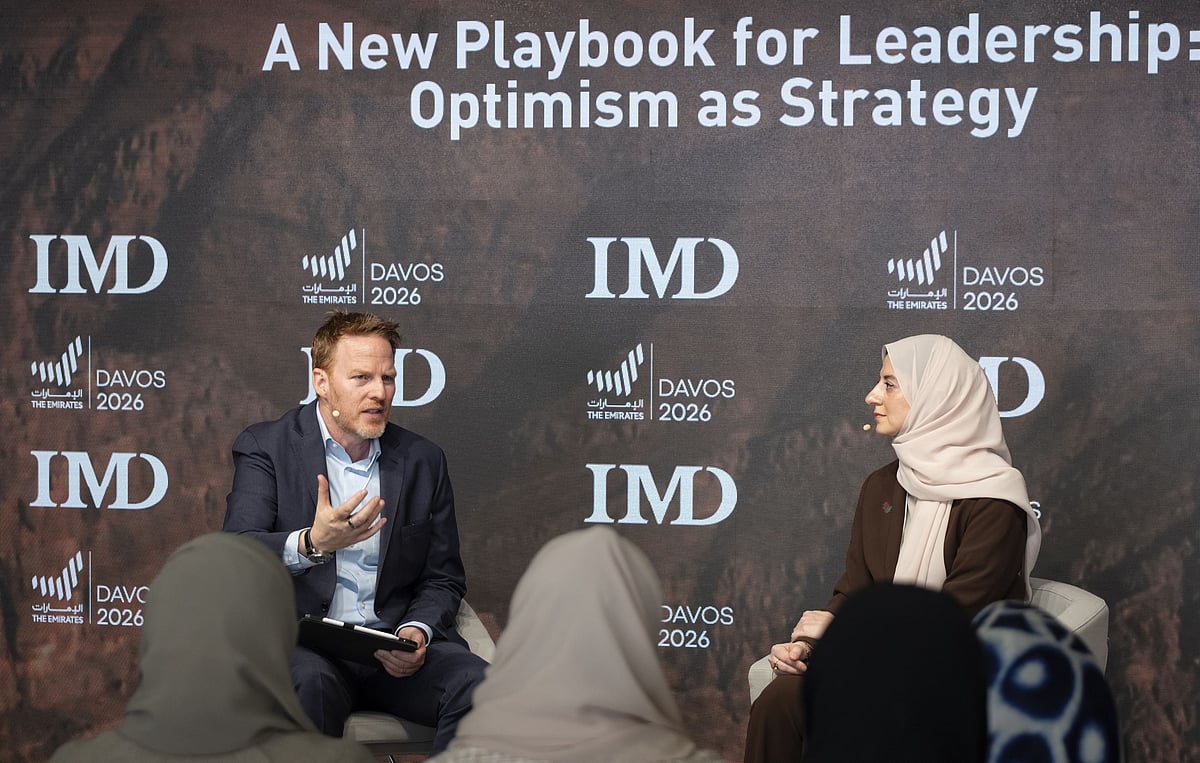
Davos: The World Economic Forum Annual Meeting 2026 hosted a high-level dialogue session titled “A New Playbook for Leadership: Optimism as Strategy”, which brought together global thought leaders to examine how realistic optimism can be transformed from a sentiment into a strategic leadership capability in an era characterised by sustained uncertainty and rapid global change.
The session featured Huda Al Hashimi, Deputy Minister for Cabinet Affairs for Strategic Affairs, and David Bach, President of the International Institute for Management Development and Nestlé Professor of Strategy and Political Economy. The discussion formed part of the UAE’s broader participation at the Forum, which focuses on future readiness, governance innovation, and strengthening long-term national competitiveness.
The dialogue addressed the current global landscape marked by geopolitical tensions, economic fragmentation, and accelerated technological change, noting that beyond these visible challenges lies a deeper and often overlooked issue: a growing scarcity of optimism in many societies. Participants explored how declining confidence in the future is influencing leadership behaviour, institutional decision-making, and societal momentum in various parts of the world.
David Bach highlighted that pessimism has become increasingly prevalent across several regions, contributing to declining levels of trust, reduced risk-taking, and slower innovation and investment. He noted that when uncertainty is met with hesitation rather than direction, it can become self-reinforcing, weakening institutional resilience and social cohesion.
In contrast, he emphasised that optimism, when grounded in realism rather than wishful thinking, serves as a catalyst for ambition, creativity, and long-term thinking, and plays a critical role in attracting talent, capital, and innovation at the national level.
The session examined the concept of “realistic optimism” as a leadership mindset that combines a clear-eyed understanding of risks with confidence in the ability to shape outcomes over time. Participants underscored that optimism does not imply the absence of challenges, but rather the presence of belief in purposeful action even when clarity is incomplete.
Huda Al Hashimi shared insights into the UAE’s leadership approach, highlighting how optimism has been deliberately embedded into governance systems, long-term strategies, and institutional frameworks. She noted that the UAE’s development journey has been guided by a forward-looking vision, proactive governance, and a readiness to act amid uncertainty, supported by agile policy tools, strategic intelligence, and continuous experimentation.
She emphasised that optimism becomes meaningful only when translated into action through institutions, policies, and measurable outcomes. She referred to the UAE’s long-term national visions, adaptive governance models, and sustained investment in future capabilities as examples of how confidence in the future has been operationalised, enabling the country to turn ambitious goals into tangible achievements across sectors such as clean energy, advanced technology, space exploration, and digital government.
The dialogue also explored the role of leadership in shaping emotional and strategic direction, noting that leaders play a decisive role in influencing collective confidence, as optimism and pessimism alike can quickly permeate organisations and societies. Participants highlighted the close link between leadership tone and psychological resilience, innovation capacity, and institutional momentum, stressing that vision provides alignment, purpose, and a sense of possibility during periods of uncertainty.
The discussion further addressed the challenge faced by many leaders who wait for certainty before acting, underscoring that clarity rarely arrives fully formed. Effective leadership, the session concluded, increasingly requires the ability to move forward with incomplete information while managing risk through strategic optionality, ecosystem readiness, and adaptive learning. In this context, optimism was framed as confidence in direction rather than certainty of outcomes.
The session concluded by reaffirming that optimism is not a soft concept, but a strategic asset when embedded into leadership practice, governance systems, and long-term planning. Participants emphasised that in a world where volatility has become a permanent feature, optimism must be disciplined, intentional, and action-oriented, enabling leaders to mobilise societies, sustain innovation, and shape the future with confidence and responsibility.
The dialogue reflects the UAE’s broader participation at the World Economic Forum 2026, where the country continues to contribute actively to global discussions on leadership, governance, and sustainable development, reinforcing its role as a forward-looking partner committed to building resilient economies and future-ready societies.
Sign up for the Daily Briefing
Get the latest news and updates straight to your inbox
Network Links
GN StoreDownload our app
© Al Nisr Publishing LLC 2026. All rights reserved.