Abu Dhabi boosts wildlife protection with new global partnership
EAD partners with IUCN to boost wildlife, nature and conservation efforts
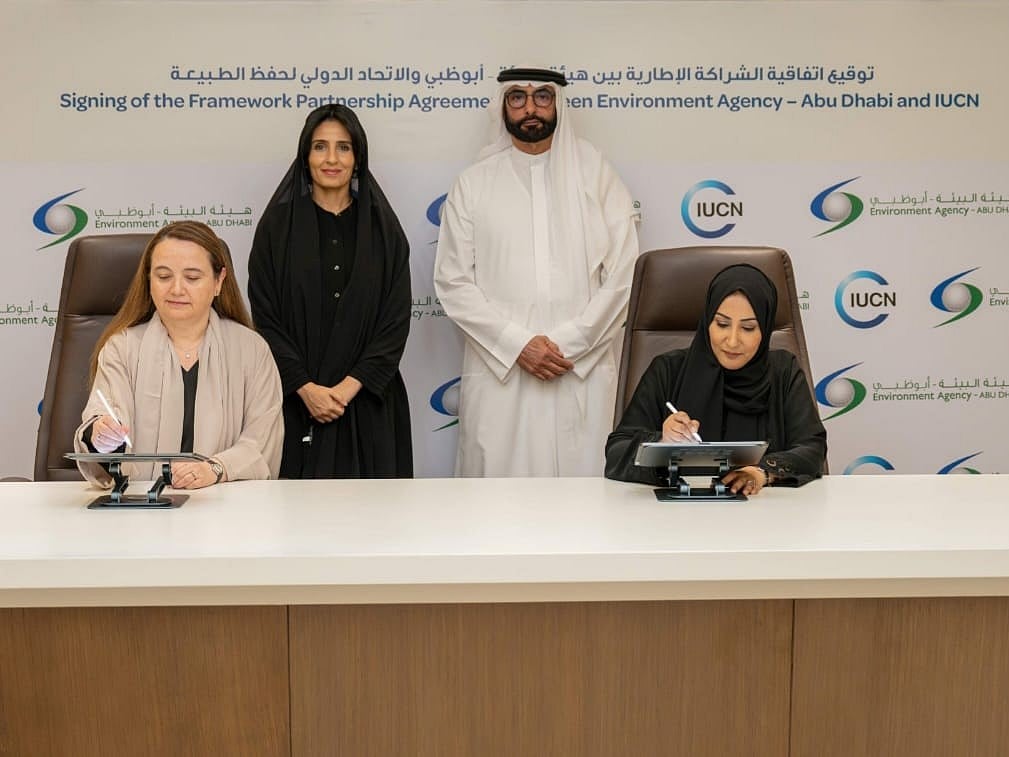
Under the directives of Sheikh Hamdan bin Zayed Al Nahyan, Ruler’s Representative in the Al Dhafra Region and Chairman of the Board of Directors of the Environment Agency – Abu Dhabi (EAD), the Environment Agency – Abu Dhabi has signed an institutional partnership agreement with the International Union for Conservation of Nature (IUCN), becoming the first organization in West Asia to establish this level of institutional collaboration with the Union.
The agreement marks the beginning of a new chapter in a partnership that has spanned nearly two decades, contributing significantly to the advancement of conservation science, the protection of endangered species, and the promotion of global environmental dialogue.
Get updated faster and for FREE: Download the Gulf News app now - simply click here.
The agreement was signed in the presence of Mohamed Ahmed Al Bowardi, Vice Chairman of the Board of Directors of the Environment Agency – Abu Dhabi, and Razan Khalifa Al Mubarak, President of the IUCN.
A history of success
Through this partnership, EAD will support the IUCN’s global conservation efforts, strategic priorities, and scientific programmes. Over the next four years, the Agency will contribute to international initiatives focused on biodiversity conservation, endangered species recovery, ecosystem protection, and sustainable development, transforming these priorities into long-term institutional commitments.
The Environment Agency – Abu Dhabi has been a member of the IUCN since 2012 and has collaborated extensively across a wide range of programmes through the Union’s global network.
Since 2008, EAD has hosted every meeting of the Chairs of the IUCN Species Survival Commission Specialist Groups—the Union’s largest scientific commission—strengthening ties between the two organizations and supporting the launch of major global initiatives, including the IUCN Red List of Threatened Species and the Abu Dhabi Red List of Ecosystems.
The Agency has also worked closely with the IUCN on identifying Key Biodiversity Areas and developing the National Strategy and Action Plan for Invasive Alien Species (2022–2026).
The agreement builds on the momentum generated by the IUCN World Conservation Congress for the Middle East, hosted in Abu Dhabi in October 2025, which brought together more than 10,000 participants from governments, civil society organizations, Indigenous peoples, the private sector, and academic institutions.
A direct response
EAD’s institutional partnership represents a direct response to Abu Dhabi’s Call for Nature Action, translating environmental ambition into a long-term commitment centred around five priority pillars: reaffirming nature as the foundation of human and planetary well-being; strengthening multilateralism, collective action, cooperation, and leadership; ensuring equity, inclusion, and broad societal participation; advancing science, knowledge, innovation, and education for action; and scaling and aligning resources in support of nature and climate objectives.
The partnership is rooted in more than five decades of environmental stewardship inspired by the vision and legacy of the UAE’s Founding Father, the late Sheikh Zayed bin Sultan Al Nahyan. His vision continues to shape Abu Dhabi’s leadership in conservation and sustainability. Today, 20 percent of the Emirate’s land and marine areas are protected through the Zayed Protected Areas Network, which includes 18 terrestrial and six marine protected areas.
Efforts to preserve rare animals
These conservation efforts have contributed to increasing the dugong (a rare marine mammal) population to more than 3,500 individuals and supporting approximately 8,000 sea turtles. More than 51 million mangrove seedlings have been planted across the Emirate.
Abu Dhabi has also played a leading role in one of the most significant species recovery success stories of modern times through the reintroduction of the Scimitar-horned Oryx in the Republic of Chad, helping move the species from the classification of “Extinct in the Wild” to “Endangered.”
Dr. Shaikha Salem Al Dhaheri, Secretary General of the Environment Agency – Abu Dhabi and Vice Chair of the Global Council for Sustainable Development Goal 14 (Life Below Water), said:
“The late Sheikh Zayed bin Sultan Al Nahyan established the principle that the environment is an integral part of our history, heritage, and future. This vision continues to guide the Agency’s work in science, policy, and conservation, while reflecting Abu Dhabi’s growing contribution to international environmental action.”
She added: “As we advance toward achieving the 2030 targets of the Global Biodiversity Framework, we are translating ambition into action. As an institutional partner, EAD will continue investing in sustainable, targeted programmes that turn commitments into measurable outcomes for biodiversity and ecosystems, benefiting future generations.
This partnership elevates our local and regional conservation priorities onto the IUCN’s global agenda, ensuring that our region’s unique perspectives help shape decisions that determine the future of nature.”
Razan Khalifa Al Mubarak, President of the IUCN, said: “Abu Dhabi’s institutional partnership with the IUCN reflects the UAE’s unwavering commitment to making nature conservation a central pillar of human development, prosperity, and planetary well-being.
This collaboration builds on the momentum generated by the World Conservation Congress in Abu Dhabi and underscores the growing role of the Environment Agency – Abu Dhabi as a key partner in advancing the Union’s mission and transforming global environmental ambitions into tangible outcomes for nature and future generations.”
Dr. Grethel Aguilar, Director General of the IUCN, said: “The Environment Agency – Abu Dhabi’s accession as an institutional partner of the IUCN marks a milestone for the region and a recognition of Abu Dhabi’s sustained contribution to the Union’s mission.
The Agency brings scientific expertise, regional leadership, and a proven track record in addressing one of the world’s most urgent challenges—protecting nature at the scale and speed required. We are delighted to welcome EAD as our first institutional partner from West Asia and look forward to working together to deliver lasting benefits for both people and nature.”
Network Links
GN StoreDownload our app
© Al Nisr Publishing LLC 2026. All rights reserved.