Abu Dhabi’s Fish AI Project pushes Sustainable Fisheries Index to 100%
Fish AI provides real-time, data-driven insights into species composition and biomass
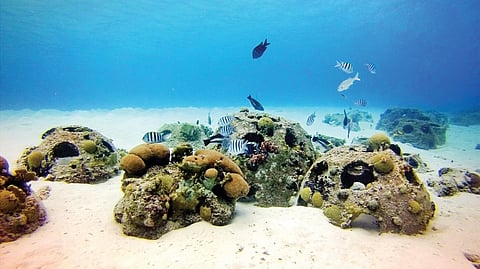
The Environment Agency – Abu Dhabi (EAD) has launched the “Fish AI” project under the Abu Dhabi X for Nature initiative, marking a qualitative leap in the monitoring of marine resources and the management of fisheries through the deployment of artificial intelligence. The project has transformed traditional fish stock assessments into a smart, data-driven process that takes only minutes. In a landmark global achievement, EAD recorded an unprecedented rise in the Sustainable Fisheries Index, reaching 100% by the end of 2025, the highest level achieved worldwide.
As part of the Abu Dhabi X for Nature initiative, the “Fish AI” project represents a paradigm shift in fisheries monitoring and management by leveraging AI technologies to replace conventional, time-consuming counting methods with an intelligent system capable of delivering results within minutes.
The system enables the instant and highly accurate identification of fish species, classifications, sizes, weights, and quantities. Fishermen simply place their catch on a designated table, where the application completes the scanning process in approximately five minutes before transmitting the data to a dedicated platform to update fisheries indicators. This innovation serves as an advanced alternative to traditional practices that required enumerators to arrive at landing sites before dawn and spend hours manually recording data.
Real-time insights driven by accurate data
EAD explained that Fish AI provides real-time, data-driven insights into species composition and biomass, significantly enhancing decision-making and fisheries policy formulation. The system also improves the efficiency of scientific data collection related to fish stocks, supports the development of sustainable recovery programs, and strengthens efforts to protect marine biodiversity.
The project constitutes a key pillar of the Abu Dhabi X for Nature initiative, launched by EAD in collaboration with the Advanced Technology Research Council. The initiative aims to harness technology and artificial intelligence to enhance species and habitat conservation, develop innovative environmental solutions, and reinforce Abu Dhabi’s position as a global leader in environmental action.
Monitoring ecosystems and attracting sustainable investment
The initiative focuses on deploying advanced technologies to monitor ecosystems, attract sustainable investment, and create innovative solutions to address local and global environmental challenges. This step aligns with EAD’s comprehensive efforts to restore fish stocks, including regulating fishing gear, controlling recreational fishing activities, establishing six marine reserves within the Zayed Network of Nature Reserves, supporting sustainable aquaculture, coral restoration, and deploying artificial reefs under the Abu Dhabi Coral Gardens initiative.
Major achievements
The Environment Agency – Abu Dhabi has achieved notable milestones, recording continuous growth in the Sustainable Fisheries Index for the sixth consecutive year—from 8.9% in 2018 to 97.4% by the end of 2024—reinforcing Abu Dhabi’s regional and global leadership in sustainable fisheries management and underscoring the tangible impact of advanced technologies in protecting marine ecosystems and ensuring the sustainability of their resources.
100% sustainable fisheries index
EAD achieved an unprecedented rise in the Sustainable Fisheries Index, reaching 100% by the end of 2025, compared to just 8% in 2018, marking one of the most significant achievements globally. These results reflect Abu Dhabi’s success in restoring balance to its marine resources through the application of rigorous scientific policies, effective habitat protection, and the development of a sustainable framework that enhances fish stock abundance.
This rapid progress demonstrates the strength of Abu Dhabi’s environmental governance model and its ability to rebuild fish stocks in line with the highest international standards.
Sheikh Hamdan bin Zayed Al Nahyan, Ruler’s Representative in Al Dhafra Region and Chairman of the Board of the Environment Agency – Abu Dhabi, affirmed that this achievement reflects the strong support provided to the Agency by Sheikh Mohamed bin Zayed Al Nahyan, President of the UAE, and is guided by the directives of Sheikh Mansour bin Zayed Al Nahyan, Vice President, Deputy Prime Minister, and Chairman of the Presidential Court.
Fish stock monitoring
Sheikh Hamdan bin Zayed Al Nahyan noted that this achievement is the result of an integrated research and development project supported by the Presidential Court, through which advanced scientific methodologies were developed to monitor fish stocks and analyze marine ecosystems. The project leverages big data and modern technologies to support policies and legislation, driven by a commitment to the sustainability of natural resources as a cornerstone of comprehensive national security. He emphasized that protecting marine wealth is not merely an environmental obligation, but a national strategy to enhance food security and reduce reliance on imports.
Sheikh Hamdan further stated that the accelerated rise in the Sustainable Fisheries Index reflects the success of the strategic approach adopted by the Emirate in managing its marine resources, adding:
“What has been achieved over recent years is the result of a vision grounded in knowledge, innovation, and the regulation of marine practices—preserving the balance of the sea and ensuring the sustainability of its resources for future generations.”
A global model for marine wealth management
Mohamed bin Ahmed Al Bowardi, Vice Chairman of the Board of the Environment Agency – Abu Dhabi, stated that the significant leap in the Sustainable Fisheries Index is part of an integrated system of legislation, policies, and scientific measures that contributed to rebuilding fish stocks within a relatively short period compared to global benchmarks. He noted that this improvement reflects precision in planning and strength in execution, reinforcing the responsible use of marine resources as a fundamental component of long-term sustainability and community well-being.
Dr. Shaikha Salem Al Dhaheri, Secretary General of the Environment Agency – Abu Dhabi, described achieving a 100% Sustainable Fisheries Index as “a historic transformation and a global model for marine resource management.” She emphasized that the achievement is the result of a unique national partnership that brought together the Agency, the National Guard, fishermen’s associations, and the wider community—turning a challenge into a globally recognized success story grounded in scientific data.
She added: “We have transitioned from a phase of protection to a phase of prosperity, thanks to the trust placed in us by our leadership and the commitment demonstrated by our partners. Our role is not limited to protecting the sea—we are rebuilding it faster and stronger.”
She noted that this milestone marks “only the beginning of a longer journey,” driven by the new Sustainable Fisheries Policy and advanced technologies such as artificial intelligence and the research vessel Jayoun.
Artificial Intelligence and smart systems for monitoring fishing effort and environmental data
The Environment Agency – Abu Dhabi continues to enhance the protection of productive marine habitats through an integrated portfolio of projects aimed at increasing marine productivity and restoring ecological balance. These efforts include rehabilitating natural habitats, restoring ecosystems, implementing extensive biodiversity enhancement programs, expanding the Abu Dhabi Coral Gardens, and deploying 40,000 artificial reef structures to create fish-attracting environments.
In parallel, the Agency is strengthening its regulatory and monitoring framework through AI-powered and smart systems to track fishing effort and environmental data, supported by the advanced capabilities of the research vessel Jayoun, which provides precise scientific data to inform decision-making.
EAD relies on an extensive network of monitoring and analysis programs, along with strengthened collaboration with partners, fishermen, volunteers, and community members, who play a vital role in safeguarding fish stocks and ensuring their sustainability.
Advanced program to release fish fingerlings
In the same context, the Abu Al Abyad Island Management continues to implement an advanced program to release fish fingerlings produced in its specialized facilities—an initiative that directly contributes to rebuilding marine wealth. The program compensates for losses caused by natural pressures and fishing by releasing fingerlings raised in controlled, healthy environments, enhancing their ability to adapt, grow, and reproduce in the wild.
These combined efforts support biodiversity, restore damaged marine habitats, and reinforce sustainable fisheries, strengthening environmental protection and long-term sustainability.
Through these data-driven policies, strategic partnerships, and advanced technologies, Abu Dhabi continues to consolidate its position as a global benchmark for the sustainable management of natural resources, ensuring ongoing recovery and the realization of the Emirate’s vision for a resilient and self-renewing marine ecosystem that benefits society and future generations.


