From left to right: Moderator Lachlan Kitchen; Tariro Masukume, Education Relationships Lead, ACCA; Prof. Gisela Loehlein, Academic Director, De Montfort University Dubai; Ebru Goksu Yildirim, Executive, Leadership and Team Coach, Facilitator & Trainer, London Business School; Dr. Salma Soliman, Assistant Professor in Management, Heriot-Watt University Dubai; and Dr. Jamid Ul Islam, Associate Professor, Canadian University Dubai
Want a promotion? Here’s what UAE career experts say you need
Experts say moving up the career ladder requires more than years of experience
Last updated:
5 MIN READ
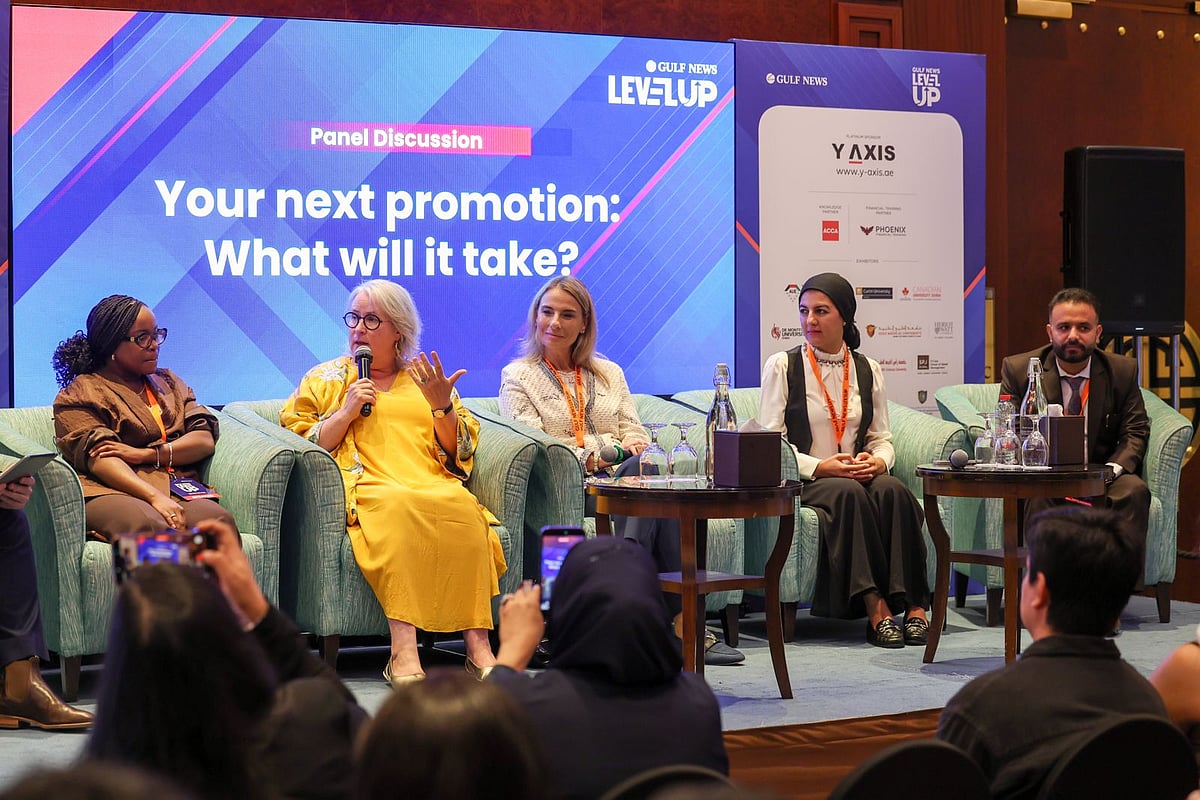
From left to right: Tariro Masukume, Education Relationships Lead, ACCA; Prof. Gisela Loehlein, Academic Director, De Montfort University Dubai; Ebru Goksu Yildirim, Executive, Leadership and Team Coach, Facilitator & Trainer, London Business School; Dr. Salma Soliman, Assistant Professor in Management, Heriot-Watt University Dubai; and Dr. Jamid Ul Islam, Associate Professor, Canadian University Dubai
Virendra Saklani / Gulf News
Dubai: What does it really take to get promoted? For professionals looking to move into their next role, having more years of experience may not be enough.
Career and education experts have noted that promotion readiness increasingly involves demonstrating impact, developing new capabilities, building leadership skills, and understanding what the organisation needs.
These issues have been discussed during a panel titled “Your next promotion: What will it take?” during the inaugural Gulf News LevelUP held at Dusit Thani Dubai.
Get updated faster and for FREE: Download the Gulf News app now - simply click here.
It’s about the impact you make
Tariro Masukume, education relationships lead at the Association of Chartered Certified Accountants, has bared that professionals preparing for promotion should look beyond what they know and consider the impact they have within their organisation.
“Being ready for a promotion is about doing the internal work. The question you should be asking is what does impact look like within the company that you're working in,” shared Masukume.
For her, knowledge is only part of the equation.
“It’s not just what you know, it’s being able to empower others to know what you know.”
Tariro Masukume, education relationships lead at the Association of Chartered Certified Accountants
Keep building new skills
Professor Gisela Loehlein, academic director at De Montfort University Dubai, has stressed the importance of continuous learning as professionals progress in their careers.
“You should constantly skill up. The market now is incredibly flexed, volatile, and demanding,” described Loehlein.
For some, that may mean obtaining a degree or an additional degree, while for others it could mean targeted upskilling. Loehlein’s advice is to keep adding new learning to your professional profile.
“If you can’t add something new in your CV every six months, you’re not going to learn anything new, you’re just treading the waters.”
Professor Gisela Loehlein, academic director at De Montfort University Dubai
Don’t automatically pursue another degree
While qualifications can support career progression, Dr. Jamid Ul Islam, associate professor at Canadian University Dubai, has mentioned that professionals should first identify what their next role actually requires.
“MBAs can give you a broader understanding of the business but sometimes what you need is a more targeted learning,” explained Islam.
As opposed to simply asking what degree to pursue next, professionals should be able to “fill those capability gaps.”
“Rather than asking what’s the next degree shall I pursue, I would ask what capabilities and qualifications does my next role expect from me that I don’t currently own.”
Dr. Jamid Ul Islam, associate professor at Canadian University Dubai
Moving from expertise to leadership
According to Dr. Salma Soliman, assistant professor in management at Heriot-Watt University Dubai, professionals need to develop a different set of skills as they move higher up the career ladder.
“You need to be focused on certain skills and expertise as you move up the ladder and when you gain more skills in preparing yourself in leadership positions,” remarked Soliman.
Her approach is to build expertise first and then diversify. The key question has been about the contribution a professional can make.
“It’s the impact that you can make. We need to look for what’s good for the organisation.”
Dr. Salma Soliman, assistant professor in management at Heriot-Watt University Dubai
Leadership begins with self-awareness
On the other hand, Ebru Goksu Yildirim, executive, leadership and team coach, facilitator, and trainer at London Business School, has highlighted that professionals also need to understand themselves before taking on greater responsibility.
“The main focus is first of all who the leader is, whether they can manage themselves before other projects,” stated Yildirim.
She has revealed that it takes five to seven years to really strengthen leadership capabilities, emphasising the need for professionals to invest consistently in their development.
Ebru Goksu Yildirim, executive, leadership and team coach, facilitator, and trainer at London Business School
Yildirim has used the image of a tree to describe career development, with professionals needing strong roots while continuing to branch out by developing leadership skills.
“In challenging times, when there are recessions happening, it's time for us to look at different perspectives. It's important to know who we are and what we're passionate about, but also how we can grow and invest in ourselves.”
Visibility matters
As professionals progress towards leadership roles, Yildirim has also underscored the importance of visibility.
“We need to become visible as leaders. Visibility is a decision driver that we need to make peace with,” exclaimed Yildirim.
For professionals, this means that developing skills and capabilities needs to be accompanied by an ability to demonstrate those capabilities and make their contribution visible.
Your value changes as you move up
Meanwhile, Islam has noted that one of the most important changes that comes with career progression is how a professional’s contribution is measured.
“The unit of contribution changes. Your value should migrate from your individual performance to the organisation’s leverage,” said Islam.
He has added that an individual’s value is not judged only by how well they perform their own job, but also by how well they can align people.
Visitors listening to experts during a panel discussion on the first day of Gulf News LevelUP at Dusit Thani Dubai on Sheikh Zayed Road
The promotion starts before the promotion
For professionals in the UAE considering their next career move, the panel’s message was that preparation needs to begin before the opportunity arises.
That preparation can involve strengthening specialist expertise, identifying capability gaps, developing leadership skills, seeking feedback, becoming more visible, and understanding the needs of the wider organisation.
The experts have also shared that there is no single qualification or fixed career path that guarantees progression. Instead, professionals need to understand what their next role requires and identify what they need to develop to be ready for it.
Network Links
GN StoreAbout Gulf NewsTerms & ConditionsReach by GNSitemapContact usPrivacy PolicyGN FocusHave your sayWork with usAdvertise with usGulf News epaperPrinting Services
Download our app
© Al Nisr Publishing LLC 2026. All rights reserved.