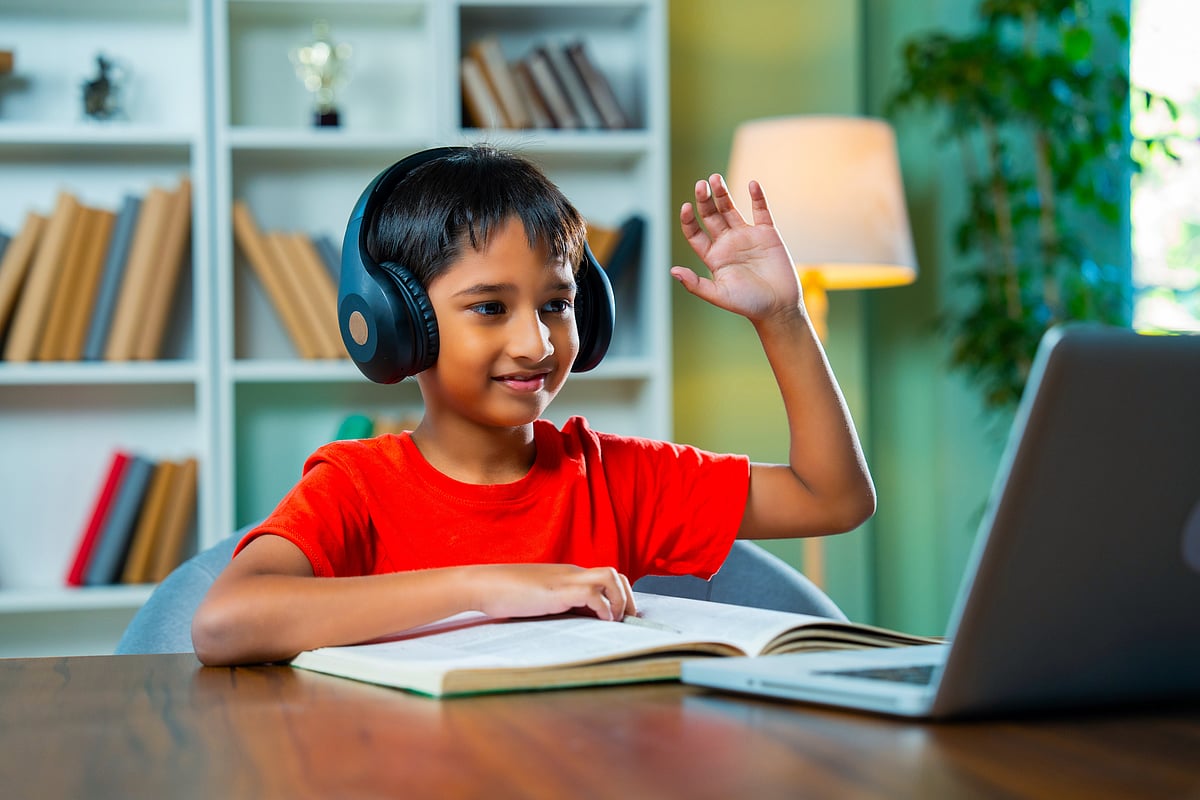
Dubai: It has been a daily test of balance, patience and emotional endurance, but UAE parents are determined to push through, with a little help from leaning on each other.
The world of early morning meetings, school log-ins, deadlines and domestic routines continue, while one part of the house is also transformed into a classroom and office. And while systems have improved since the early days of remote learning, the emotional weight of managing both roles has not entirely eased.
For instance, Dubai-based Larissa Smit, whose son is in nursery, is grateful for the parent community that comes together in such times. “My son attends pod learning sessions with Little Land Nursery and Montessori at Gymboree. They have supplied us with amazing activity kits at home as well. We also have a community WhatsApp group that supports us with questions and concerns, a weekly parenting support workshop to help.”
Apart from this, they go to the park with friend, three times a week for playdates.
Across the UAE, many parents have found different ways to manage distance learning as well as their own professions.
‘On different sides of the same boat’: The working parent reality
For Dr. Aseel A. Takshe, Acting Dean at the School of Health Sciences & Psychology at Canadian University Dubai, the experience has been a ‘humbling’ one, as she says. “I’ve come to realize that beyond schedules and structure, what truly matters is presence, being there, even when everything feels like it’s happening at once. It did remind me of COVID.”
Building structure in the chaos of home learning
In her home, mornings are intentionally slow and structured, an attempt attempt to create stability before the day accelerates. She aims to give her son’s day a sense of normalcy: The day starts quietly, before the grind begins. “We would have prepared a night before the material needed for our forthcoming classes and ensure he is aware of his school schedule for the day. At the same time, sometimes I sit nearby with my own work, and there’s something comforting about that silent partnership, we’re both ‘showing up’ for our responsibilities together. It’s not always perfect, but it feels grounding,” she says.
The ’silent partnership’ becomes a recurring theme throughout the day, two parallel worlds unfolding in the same space.
Get updated faster and for FREE: Download the Gulf News app now - simply click here.
The hardest hour: when work and parenting collide
The hardest part of the day, is often the middle. When work intensifies, meetings stack up and he might need help. These moments are overwhelming, and there’s a guilt that comes with being pulled in two different directions. “I’ve had to learn to be kinder to myself in those moments, to accept that I can’t always give 100% to everything at the same time, and that’s okay.”
Rather than striving for rigidity, she has learned to adapt her parenting style to the unpredictability of the situation. She doesn’t opt for stringent and rigid rules or expectations. “Flexibility has become essential because his well-being comes first. I pay closer attention to how he’s feeling, not just how he’s performing,” she says.
Yet, there are moments to celebrate, regardless of how small they are. Sometimes, it’s something as simple as completing an assignment.
Finding strength in shared experience and parent communities
If the individual experience is marked by adaptation, what makes it manageable is the presence of community. For Dr. Aseel, connection with other parents has become an essential form of support. She knows that she isn’t alone, and that’s the solace. “I’ve built connections with other parents, and those conversations have been a lifeline. Sometimes we exchange practical advice, but often it’s just about listening and saying, ‘I understand.” That shared empathy carries a lot of weight.”
This collective understanding extends beyond individual friendships, into wider school networks and parent groups. “I’ve also found comfort in the sense of community around me here in Abu Dhabi. Through school groups, there’s always someone willing to share a tip, recommend a resource, or simply check in. It reminds me that while each family’s experience is unique, we are all navigating similar emotions,” she says.
Juggling between emails and homework
Similarly, Aida Ghazal, Marketing and Communications Manager at Rochester Institute of Technology Dubai, highlights the operational side of the same reality, constant switching between roles, tasks and expectations. “I think we have all been trained since covid days on how to handle online learning and online work at the same time,” she says.
As Ghazal notes, her child is at an age where she needs constant monitoring and help. “At the beginning of online learning she was struggling with uploading work or editing a google document, and so I had to stay around her while I have my laptop open trying to juggle between emails, my work and her work.”
Communication, rhythm and independence
Nevertheless, as the days passed, the rhythm was set and she needed less attention. “It gets challenging when I have online meetings or calls, and this is when I would brief her that I would be away for a while, in the meanwhile, she has to finish whatever is due,” adds Ghazal.
So communication was the key here, as well as setting expectations.
The power of parent networks
As Ghazal notes, there has been a school WhatsApp community to help out, answer questions, offer good reads and even ideas for children activities. “Seeing other parents going through the same and trying to help them out creates a sense of belonging and help ease the feeling of loneliness – that I am going through this alone,” she says.
'I need to maintain a constant state of vigilance'
For Sammar Shabir, author, entrepreneur and certified professional life coach, the transition has been easier thanks to one key advantage: flexibility. But even with adaptable work hours, she says the real challenge is rhythm.
“I’m fortunate to have flexible work hours, which makes long-distance learning easier to manage,” she explains. “At this stage, both my children are old enough to handle their online classes independently, so I don’t need to sit with them. However, I maintain a level of vigilance so they know a parent is around.”
That 'light supervision,' she adds, has become necessary to keep children accountable, especially when distractions creep in. “We’ve had a few incidents of switching between classes and gaming, so that helps keep them on track.”
While children attend online classes, Sammar works from home. However, she says the real obstacle is, when learning and leisure start to blur.
“The bigger challenge is the extended screen time,” she says. “As so much of their day is already spent online, their usual leisure screen time needs to be reduced. Simply telling them doesn’t work.”
Instead, she builds in offline breaks through more active routines. “We’ve been spending more time at the park, doubling up on sports and physical activities, and encouraging them to contribute more at home.”
Sammar has also added purpose-driven activities, including helping re-home abandoned pets. “Since the recent situation, there have been so many cases. It’s been a meaningful way to keep the kids engaged, active, and aware, while maintaining balance.”
However, unlike structured school hours, the emotional weight of the day doesn’t follow a timetable. For Sammar, the continuous overlap of roles turns a little strenuous. "Staying emotionally available means I shift my work to early mornings and late nights.”
It’s a structure that functions, but leaves little space for pause. “Having the kids around all day without a real break can be overstimulating. The day becomes a cycle of working early, being present with them during the day, and then returning to work at night.”
Nevertheless, while the demands are high, Sammar says she has not had to navigate them alone. Recently relocated to Dubai, she has found support in both familiar relationships and new connections.
“I’ve been fortunate to meet parents across different circles, including coaches, authors, and people I’ve connected with along the way,” she says. “My sister and sister-in-law also live nearby and have children, which gives me an additional layer of support.”
Like many parents, she relies on quick exchanges and informal check-ins to stay grounded. “I regularly reach out to friends and family who are also parents to exchange tips, share frustrations, and ease the anxiety that comes with it all, often through lighthearted banter.”
Keeping children grounded: How schools and parents can help
For Ami Shah, CEO and co-founder of Peekapak Wellbeing Education, structure and emotional safety are the cornerstones of effective remote learning. Her platform offers short, engaging wellbeing experiences designed to help students manage stress, build self-awareness, and stay connected, both to their learning and to one another.
Peekapak is an edtech platform delivering social and emotional learning for KG to Grade 12, with curriculum, educator training, and family resources available in English and Arabic.
In response to mounting pressures on school communities, Peekapak has opened free access to its full KG–Grade 12 wellbeing platform. This includes ready-to-use lessons, multilingual student activities, and quick wellbeing check-ins suitable for classrooms and home environments alike.
"These are not one-off activities," Shah explains. "They offer a structured, research-backed, and culturally relevant approach to building skills like emotional regulation, empathy, and resilience." Families are supported too, through resources such as the Steady, Together lesson series — designed to help parents and caregivers guide children through periods of change and uncertainty.
Peekapak's impact in the region has been recognised formally: the platform was selected by Abu Dhabi's Early Childhood Authority Anjal Z programme as one of six global innovations, and has since partnered with schools and education leaders across all seven emirates. "Ultimately, this initiative removes barriers and provides meaningful support," Shah adds, "helping school communities feel more connected and grounded during uncertain times."
What businesses must do differently
The UAE's Year of the Family is a strategic signal, not merely a social one, and for organisations, it represents a clear call to lead with intention rather than simply tick boxes for compliance.
Nandini N Navaseelan, Director and Founder of Pathwayz Solutionz, argues that businesses must fundamentally rethink how performance is measured. "Redefine expectations around KPIs, delivery, and timelines, not visibility," she says. Digital performance management tools allow leaders to track progress and maintain accountability without defaulting to presenteeism.
Flexible working arrangements, staggered hours, shift-based models, and remote options where feasible - must be deliberately designed and clearly communicated, rather than left to improvisation. "Technology enables this at scale," Navaseelan notes, "ensuring consistency across teams and geographies."
Crucially, flexibility must be paired with shared accountability. Line managers play a pivotal role in rebalancing workloads and modelling the behaviours they expect from their teams, whilst employees remain responsible for disciplined execution.
"When these principles are embedded in how work is designed," Navaseelan concludes, "organisations create conditions where performance is not compromised by family responsibility — it is strengthened by it."
Network Links
GN StoreDownload our app
© Al Nisr Publishing LLC 2026. All rights reserved.