The municipality prohibits eateries from serving the liquid collected in the tray under the grill, often described as “chutney," as it contains risk of bacterial contamination
Dubai sets Guinness record to stop unsafe rotisserie practices: Is your grilled chicken safe?
Municipality wants you to report prohibited practices involving dripping juice and gravy
Last updated:
5 MIN READ
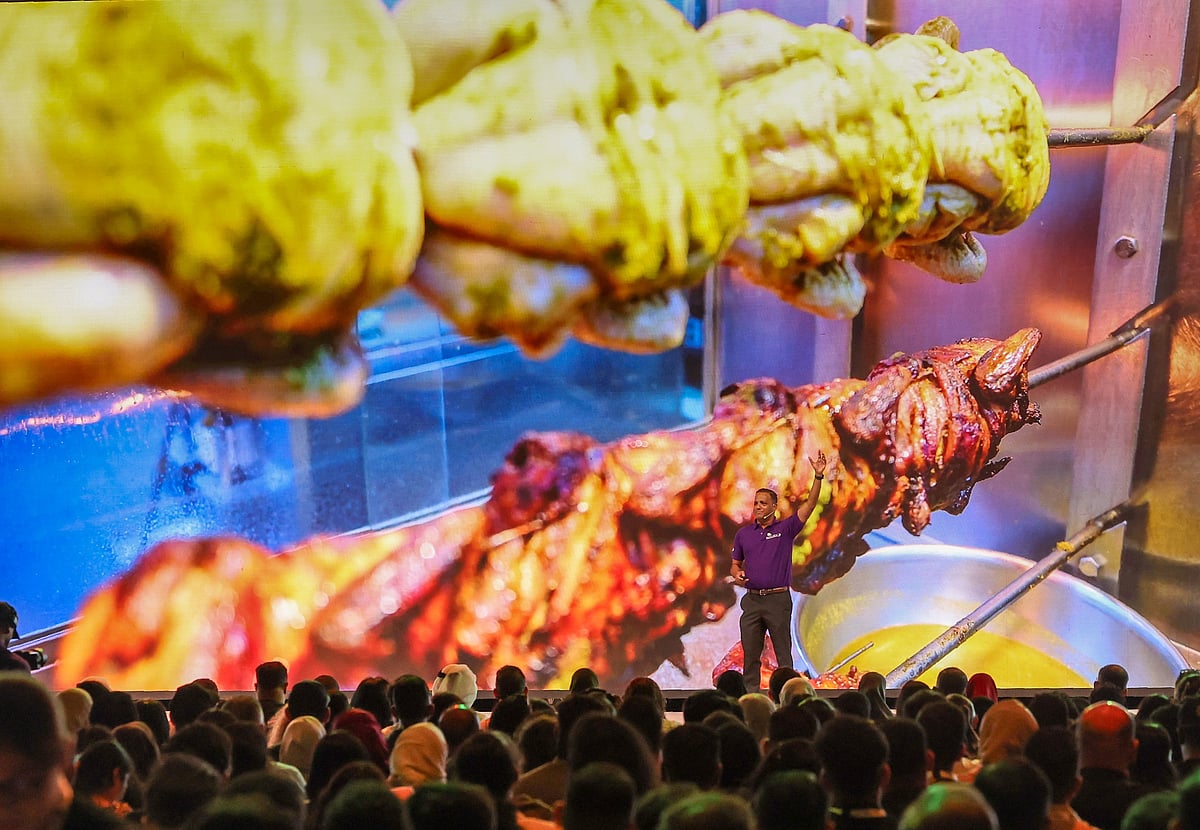
Bobby Krishna conducts the Grill Safe session that set two Guinness World Records to raise awareness about safe rotisserie grilling practices at the 20th Dubai International Food Safety Conference on Tuesday
Virendra Saklani/Gulf News
Dubai: The grilled chicken on your plate may look perfectly cooked and appetising, but what happens behind the rotisserie could tell a different story.
From juices dripping from raw chicken onto cooked portions to restaurants serving liquid collected from grilling machines, unsafe handling can turn a favourite meal into a potential health risk. Dubai Municipality has now taken its message to the world stage, setting a Guinness World Records title while training food handlers on how to grill chicken safely and prevent food poisoning.
The record for the “Largest Food Safety Lesson” was set on Tuesday, November 17, at the Dubai World Trade Centre, during the 20th Dubai International Food Safety Conference.
The Food Safety Department's "Grill Safe" session set two records: One for the largest number of people learning a food safety lesson together and the second one for the most nationalities in a food safety lesson.
Raafat Tawfik, Official Adjudicator of Guinness World Records conferred the records.
Get updated faster and for FREE: Download the Gulf News app now - simply click here.
The training focused on chefs and Persons in Charge (PICs) working in restaurants, cafeterias and supermarkets that sell grilled chicken, along with outlet managers.
Hidden dangers
The initiative followed several unsafe practices the department has observed in outlets operating rotisserie grills, said Bobby Krishna, Principal Food Safety Specialist at the department and a member of the International Commission on Microbiological Specifications for Foods (ICMSF), who conducted the training session.
The first is the collection and serving of gravy or juices that drip from chicken during grilling, an unsafe practice that has become popular among several Dubai cafeterias and restaurants in the past couple of years, Bobby said.
This liquid collected in the tray under the grill is often described as “chutney." It can contain juice dripping from raw chicken and may not be cooked adequately, creating a risk of bacterial contamination. To prevent cross-contamination, Dubai Municipality prohibits serving gravy or juices collected from rotisserie grills.
The second is placing raw, whole chicken above partially cooked or cooked chicken in rotisserie machines. Juices dripping from the raw birds can contaminate the cooked ones below.
The third involves leftovers which can compromise safety. When a customer orders half a chicken, the remaining half is sometimes put back inside the rotisserie machine, often on the bottom tray with the risky gravy, instead of being moved to an appropriate temperature-controlled holding facility.
While these practices may not make people ill every time, the department says they create risks that can go unnoticed, and repeated exposure can have consequences for consumer health and the reputation of Dubai’s safe food culture.
Silent risk
Bobby said the problem is hard to spot because contamination is rarely visible.
The municipality's disease surveillance system receives information directly from hospitals about foodborne illnesses. According to figures presented during the training, Salmonella accounts for approximately 600 confirmed cases a year. The real number may be higher, as many visitors who fall ill after returning home never report it here.
Symptoms of bacterial infections can also take 24 to 72 hours to appear, so people often fail to link their illness to a meal eaten days earlier.
Bobby stressed that cooking is not the end of food safety. Handling, storage, cleaning and supervision all matter once the chicken is cooked.
Bobby Krishna, Principal Food Safety Specialist at Dubai Municipality, who conducted the record-setting session aimed at stopping unsafe rotisserie grilling practices in Dubai
Commercial pressure
He said business pressure often keeps unsafe habits alive. He described a restaurant that was told to stop serving collected gravy, only for its owner to say customers were drifting to a neighbouring eatery that still offered it.
He compared the spread of bad habits to littering. Once one person drops rubbish somewhere, others tend to follow, and unsafe practices can become normal in the same way.
He warned that a single incident can damage confidence in Dubai's wider hospitality industry. A tourist who falls ill may share the experience with friends, family and followers on social media.
"When you have food poisoning in your facility, you're not just losing your customers. You're also making others lose their customers," he pointed out.
Associated risks
Kitchen design also plays a part. Restaurants need enough space and the right equipment to keep raw and cooked chicken apart, with food safety planned alongside the menu. Bobby cited a Walmart example, where rotisserie equipment was redesigned so raw chicken is loaded from one side while cooked chicken is removed from the other.
He also said that "just because nothing has happened for months does not mean you can continue an unsafe practice". He was referring to an outbreak investigation at a restaurant that served garlic paste with mandi rice. Its manager knew pasteurised eggs should be used, but the business had switched to ordinary eggs after months without a problem.
Managers, he added, must keep training and supervising staff, especially new recruits, rather than treating training as a one-off exercise.
Dr Naseem Mohammed Rafee, acting CEO of the Environment, Health and Safety Agency at Dubai Municipality receives the Guinness World Record certificate along with members of the Food Safety Department
Speak up
The department stressed that the aim is not to discourage restaurants from serving rotisserie chicken. It wants businesses to keep offering the popular dish while protecting consumers. "You have to make sure that you stay competitive, keep your taste good and also make sure that the food is safe."
The record is also meant to carry that message to diners, who may assume grilled chicken is automatically safe because it has been cooked.
Consumers have a role too. They are urged to tell family and friends about the dangers of gravy and dripping juices collected from rotisserie grills. Dubai Municipality wants the customers to raise concerns with restaurant management if they see raw chicken handled above cooked chicken, unsafe chutney or gravy is served and report suspected violations to its toll-free call centre on 800900.
Need for behavioural changes
Dubai-based RJ and Malayalam actor Mithun Ramesh, who attended the event to support the initiative and spread awareness, stressed the need for behavioural changes among both food businesses and consumers to improve food safety, particularly when it comes to grilled chicken.
“As highlighted in the session, consumer demand for the gravy encourages some businesses to serve it despite the potential risks. Consumers, too, need to change their behaviour and give food safety as much importance as they give taste,” he said.
Neethu Pratheep, a food hygiene officer in Dubai, described the initiative as an effective way to communicate food safety risks through practical demonstrations.
“The session was particularly valuable because several food handlers and PICs can understand risks better when they see them demonstrated visually. Despite repeated training and instructions, visual demonstrations can make a stronger impact, especially when highlighting risks associated with chicken drippings, raw eggs in garlic paste or mayonnaise, and vegetables served alongside grilled chicken,” she said.
Goldeena Philipson, Quality Assurance Manager at Alabbar Enterprises, who attended the event with more than 80 colleagues, said: “Although we do not serve rotisserie chicken, food safety is everyone's responsibility. People of all ages, including children, pregnant women, the elderly and those with underlying health conditions, consume grilled chicken. We want our employees to understand the risks and make informed choices about the food they eat, even outside the workplace and spread the message to their families,” she said.
Network Links
GN StoreAbout Gulf NewsTerms & ConditionsReach by GNSitemapContact usPrivacy PolicyGN FocusHave your sayWork with usAdvertise with usGulf News epaperPrinting Services
Download our app
© Al Nisr Publishing LLC 2026. All rights reserved.