Sharjah Police bust 4 global crime networks, uncover Dh8.8 billion money laundering
Operation leads to 33 suspects and seizure of Dh200 million in funds
Sharjah: Sharjah Police have dismantled four interconnected international criminal networks involved in cyberattacks, digital wallet theft, money laundering, online fraud, extortion and violent assaults, arresting 33 suspects from 12 nationalities and securing assets belonging to more than 30 companies and institutions worldwide valued at over Dh65 billion.
The operation, codenamed ‘End of the Battle’, was conducted in cooperation with the Ministry of Interior and involved coordinated efforts to track down and arrest the networks’ leaders, including suspects apprehended abroad and brought back to face justice.
Get updated faster and for FREE: Download the Gulf News app now - simply click here.
Authorities seized more than Dh200 million in funds, froze or secured assets linked to the suspects and subjected more than 3,000 digital wallets to auditing and verification. Investigations also uncovered money laundering transactions worth Dh8.825 billion, carried out through bank accounts, digital wallets, international platforms and intermediary companies.
The networks allegedly used artificial intelligence tools to support phishing and fraud schemes, traded compromised data on the dark web and laundered criminal proceeds through virtual assets before investing the money in property, luxury cars, watches and jewellery.
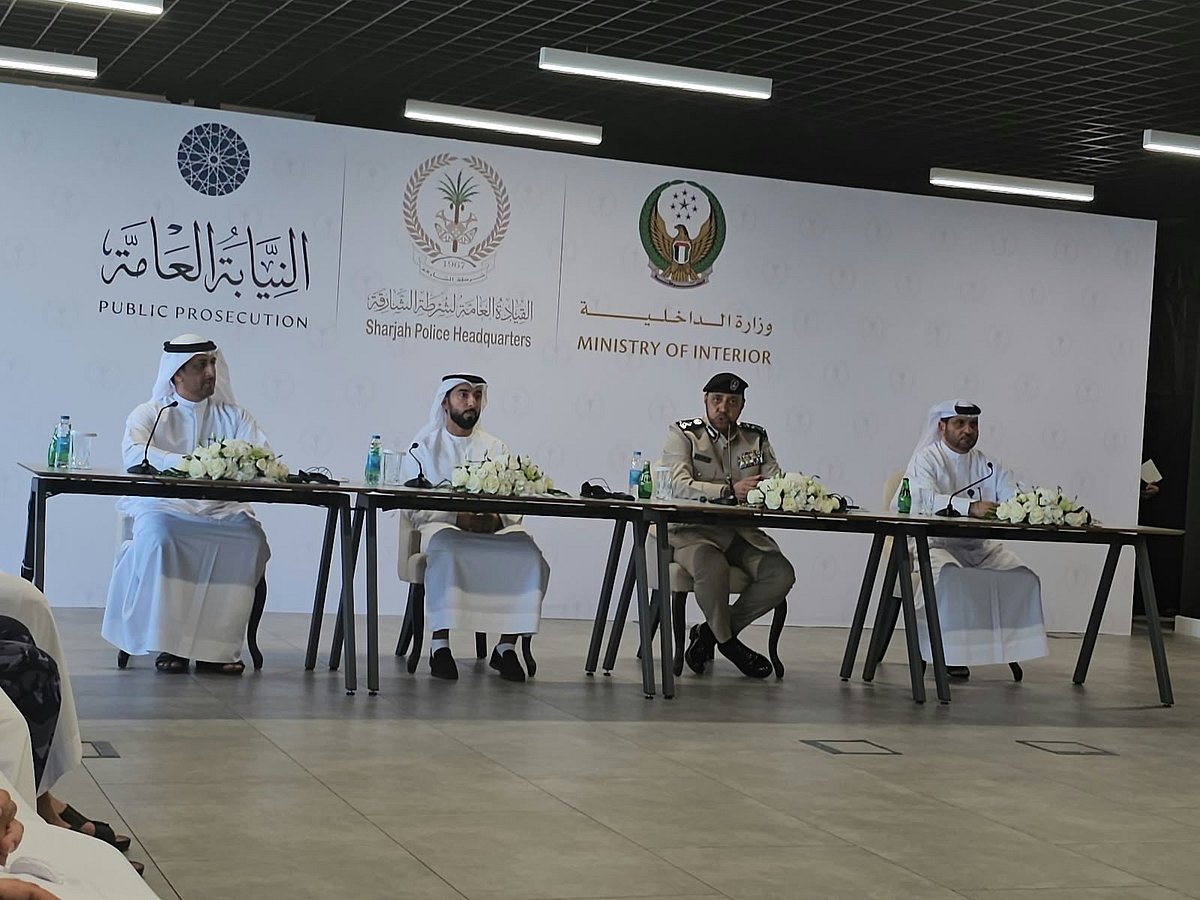
The operation was announced by Sharjah Police on Thursday during a media briefing at Sharjah Media City (Shams), where senior police and prosecution officials outlined the scale of the investigation and the measures taken to protect assets and limit potential economic repercussions for global digital asset markets.
A complex international criminal operation
Lieutenant General Abdullah Mubarak bin Amer, Commander-in-Chief of Sharjah Police, said the operation demonstrated the UAE's ability to confront organised crime, including increasingly sophisticated cybercrime that crosses national borders.
He said the success of the operation was the result of sustained security efforts and close cooperation between federal, local and international authorities.
The investigation uncovered a highly concealed criminal infrastructure whose members operated through encrypted communications, restricted online platforms and networks designed to evade law enforcement.
While presenting themselves publicly as wealthy businesspeople and investors, some suspects allegedly maintained lavish lifestyles and travelled between international capitals while participating in criminal activities spanning several countries.
“The results of the security operation were not limited to arresting those involved and stopping their criminal activities,” Lieutenant General bin Amer said, noting that the operation also protected financial interests and assets and helped limit potential economic and security repercussions.
He credited the UAE's leadership and the Ministry of Interior, under the support and supervision of Lieutenant General His Highness Sheikh Saif bin Zayed Al Nahyan, Deputy Prime Minister and Minister of Interior, with strengthening the capabilities of police forces and supporting the country's integrated security framework.
He also praised the officers involved for their professionalism and dedication, as well as the cooperation of the Ministry of Interior, other security agencies and the Public Prosecution in Sharjah.
He said safeguarding society and protecting the country's assets remained a priority, adding that those who exploited technology to commit crimes would be tracked down and brought to justice.
Dh8.8 billion in money laundering uncovered
Counsellor Anwar Al Harmoudi, Attorney General of Sharjah, said Public Prosecution investigations uncovered an international criminal organisation with clearly defined roles, involving the theft of victims’ funds, concealment of illicit proceeds and the conversion of criminal money into assets and investments to make it appear legitimate.
The total value of funds involved in the money laundering offences reached Dh8,825,381,741.50, transferred through bank accounts, digital wallets and multiple international platforms, with companies and intermediaries allegedly used to conceal the movement and origin of the money.
Al Harmoudi said the scale of the funds, the organisation of the criminal activities and the speed with which proceeds were moved across borders made the case particularly serious. The dispersal of money across multiple countries also complicated efforts to trace the transactions and identify the ultimate beneficiaries.
Investigators found that the process began with victims being lured into fraudulent schemes, followed by the hacking of their accounts and the theft of their money and digital assets. The proceeds were then routed through financial accounts and virtual asset platforms before being invested in real estate, luxury cars, valuable watches and jewellery.
To establish the organisation's structure and trace its financial activities, the Public Prosecution conducted parallel judicial, digital and financial investigations.
The investigation team examined more than 10,000 documents and reports, held 142 investigation sessions and issued 385 decisions and 478 judicial orders. Authorities also inspected 103 electronic devices.
The case involved 33 suspects, including six legal entities, with those implicated representing 12 nationalities.
Investigative measures included 12 search warrants, 109 requests coordinated with the Financial Intelligence Unit and eight requests and procedures for international cooperation. Authorities worked with judicial, security, technical and regulatory bodies to establish the suspects' roles, follow financial transfers, freeze accounts and locate assets connected to the alleged offences.
The measures resulted in the seizure of more than Dh200 million, 17 luxury cars, 29 valuable watches, jewellery, a residential villa, two villas under construction and two residential plots of land.
Searches also uncovered cold digital wallets, narcotic substances, counterfeit currency and equipment used for counterfeiting.
Al Harmoudi praised the cooperation between the Public Prosecution and security agencies, saying institutional coordination was essential to establishing the facts, protecting rights and strengthening the criminal justice system.
Four networks with specialised roles
Major General Omar Ahmed Bu Al Zoud, Director-General of the General Department of Criminal Security and Ports, said the organisation operated through four interconnected criminal networks, each responsible for a specific part of the operation.
The first network specialised in hacking and stealing data, while the second handled money laundering through virtual assets. The third focused on social engineering, online fraud and digital wallet theft. The fourth carried out physical assaults and threats to force victims to disclose their digital wallet passcodes or surrender access to their assets.
In some cases, suspects allegedly threatened or harmed victims' family members, with violent offences reported across several countries.
The division of responsibilities allowed the networks to target individuals, companies and institutions while maintaining a coordinated structure that made it difficult for investigators to identify their leaders and establish links between members.
Major General Bu Al Zoud said investigators combined digital evidence, financial intelligence, wallet tracing and open-source information to identify suspects linked to international cybercrime, violence and threats.
Police officers monitored movements, analysed communications and traced digital evidence while coordinating with local and international partners. The investigation ultimately led to the arrest of the networks' members and the apprehension and return of key suspects from abroad.
Subsequent searches revealed the scale of the alleged criminal proceeds, including luxury properties, vehicles, watches, jewellery, cash and electronic devices. Digital wallets linked to the suspects had recorded transactions amounting to billions of dirhams.
The assets seized or placed under precautionary measures formed part of the wider effort to prevent the proceeds of crime from being concealed, transferred or used elsewhere.
How investigators foiled a planned kidnapping
Brigadier Dr Khalifa Yousif Belhai, Director of the Criminal Investigation Directorate at Sharjah Police, detailed how investigators uncovered the networks' connections and disrupted a suspected plot to target people holding substantial digital assets.
The investigation initially led officers to a juvenile who had not reached the legal age and was found in possession of a digital wallet containing large sums of money.
Further inquiries revealed links to international suspects involved in digital wallet theft and the laundering of proceeds obtained through fraud, hacking and online extortion.
Continued surveillance and analysis subsequently identified a key link between the networks, allegedly involved in assault, kidnapping, digital wallet theft and the possession and sale of compromised data on the dark web. Investigators also established links to international groups involved in cyberattacks, extortion and online fraud.
After analysing the suspect's movements and behaviour, police developed a plan to monitor and apprehend him.
Investigators found that he had allegedly been planning, with a group of foreign nationals, to target people who owned multiple digital wallets and kidnap them as part of a plan to gain access to their assets. Police foiled the alleged plot and arrested the suspect before it could be carried out
The investigation then expanded to identify other members, establish connections between them and determine their respective responsibilities.
Encrypted communications and artificial intelligence
Brigadier Belhai said the networks operated through a concealed communications hub on a social media platform. Members allegedly used a security code that changed every eight hours to protect their communications and conceal their activities.
The organisation had a structured hierarchy, with members assigned interconnected tasks to ensure the continuity of its operations.
Some members allegedly carried out cyberattacks and stole databases. Others managed, sorted and sold the compromised information on the dark web, where it was used to support phishing and fraud schemes.
Artificial intelligence tools were also used to support social engineering, through which victims were manipulated into transferring money or revealing sensitive information.
Other members allegedly contacted victims, persuaded them to make financial transfers or used threats and physical violence to force compliance.
In parallel, members managed digital assets and wallets that received cryptocurrency proceeds stolen from victims. The money was then distributed and transferred through multiple channels before being laundered and allocated among members according to their roles.
Investigators linked financial transactions, communications and organisational indicators to establish relationships between the suspects and their alleged activities.
Brigadier Belhai said officers analysed hundreds of pieces of digital evidence, identified patterns and connected financial and electronic records to reconstruct the networks' structure.
He credited the success of the operation to the team's systematic approach, technical expertise and ability to turn complex digital and financial information into evidence linking suspects to specific roles.
He added that the operation demonstrated how specialised national capabilities, supported by advanced technology and international cooperation, could help investigators uncover sophisticated criminal networks regardless of the methods used to conceal their activities.
UAE's security framework
Lieutenant General bin Amer said the operation reflected the UAE's commitment to maintaining security and stability and protecting individuals, businesses and economic interests from emerging threats.
He emphasised that cooperation between police, the Ministry of Interior, international partners and the Public Prosecution was essential to combating organised crime that extends across borders.
He also commended the Public Prosecution in Sharjah for its continued work in upholding the rule of law, safeguarding individual and community rights and supporting the criminal justice system.
Brigadier Belhai expressed his appreciation to the officers and specialists who worked on the investigation, praising their coordination, attention to detail and ability to identify links between digital evidence, financial indicators and the suspects' activities.
He said the suspects had relied on digital tools and encrypted communications in the belief that these would shield them from detection, but investigators were able to trace the networks through sustained analysis and coordinated enforcement efforts.
Sharjah Police said protecting society, securing assets and confronting the misuse of technology would remain key priorities, warning that those who exploit digital tools to commit crimes would face efforts to track them down and bring them before the courts.
Network Links
GN StoreDownload our app
© Al Nisr Publishing LLC 2026. All rights reserved.