Major exhibition brings together more than 240 artworks to explore a millennium of trade, exploration and cultural exchange across the Indian Ocean, from antiquity to the 17th century
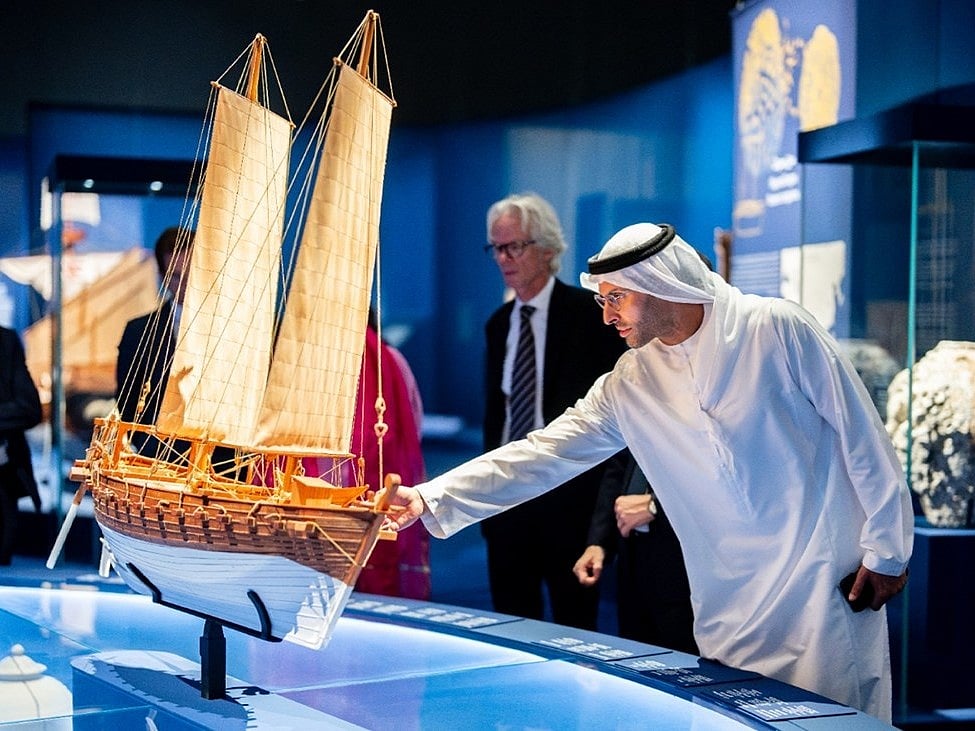
Mohamed Khalifa Al Mubarak, Chairman of the Department of Culture and Tourism – Abu Dhabi (DCT Abu Dhabi), has inaugurated Spices and Wonders: Journeys Through the Indian Ocean at Louvre Abu Dhabi. Organised in partnership with the Musée National des Arts Asiatiques – Guimet in France, the exhibition will run from October 14, 2026, to February 14, 2027, taking visitors on an extraordinary journey through the maritime world of the Indian Ocean.
Get updated faster and for FREE: Download the Gulf News app now - simply click here.
Tracing ten centuries of trade, exploration and cultural exchange, the exhibition explores the interconnected networks that linked communities across Africa, the Arabian Peninsula, South Asia, Southeast Asia and Europe, from ancient times through to the 17th century.
Visitors to Spices and Wonders will discover the contributions of one of the world’s largest trading networks and its profound influence on the development of civilisations across several continents.
The exhibition traces the evolution of long-distance navigation across the Indian Ocean, highlighting the role of coastal communities in the UAE within these centuries-old networks and the connections they forged with merchants, seafarers and cultures throughout the region.
Through more than 240 artworks and historical objects, including textiles, metalwork, ceramics, sculptures and navigational instruments, visitors can explore the treasures accumulated along these maritime routes and the richness of both tangible and intangible exchanges that helped shape the world as we know it today.
The exhibition is curated by Dr Guilhem André, Director of Curatorial Affairs, Collection Management and Scientific Research at Louvre Abu Dhabi, and Dr Claire Delery, Curator of the Chinese Ceramics Collection at the Musée National des Arts Asiatiques – Guimet in France. They are supported by Fakhra Al Kindi and Dr Andrea Rosavolgi from the Louvre Abu Dhabi team.
Dr Guilhem André, Director of Curatorial Affairs, Collection Management and Scientific Research at Louvre Abu Dhabi and curator of the exhibition, said: “Spices and Wonders embodies the essence of Louvre Abu Dhabi’s mission to highlight the stories that connect cultures.
“This exhibition is the result of a close partnership with the Musée Guimet. It shines a light on the Indian Ocean as one of history’s most significant arenas for commercial and cultural exchange, while highlighting the important historical role played by the Arabian Peninsula and the UAE within these networks.
“From the UAE’s coastlines and ports, people, goods and ideas travelled across the Indian Ocean, helping connect communities in Africa, the Arabian Peninsula, South Asia, Southeast Asia and beyond.
“This inspiring narrative holds particular significance for our region and offers an opportunity to explore the deep-rooted connections that have linked the UAE with the wider Indian Ocean world.”
The exhibition is organised into six thematic sections, tracing a journey that begins with early commercial and cultural exchanges in the UAE and the Arabian Gulf and concludes with a contemporary perspective on the Indian Ocean as a vibrant, interconnected system.
The exhibition opens with a short film by Emirati poet, visual artist and filmmaker Nujoom Al Ghanem. Drawing on archival imagery and evocative storytelling, the film explores the connections between the UAE, the Arabian Gulf and the Indian Ocean through maritime heritage, pearl-diving traditions and trading networks.
These traditions are further represented through precious pearls and a jewellery set inspired by Al Murtasha, a traditional form of adornment associated with the UAE’s pearl-diving heritage. Presented by Al Fardan Fine Jewellery, the set reflects exceptional craftsmanship and the rich cultural traditions surrounding the pearl trade.
The first section, The Origins of Indian Ocean Trade Routes, examines the beginnings of these networks in antiquity, tracing the movement of plants, precious stones and pearls, as well as exchanges between the Mediterranean, the Arabian Gulf and India.
The second section, Crossing the Indian Ocean, features historical maps, accounts of voyages to unfamiliar territories and stories of explorers, while examining the arrival of new powers in the Indian Ocean.
Visitors will also encounter a manuscript by Ibn Majid, the 15th-century Arab navigator associated with Ras Al Khaimah, whose writings helped document maritime knowledge and navigation routes across the Indian Ocean. The manuscript is on loan from the National Library of France.
The third section, Ships and Cargoes, presents six large-scale ship models representing different historical periods, from the Middle Ages to the early modern era. The models draw inspiration from historical shipwrecks.
The displays are accompanied by interactive elements and videos recounting stories of ocean navigation and the knowledge associated with sailing across the Indian Ocean.
The fourth section, Spices and Precious Commodities of the Indian Ocean, explores the export of valuable materials, including gold, jewellery and perfumes, as well as manufactured goods. It also examines how materials imported from beyond the region were transformed and repurposed.
This section offers a multisensory olfactory experience developed in partnership with Givaudan, the global fragrance and beauty company.
Bringing the legacy of maritime trade to life, the experience features six raw fragrance materials and three perfume compositions inspired by historical recipes from the Arab world during the Ottoman era, China and India. Among the featured materials is frankincense, an aromatic resin that has been closely associated with the Arabian Peninsula since antiquity.
The fifth section, Peoples of the Indian Ocean: Worlds in Dialogue, explores the role of local communities in trading networks and their influence on customs, practices and everyday life.
The sixth section, An Ocean of Beliefs and Wisdom, examines the spread and exchange of religions and artistic traditions along these maritime routes, alongside the movement of musical traditions and sounds.
The exhibition concludes with an immersive installation by musician and composer Sam Nester, combining sound and video to reimagine the act of listening through the ecological networks of the Indian Ocean and the Arabian Gulf.
Across the exhibition, six multimedia experiences offer visitors a layered sensory journey in which sound, imagery and fragrance combine to bring the history of the Indian Ocean to life.
Dr Claire Delery, Curator of the Chinese Ceramics Collection at the Musée National des Arts Asiatiques – Guimet in Paris and co-curator of the exhibition, said: “This exhibition highlights the pioneering role of Arab seafarers in navigating the open-sea routes between the Arabian Peninsula and India.
“Voyages along these routes relied on a sophisticated understanding of monsoon wind cycles, which guided navigation across the Indian Ocean, as well as the ability to use the stars to determine ships’ positions and calculate latitude.
“For centuries, seafarers from the Arabian Gulf were at the forefront of Indian Ocean trade, including some of the most renowned innovators in celestial navigation, such as Ibn Majid, who was born in Ras Al Khaimah in the 15th century.”
The exhibition brings together exceptional works on loan from 24 international institutions across seven countries in the Gulf Cooperation Council (GCC), Southeast Asia and Europe, with a particularly strong contribution from institutions throughout the Arabian Gulf.
Highlights include a Dagger and Scabbard from India, dating to around 1615–1620, on loan from the al-Sabah Collection at Kuwait’s Dar al-Athar al-Islamiyyah; an incense burner from Egypt’s Mamluk Sultanate, dating to 1294–1340, on loan from the Museum of Islamic Art in Doha, Qatar; and a Palampore, a large printed cotton textile from India dating to around 1700–1725.
Other highlights include a statue of Bodhisattva Avalokiteshvara, from southern Vietnam, dating from the second half of the seventh century to the early eighth century, and a De Bure terrestrial globe from Germany, dating to around 1535. The textile and statue are on loan from the Musée Guimet in France, while the globe is on loan from the National Library of France.
Louvre Abu Dhabi is contributing the largest number of artworks from its own collection to an exhibition since the museum opened.
Among the highlights are Flat Map of the World by Vesconte Maggiolo, produced in Genoa, Italy, around 1531; a World Map in the Namban screen style, created in Japan around 1690; a Gem-Studded Carved Ivory Casket from Kotte, Ceylon, dating to around 1543; and Dutch Tribute and the Western Lake, a lacquered screen from China dating to the period between 1644 and 1912.
The exhibition is supported by Al Fardan Fine Jewellery, whose involvement highlights the UAE’s longstanding pearl-diving heritage and the exceptional craftsmanship associated with it. The company has also loaned works from its collection for the exhibition.
Additional support comes from Winton Capital Management.
Alongside the exhibition, Louvre Abu Dhabi is presenting a comprehensive cultural and educational programme for families, teenagers and children, designed to deepen visitors’ engagement with the artworks and themes on display.
Highlights include a dedicated children’s trail featuring engaging questions and information to help younger visitors discover the exhibition; a discussion with the exhibition’s curators; and a separate conversation with two contemporary artists participating in the exhibition, both scheduled for October 13. The programme will also feature a performance by the UAE National Orchestra on November 15, alongside film screenings.
The museum’s ongoing programmes, including Family Weekends, Drawing at the Museum and Sketch and Talk, will feature sessions dedicated to the exhibition, complemented by specially designed guided tours.
A trilingual exhibition catalogue will also be available for purchase at the museum shop.
The second edition of the travelling exhibition is scheduled to take place at the Musée Guimet in France from May 12 to September 6, 2027.
Network Links
GN StoreDownload our app
© Al Nisr Publishing LLC 2026. All rights reserved.