2026. Washwasha. Curated by Bana Kattan
Exclusive: Washwasha: When meaning moves at low volume
You don’t exactly enter the UAE Pavilion at the Venice Biennale - you adjust to it.
Last updated:
5 MIN READ
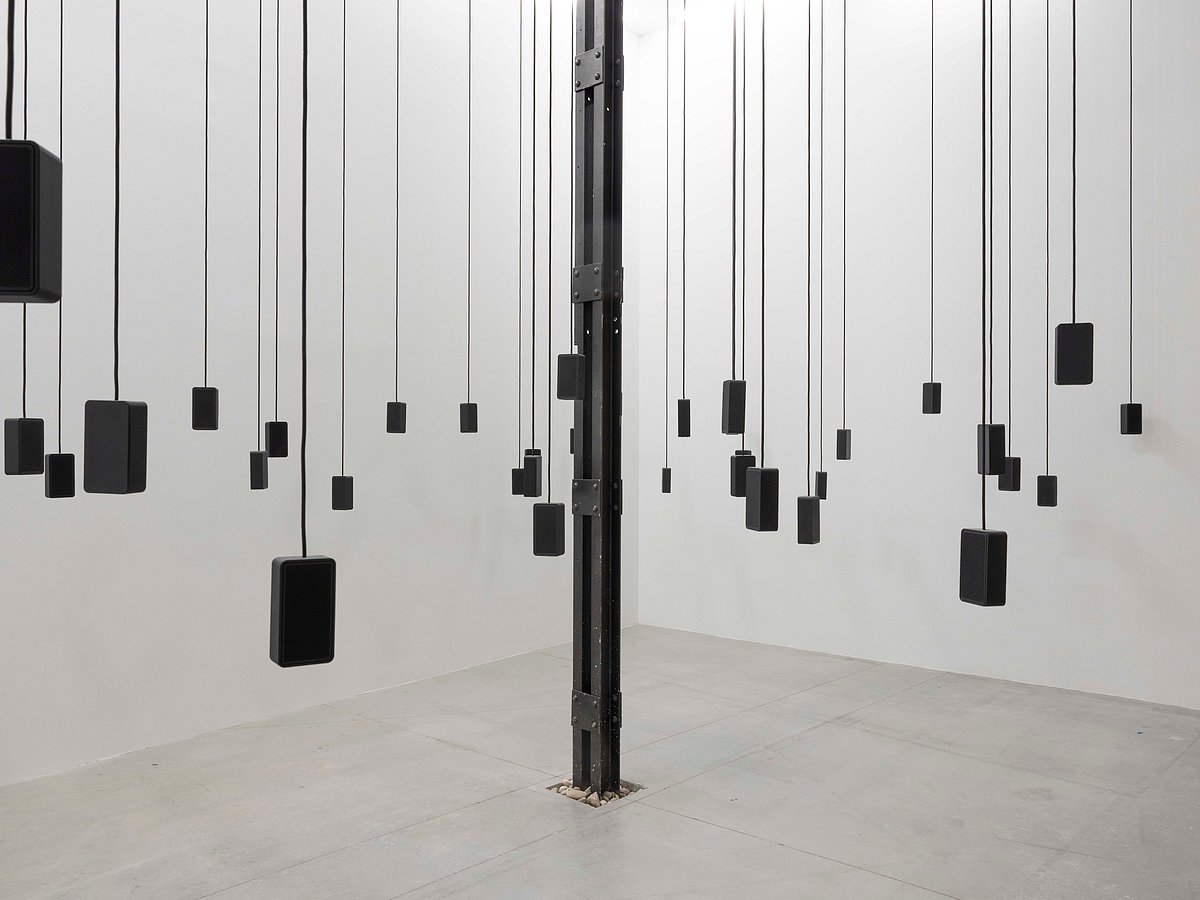
2026.Washwasha.Taus Makhacheva. Dear R…L.. (Speakers). Image courtesy of National-Pavilion UAE – La Biennale di Venezia.
Ismail Noor of Seeing Things
Venice outside is still operating at its familiar tempo: reflective surfaces, tuned attention, the managed density of national statements competing for visibility. Inside the pavilion, that tempo loosens. Sound does not disappear, but it loses its authority to resolve into definition. What remains is a field of near-utterance, interruption, and deferred articulation. Washwasha is built from that condition.
Curated by Bana Kattan with Tala Nassar, the UAE Pavilion at the 61st Venice Biennale takes its title from the Arabic word for whispering. Yet the exhibition is not concerned with whispering as mood or atmosphere. It treats it as an epistemic condition: a way of knowing in which meaning arrives incomplete, shaped by interference, distance, and the pressure of competing voices.
The pavilion brings together Lamya Gargash, Farah Al Qasimi, Jawad Al Malhi, Mays Albaik, Alaa Edris, and Taus Makhacheva. No single visual language binds them, nor does the exhibition attempt to resolve their practices into a unified national image. What connects them is a shared instability in language itself - speech that does not settle, narration that disperses, meaning that resists closure. The works do not converge. They coexist in unresolved articulation.
Lamya Gargash establishes the conceptual ground without ornament. She tells us:
“Sometimes whispers are louder than screams. It is about paying attention to the subtle shifts around us - the tiptoe of movement, the quiet footsteps of sound that slowly alter our lives. Not everything loud creates change; sometimes it is the smallest hidden voices that leave the deepest mark.”
Within the pavilion, this operates less as metaphor than as method. Hierarchies of audibility are suspended. What is usually treated as marginal becomes structurally central, not through amplification but through sustained attention to what refuses to stabilise into signal.
Gargash extends this through oral transmission, positioning voice as a system of continuity rather than inscription:
“Stories shared by the fire, carried through the voices of elders, have always had the power to transport us across worlds, places, and times. Through mere sound and the power of the mind, entire worlds unfold before us.”
Here, transmission does not depend on fixity. It moves through repetition, variation, and communal circulation - forms of knowledge that resist archival containment.
Her articulation of practice sharpens this orientation:
“My work has always been rooted in reflection, in noticing what is often overlooked, a way of listening to what has not been shouted loudly, but instead exists softly beneath the surface, waiting to be heard.”
The operative term is not “softly,” but “waiting” - a temporality of deferred recognition threaded through the pavilion.
Washwasha.Lamya Gargash. Majlis.
Farah Al Qasimi shifts the emphasis into the infrastructural present, where attention is not only dispersed but actively compressed and monetised. Her diagnosis is direct:
“Our attentiveness is being whittled away by capitalism and social media - every idea, however complex, needs to somehow be transmittable via a sound bite or infographic.”
This is not aesthetic observation but a description of constraint: complexity reduced to transmissible fragments, intelligibility shaped by brevity.
Against this compression, the pavilion stages a refusal of immediacy as method rather than gesture. Al Qasimi articulates this plainly:
“It’s rare that we are afforded the opportunity to truly listen.”
Washwasha.Alaa Edris. Wiswas.
And further:
“I hope this allows people a moment in which they can have a seat and slow down.”
The phrasing remains restrained, but the implication is structural: sustained attention has become exceptional rather than default.
She also situates the UAE not as symbolic unity but as sustained heterogeneity:
“It is impossible to think about the Emirates without thinking of the many cultures that call it home, there is so much cross-pollination of language and information.”
Identity here is not asserted but continuously negotiated across linguistic and cultural interference patterns.
Across the pavilion, “voice” ceases to function as a stable category. It becomes an unstable medium of transmission.
Washwasha.Farah Al Qasimi. The Curse
In Jawad Al Malhi’s reconstructed oral histories, communal memory is neither preserved nor archived but reactivated through recollection - fragmented, affectively charged, and embedded in social ritual. In Lamya Gargash’s majlis works, space is not represented but activated as an apparatus of listening, where sociality is structured through presence rather than display.
In both cases, sound is not informational. It becomes relational infrastructure - binding without fixing, transmitting without stabilising.
Mays Albaik pushes language into material interruption. Speech is arrested at the threshold of articulation and converted into object. What remains is not communication but residue: the sculptural imprint of attempted utterance, language suspended at the point where meaning would ordinarily consolidate.
Alaa Edris extends this condition into systemic interference. Here, washwasha becomes tashwīsh: noise, distortion, breakdown of signal coherence. Temporal sequence disintegrates into non-aligned flows. Narrative does not develop; it disperses across incompatible frames of perception.
Across these practices, communication is not depicted as failing once, but as persistently unable to stabilise into transparent exchange.
Washwasha.Mays Albaik. Be, so that I may be as I say!.
Venice itself operates as an unacknowledged structural counterpart.
Gargash describes it with observational precision:
“It is a city layered with histories and human traces, the echo of footsteps, distant conversations, water moving through canals.”
The city does not preserve silence. It preserves reverberation - sound extended beyond origin, never fully extinguished, only redistributed. In this sense, Washwasha does not introduce an external sonic logic into Venice; it inhabits an already resonant environment structured by persistence and return.
By the time the pavilion concludes, no interpretive closure is offered and no synthesis is proposed. What remains is not resolution but a shift in how attention behaves after exposure.
Gargash articulates this without excess:
“Not everything loud is impactful. Sometimes the most powerful works are the ones that linger quietly, making you question, reflect, and feel.”
Yet what persists is not “lingering” as mood, but a disruption of certainty in interpretation itself. Meaning does not present itself during encounter; it accrues afterward, once the impulse to resolve has receded.
Outside, Venice continues in its established rhythm. But its signals no longer resolve as cleanly as before.
And Washwasha leaves behind not an argument, but a condition: that meaning does not depend on clarity, and that listening begins precisely at the point where certainty fails to complete itself.
Network Links
GN StoreAbout Gulf NewsTerms & ConditionsReach by GNSitemapContact usPrivacy PolicyGN FocusHave your sayWork with usAdvertise with usGulf News epaperPrinting Services
Download our app
© Al Nisr Publishing LLC 2026. All rights reserved.