Marwan Sahmarani's art explores chaos, renewal, and resilience
Lebanese artist's journey from conflict to hope in Dubai exhibition
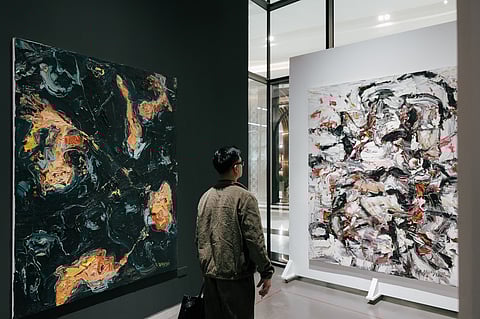
Dubai: Rooted in Lebanon’s complex modern history and Marwan Sahmarani’s own multi-faith, multicultural upbringing, Rupture Into Light, a major solo exhibition, traces the Lebanese artist’s journey from conflict and fragmentation toward transformation and hope. Born in wartime Beirut, Sahmarani’s life and art have been profoundly shaped by displacement and survival - experiences that reverberate across his sweeping canvases. The Kurator sat down with the artist to explore the themes behind the exhibition, the turbulent intersections between destruction and renewal, chaos and transcendence, his collaboration with The Farjam Foundation, and the evolution of his artistic journey.
Let’s start with the philosophy behind the work you create: Your paintings often deal with dualities - chaos and calm, destruction and renewal. How do you bring those opposites together in a single composition?
During this process, I do not concern myself with how the painting will look or what it may become. I allow my unconscious to guide the work. Naturally, all the contradictions that reside within me can surface as I paint. Within every painting lies a contradiction: life and death, destruction and rebirth, light and shadow. These opposing forces coexist, and it is through their tension that the painting comes alive.
This philosophy feels deeply present in your current exhibition, Rupture Into Light, a powerful title that suggests both transformation and transcendence. What does “rupture” mean to you personally, and how does this idea manifest in your work?
As Roxane mentioned so well in the catalogue essay, Rupture into Light as a title was inspired by the notion of the disruptive, violent forces which may – or may not - give birth to a light beyond. It came from the conceptual framework behind the Quadriptych where the awesome power of dark destructive forces wrestle with accents of ‘light’ that struggle to emerge from beneath the amassed textures of layered paints”
Throughout the process, ruptures can occur. I may be working on a painting and suddenly shift the mood or the idea entirely. These disruptions leave visible traces on the canvas: abrupt changes in the direction of the brushstrokes, surfaces that move from flat to heavily textured, or moments where figuration dissolves into abstraction. All of these marks testify to the evolving, unpredictable nature of the practice itself.
Tell us about the exhibition. How did this collaboration with The Farjam Foundation come about, and what made you want to present Rupture Into Light in Dubai?
Some while ago, Dr. Farhad Farjam contacted me about exhibiting several paintings he had acquired over the years. Among them are works that are especially meaningful to me, as they mark key moments in my career and artistic practice. They are also some of my most powerful pieces.
I found it compelling to present the work in a Foundation rather than a gallery, particularly in Dubai. As a non-profit institution, the Foundation offers a different kind of engagement with the artwork—one free from the pressures of sales or market speculation. We were able to design the space to optimise presentation of these visually striking pieces, and since there will be some programming around it, there will also be an educational value to the public.
Over the years, I have built a strong relationship with Dr. Farhad Farjam, grounded in our shared passion for art. He has a deeply personal vision as a collector, choosing pieces with his heart, and this is something I truly respect—especially now, when the art market has grown increasingly complex and many collectors approach it from a different perspective.
Tell us about your process working with the curatorial team, and how that dialogue influenced the selection and presentation of the works.
There were several important paintings that we wanted to exhibit, especially the large work connected to the Lebanese revolution and the Beirut blast of August 4, 2020. Roxane Zand, the curator of the show, worked closely with this piece and built a narrative around it in dialogue with the other paintings in the collection. We had a number of discussions about my process in approaching these paintings and she was able to reflect my vision as closely as I had hoped.
The selected works converge around a central theme of the complexity of human reaction to conflict, war and its fall-out. There is both resilience and strength, as well as glimpses of light in this exhibition, deliberately titled Rupture Into Light. The colour palette of the large Quadriptych reinforces the darkness of violence, whereas the Collision I composition involves more earthy, fleshy and blood-soaked tones for obvious reasons. Ultimately I want the viewer to have their own responses and interpretations because my work is all about response and the viewer’s imagination. I don’t like to over-intellectualize a body of work which comes so strongly from a visceral and emotional base.
Your piece Collision I carries an emotional weight, having been damaged in the Beirut Port explosion and later repaired. Why did you decide to leave the scar visible, and what does that act of repair mean for you?
This artwork was created over several stages. The first began during the revolution, when the painting felt like a testimony to everything unfolding around us. Then came the blast on August 4th, 2020: a large door was hurled into the canvas, tearing a deep hole through it. In fact, two major openings appeared, with shards of glass scattered across its surface. I found myself facing a difficult question—should I leave the painting as it was, destroy it entirely, or attempt a restoration that would conceal the damage?
In the end, my wife chose to stitch the canvas, to mend the wounds rather than hide them. And now, whenever we look at the painting, those stitches bring the moment back with striking clarity. I believe these moments—these pivotal, painful fragments of time—should not be forgotten. They have become a part of my history, woven directly into the work itself.
Your paintings carry such presence — they transform any space they’re in. When you imagine your work living beyond the gallery, what kind of person or environment do you hope it resonates with?
Yes, it’s true—my paintings carry a strong presence. Picasso once said that when you place a mirror in front of a painting, you can almost sense the breath of the person reflected on its surface. For me, a painting is a presence in its own right, not a design object or a decorative piece hung on a wall to blend with the sofa, as you put it.
I want the viewer, when standing before a painting, to feel that a conversation is taking place—a continuous dialogue. I want them to discover what lies beneath the surface, to sense how the work was built. There are layers upon layers, shifting textures, figures that appear and disappear. This dynamic exchange is essential to me.
I don’t seek to create something that feels like wallpaper, emotionless and static. I aim to stir something in the viewer—an emotion, a reaction, a moment of recognition. That experience, that interaction, is at the heart of my work.
Your influences range from mythology and literature to postwar abstraction and expressionism. Which artists or movements have most shaped your practice, and how do you see your place within Arab modernism today?
My artistic practice comes from a Western education, and I have been deeply inspired by many painters—Caravaggio, Picasso, Willem de Kooning, Baselitz, among others. I believe that in the history of art, every artist occupies a place within a long, continuous lineage. It isn’t a broken chain; we follow one another, each adding a new link.
As for the Arab modern artists, painting in Lebanon naturally places me in direct dialogue with what surrounds me and with the contributions of the generations before me. I am certain that their work has influenced mine. There are many remarkable figures among them—Arif al-Rais, Saliba Douaihi, Salwa Raouda Choucair, and Etel Adnan—powerful artists whose work I deeply respect.
Artists in this region, in the Arab world—including myself—are part of a continuous lineage. We are nothing more than an extension of those who came before us, just as we will become part of the continuity for those who come after. As long as we remain true to the criteria, the style, and the identity that define our artistic language, we carry this legacy forward.
Lebanon’s history and your own multi‑faith, multicultural background clearly shape your narrative. How does that personal history continue to evolve in your art?
I was born and raised in Lebanon, and everything around me has shaped who I am. As a painter, one is inevitably influenced—often unconsciously—by the narratives, events, and experiences that form the backdrop of one’s life. I myself come from multiple communities and carry many layers of identity, and this complexity continually leads me to question who I am and where I stand. This ongoing search is deeply relevant to my work, and it emerges clearly in both my painting and my practice
You’ve described painting as a kind of resistance, even a moral act. What role do you think artists play in bearing witness or offering hope during difficult times?
I believe that art stands as a form of resistance against the violence of history. Beauty emerges through art precisely because it can act as a remedy for the madness of humankind—a way to defy despair and resist death itself. Through art, we are able to transcend harsh realities and reach toward forms of perfection that reveal the deeper essence of existence.
In this sense, a painting becomes almost like a requiem for the world around us—for the suffering, the loss, and the misery that shape our collective experience.
Finally, what do you hope visitors take away from Rupture Into Light? Is there a feeling or thought you’d like them to leave with?
I want the visitor, upon entering the space, to feel a certain disturbance—to be unsettled—yet still able to find traces of beauty within the chaos. Through this tension, I hope they will reflect on modern society and the reality of the world we inhabit today.
Toward the end of the show I want the viewer to feel that all the conflicts of humanity—the violence, the struggle, the fragmentation—begin to dissolve and merge into a state of oneness. In these works, everything and everyone seems to float, returning to the origin, to a cosmic and mystical space where separation gives way to harmony.


