Dubai Collection Nights 2026 explores art, memory and place
Exhibitions, talks and studio visits unfold across Dubai until March 8
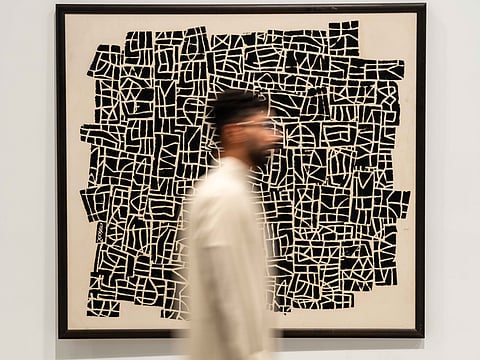
Dubai: The city's free-to-visit art exhibition Dubai Collection Nights is a must visit for art lovers. The fourth edition of this annual arts programme is running across the city until March 8, 2026 with free entry, and it is shaping up to be the most expansive one yet.
What is Dubai Collection Nights?
The Dubai Collection is a public collection of modern and contemporary art, launched in 2021 by the Dubai Culture and Arts Authority. What makes it unique is that the works it holds come from private collections, many of them housed in people's homes.
The collection's whole purpose is to make those works visible and accessible to the public, rather than keeping them locked away.
Dubai Collection Nights is the yearly programme that brings that mission to life, with exhibitions, talks, studio visits and workshops spread across the city. Al Safa Art and Design Library serves as the main base for this year's events, though several activities are taking place at other locations around Dubai.
This year's theme
The 2026 edition is built around the theme Mapping Memories: Landscapes in Flux and Geometries of the Imagination. It is a rich and layered idea, centred on how art can hold traces of place, memory, and movement, and how abstraction can work as a visual language for recording histories and imagining new ones.
The Exhibition: In Attunement
The programme opened on February 24 with the launch of In Attunement, an exhibition curated by Jumanah Abbas and running at Al Safa Art and Design Library until March 8.
The show brings together ten artists from across the Middle East, North Africa, South Asia, and Europe, all drawn from the Dubai Collection. It is organised around three loose groupings.
Speaking to Gulf News, Abbas described the exhibition's central idea as "a non-exhaustive bibliographic reading of abstraction and geometries of imagination," with the library setting of Al Safa informing how the whole narrative is framed.
"Since we're in a space, the library, which is about expanding and building knowledge, the exhibition takes the context of the library as a way of telling the narrative," she explained.
It is organised around three loose groupings. The first looks at abstraction as a system of possibility rather than simply a style. As Abbas put it, the aim is to look at abstraction "not just as a style, but as a system of possibilities that can be deconstructed and reconstructed to carry new meanings about landscapes."
The second cluster focuses on materials as a kind of record. It includes the work of Lebanese artist Chaouki Choukini, who uses wood to document landscapes of South Lebanon, placed alongside the print works of Syrian artist Moustafa Fathi.
Abbas explained that in the 1980s, Fathi "went on these fieldworks in Syria, gathered a lot of archaeological objects from Syrian sites and then used these objects as a printmaking tool," forming what she described as "beautiful paintings that can be read as maps of the city." The work in the exhibition comes from the private collection of His Highness Sheikh Mohammed bin Rashid Al Maktoum, Vice President and Prime Minister of the UAE and Ruler of Dubai.
The third section, which Abbas called "forms of presence," brings together large-scale sculptures by Egyptian artist Ahmed Askalani, which first appeared at the Venice Biennale for the Egyptian Pavilion in 2009. Abbas described them as works that "create a moment of encounter," noting that Askalani works with palm leaves and resins to create large-scale sculptures that "look down at us in the same way we look up at them." These are placed in dialogue with works by Emirati pioneer Hassan Sharif and Spanish artist Santiago Giralda, all of whom, in Abbas's words, look into "materials and their contexts."
Speaking about the exhibition's overall intention, Abbas described it as a space for reading geometries of imagination, with abstraction as a framework through which histories are remembered and new spatial possibilities take shape.
The show is also designed as "an invitation during the holy month to slow down, tune in to these different collecting and artistic practices and index the different knowledge that can be distilled from landscapes through the artists' practices."
Getting out into the city
Beyond the exhibition, Dubai Collection Nights takes visitors out into Dubai itself. On March 5, there is a studio visit with Dubai Collection artist Hazem Harb, followed in the evening by a visit to the House of Arts grassroots initiative and a Suhoor. On March 6, artist Saif Mhaisen opens his studio to visitors.
There is also a corporate collection visit to A.R.M. Holding on March 2, and a VIP patron collection visit to the Ghada Kunash and Khaled Abdel Hamid Collection on March 6.
Talks worth showing up for
Three panel discussions are taking place at Al Safa Art and Design Library on March 3 and 4. One looks at the history and legacy of art patronage, with Dubai Collection patrons in conversation with Hala Khayat.
Another explores how archives help preserve cultural memory across generations, with art historian Nada Shabout and Adina Hempel.
The third is a Curator's Corner session with Jumanah Abbas in conversation with Suheyla Takesh, Director of the Barjeel Art Foundation, focused on curatorial research and practice.
Workshops for all ages
On March 7, Emirati artist Sarah Al Mehairi leads a workshop on geometry and abstraction for adults. The final day, March 8, is dedicated to younger visitors, with a children's workshop on composition led by Noor Al Suwaidi, followed by a reading session with author and cultural strategist Myrna Ayad.
How to attend
All events are based around Al Safa Art and Design Library as the central hub, with studio visits and collection tours across the city that are for free.
To register for events and find out more, visit dubaicollection.ae.
Areeba Hashmi is a trainee at Gulf News.


