Cybersecurity snakes and ladders: Major outages, AI-discovered vulnerabilities and the uncertain road to business resilience
AI accelerates threat discovery, but are businesses keeping pace with resilience demands?
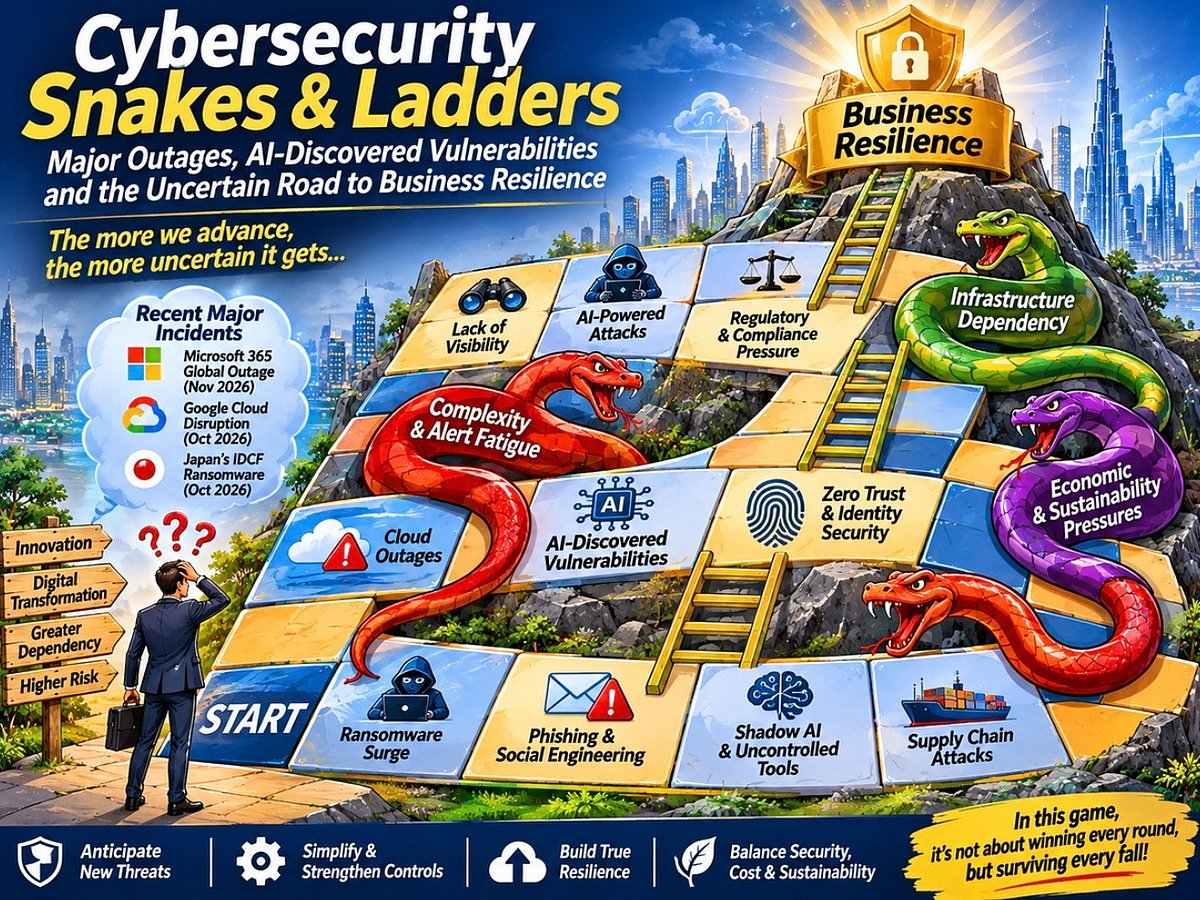
Organisations are investing in smarter cybersecurity, yet major technology outages, AI-accelerated vulnerability discovery and increasingly interconnected threats are creating an uncomfortable paradox: the more digitally advanced businesses become, the more uncertain their resilience appears.
Imagine playing a giant game of Snakes and Ladders, where every ladder represents a cybersecurity breakthrough and every snake represents an unexpected threat. You climb one step through AI-powered detection, Zero Trust or automation, only to slide backwards because of a newly discovered vulnerability, a cloud outage or an attack on a critical supplier.
Get updated faster and for FREE: Download the Gulf News app now - simply click here.
Welcome to the modern cybersecurity landscape, where the rules keep changing even while the game is in progress.
For years, organisations believed that deploying more security products, improving detection capabilities and moving infrastructure to the cloud would make them safer. Artificial intelligence has now accelerated this transformation. But it has also introduced a new dimension of uncertainty.
We are discovering vulnerabilities faster, detecting threats more intelligently, but are we becoming resilient at the same pace?
When the ladders suddenly become snakes
Recent major technology disruptions have demonstrated how fragile interconnected digital operations can become.
The November 2026 Microsoft 365 disruption, affecting services including Outlook, Teams and Copilot, illustrated how a technical infrastructure problem can interrupt business communication and productivity across organisations. It was not evidence of a cyberattack, but it exposed the operational consequences of dependence on a common digital ecosystem.
The October 2026 Google Cloud disruption, associated with a power event at a third-party London facility, affected services used by financial institutions, including Revolut, Lloyds and HSBC.
Meanwhile, the ransomware incident affecting Japan's IDCF Cloud demonstrated another dimension of the problem: a single provider's security incident can have consequences for hundreds of dependent organisations.
These incidents have different causes, but share an important lesson. Business continuity increasingly depends on infrastructure, suppliers and services that individual organisations do not completely control.
AI is discovering vulnerabilities. Who is keeping up?
Perhaps the most worrying development is the accelerating role of AI in vulnerability discovery and exploitation.
AI can analyse source code, identify weaknesses, automate security testing and help defenders prioritise remediation. However, the same capabilities can empower attackers to identify exploitable weaknesses, automate reconnaissance and accelerate attack preparation.
The problem is no longer simply how many vulnerabilities exist. It is how quickly they can be discovered, weaponised, exploited and remediated.
Security teams are being challenged to respond to a shrinking window between vulnerability disclosure and exploitation.
At the same time, generative AI, autonomous agents, APIs, machine identities and shadow AI are expanding enterprise attack surfaces.
Organisations are adding AI-powered detection platforms, security copilots and autonomous response capabilities. Yet more tools also mean more integration dependencies, more alerts, more licensing costs and more governance responsibilities.
Are we replacing traditional alert fatigue with AI-driven operational complexity?
The resilience paradox
There is an uncomfortable contradiction at the heart of digital transformation.
Businesses want intelligent, autonomous and self-healing technology. But the more interconnected and automated their environments become, the more difficult it can be to understand dependencies, isolate failures and maintain control.
An AI detection system may identify an attack, but what happens if the identity platform is unavailable?
A cloud provider may promise high availability, but what happens when an upstream infrastructure dependency fails?
An autonomous response system may contain a threat, but what happens when its decision disrupts a critical business process?
Technology availability, cybersecurity effectiveness and business resilience are three different outcomes. Organisations cannot assume that achieving one automatically delivers the others.
Sustainability is another casualty
There is also an economic and environmental dimension.
Continuously adding security products, AI workloads and infrastructure creates additional costs, energy consumption, specialist staffing requirements and operational complexity.
Security investment must therefore deliver measurable risk reduction rather than simply increasing the number of products deployed.
The next generation of cybersecurity architecture must prioritise integration, simplicity, independent recovery capabilities, responsible AI governance and sustainable operations.
Who wins the Snakes and Ladders game?
The future CISO must move beyond counting alerts, vulnerabilities and security products. The real responsibility is to understand business dependencies, anticipate disruption and ensure that critical operations survive unexpected events.
Boards should ask five difficult questions:
1. How quickly can we identify and remediate newly discovered vulnerabilities?
2. Can critical operations continue if our primary cloud or productivity provider becomes unavailable?
3. Are our AI systems governed, monitored and capable of operating within defined boundaries?
4. Have we tested recovery from simultaneous technology, supplier and security failures?
5. Is our cybersecurity investment sustainable and aligned with business risk?
The uncomfortable reality is that there may be no final square in this game.
Every new technology introduces opportunities and uncertainties. Every new defence creates another responsibility to govern, maintain and test.
Cybersecurity is no longer just about staying ahead of attackers. It is about ensuring that businesses can continue moving forward when technology, infrastructure or trust suddenly fails.
The real winner in the Snakes and Ladders game will not be the organisation with the most ladders or the fewest snakes.
It will be the organisation that can take a fall, recover quickly and continue playing without losing its business.
Network Links
GN StoreDownload our app
© Al Nisr Publishing LLC 2026. All rights reserved.