Why AI governance could be the key to faster business adoption
Companies need more than compliance tools to deploy AI safely and confidently
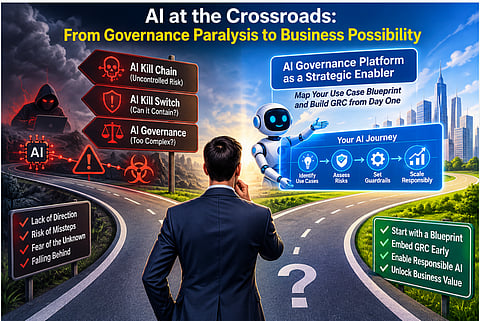
An intriguing conversation among few of our community expert CXOs and some AI GRC product vendors, started with this statement “the biggest obstacle to AI adoption is not technology. It is uncertainty”.
Business leaders see immense potential in AI to improve productivity, automate processes, enhance customer experience, and unlock new revenue opportunities. Yet risk, legal, compliance, audit, and cybersecurity teams often see unanswered questions around accountability, privacy, security, regulatory exposure, and operational resilience. The result is governance paralysis, where promising AI initiatives remain stuck in discussion rather than delivering business value.
Get updated faster and for FREE: Download the Gulf News app now - simply click here.
This is where AI governance vendors have an opportunity to redefine their role.
Traditionally, governance platforms have been positioned as control frameworks focused on compliance, risk assessments, and policy enforcement. While these capabilities remain essential, the next generation of AI governance providers must become something more valuable like AI adoption accelerators. A collective concern raised by our experts “how many of such vendors in the market?”
The organisations that succeed with AI will not necessarily be those deploying the most AI agents. They will be those deploying AI with the greatest confidence.
To create that confidence, governance vendors must shift the conversation away from controls and towards outcomes. Instead of beginning with regulations, they should begin with business objectives.
When a marketing team wants to deploy an AI-powered customer segmentation engine, a finance team seeks automated invoice processing, or an HR department explores AI-assisted recruitment, governance platforms should guide them through a structured onboarding journey. This journey should identify the intended business outcome, define the required data sources, map application and process dependencies, assess risks, establish ownership, and determine the necessary guardrails before deployment begins.
In effect, governance becomes the blueprint for adoption rather than the barrier to adoption.
Leading organisations increasingly struggle with a simple question, "Where do we start with AI?" Most have hundreds of potential use cases but little clarity on which initiatives offer the best balance between value and risk.
AI governance vendors can solve this challenge by providing standardised use-case onboarding frameworks. These frameworks help organisations evaluate business benefits, data sensitivity, regulatory obligations, technical dependencies, and security requirements in a repeatable manner. Instead of every project starting from scratch, teams can follow an established pathway from idea to production.
The result is faster decision-making, improved stakeholder alignment, and greater confidence to scale.
As organisations progress from experimentation to enterprise-wide deployment, governance platforms become even more valuable. AI adoption introduces a new digital workforce of assistants and autonomous agents capable of accessing data, triggering workflows, and influencing decisions. Business leaders need visibility into what these systems can access, what actions they can perform, and who remains accountable for the outcomes.
This is where governance transforms from a compliance tool into a business enabler.
A mature AI governance platform should continuously answer critical questions:
What AI systems are deployed across the organisation?
What data can they access?
What decisions can they influence or automate?
What regulations apply?
What risks have been identified and mitigated?
Who owns and supervises each AI capability?
How is performance being monitored?
By providing these answers in real time, governance platforms give boards, executives, and business leaders the confidence to expand AI initiatives rather than delay them.
One of the most important capabilities governance vendors should champion is the concept of the AI Kill Switch.
This is not a marketing feature or an emergency button. It is an operational capability that allows organisations to regain control immediately if an AI system exceeds its authority, behaves unexpectedly, becomes compromised, or creates unacceptable business risk.
An effective AI Kill Switch requires visibility into AI inventories, agent identities, permissions, workflows, monitoring mechanisms, containment procedures, and response processes. More importantly, it provides assurance that organisations remain in control as autonomy increases.
The irony is that the organisations moving fastest with AI are often those investing most heavily in governance. They understand that governance is not the brake on innovation. It is the foundation that makes innovation sustainable.
The future role of AI governance vendors is therefore much larger than regulatory compliance. Their success will be measured not by the number of controls they implement, but by the number of AI use cases they help organisations deploy safely, confidently, and at scale.
The winners in the AI economy will not simply be technology providers. They will be the governance partners that give businesses the confidence to turn AI ambition into AI action. In the years ahead, the most successful AI governance platforms may prove to be not just risk-management tools, but the ultimate AI accelerators.
We are in conversation with many vendors and CXOs, stay tuned…


