2026 Canada/Mexico/USA: Trionda
FIFA World Cup 2026: What happens if the match ball dies mid-game? Inside the wireless tech keeping play alive
A hidden sensor inside FIFA's new ball tracks every touch, spin and pass
Last updated:
5 MIN READ
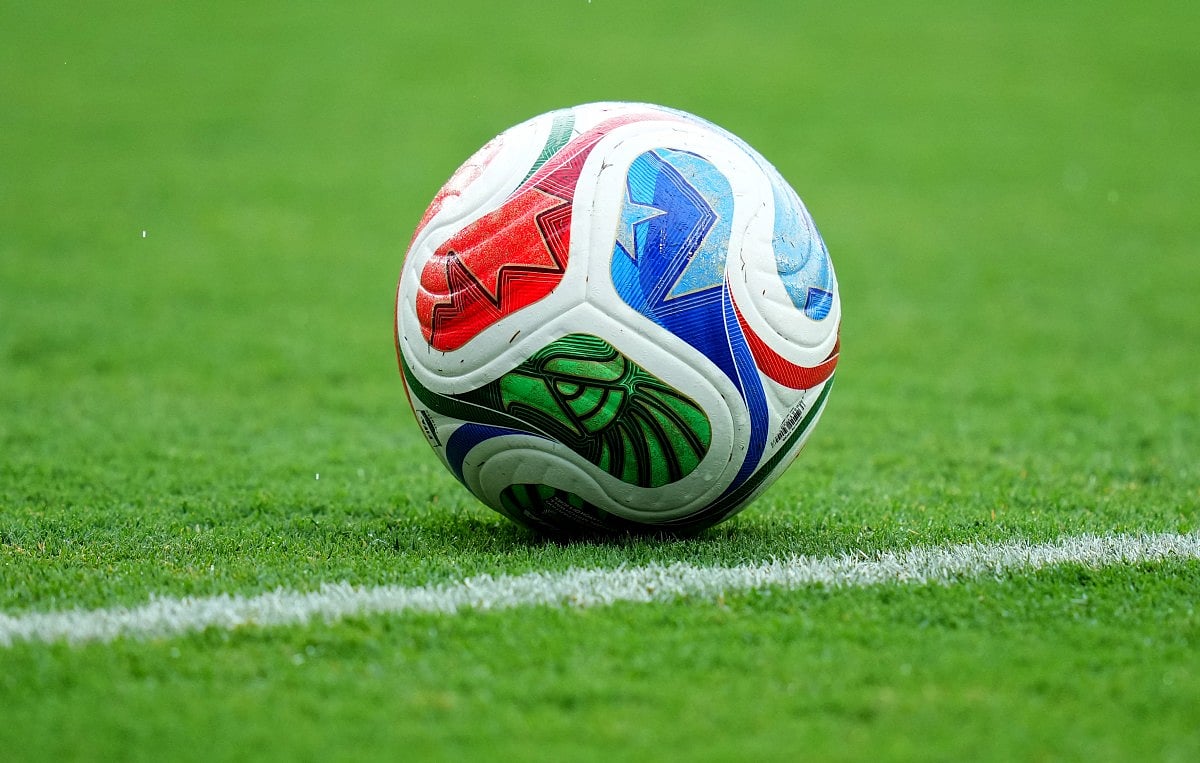
The adidas Trionda match ball is seen on the pitch prior to the International Friendly match between England and Costa Rica at Inter&Co Stadium on June 10, 2026 in Orlando, Florida.
AFP
Dubai: Yes, you read that correctly. The official ball of the 2026 FIFA World Cup has to be plugged in before every game. Not because it lights up or plays sounds, but because it contains a tiny computer chip that tracks every single thing it does on the pitch in real time.
Here is everything you need to know about the Adidas Trionda and the technology packed inside it.
What does Trionda mean?
The official match ball is called the Trionda, which in Spanish means "three waves," a direct reference to the three host nations of the 2026 tournament: Canada, Mexico and the United States. The design reflects all three countries too, with red, green and blue colouring and symbols representing each nation: a maple leaf for Canada, an eagle for Mexico and a star for the US.
It took Adidas and FIFA three and a half years to design and test the ball, going through multiple rounds of trial and error and blind testing in different locations and weather conditions before the final version was approved.
All that makes it special compared to a normal football
Most footballs are exactly what they look like: a hollow sphere stitched together from multiple panels. The classic design you likely grew up with had 32 panels. The Trionda has just four, the lowest number in World Cup history.
Fewer panels means a rounder, smoother surface, which reduces the unpredictable aerodynamic wobbles that have plagued previous tournament balls, most notoriously the Jabulani from South Africa 2010, which goalkeepers widely complained moved erratically in the air.
The Trionda's outer shell also features intentionally deep seams to distribute drag evenly, alongside embossed and debossed micro-textures that improve grip in wet and humid conditions.
But the real difference is what is hidden inside one of those four panels: an inertial measurement unit, or IMU sensor.
The sensor: what it is and what it does
This sensor records the ball's acceleration, spin, rotation and every single contact event at 500 readings per second. Five hundred times every second, it is capturing data about what the ball is doing. It then transmits all of that information wirelessly to the VAR room in real time, where it is combined with optical tracking cameras positioned around the stadium to create a continuous, live digital model of the match.
Trionda sensor
In previous World Cups the ball, Al Rihla, the sensor was positioned at the centre of the ball. In the Trionda, it sits within one of the four panels. To prevent that from affecting the ball's balance, Adidas added counterweights in the other three panels, ensuring it behaves exactly as a match ball should despite the technology inside it.
Al Rihla sensor
Wireless charging for the ball
Because the sensor needs power to run continuously throughout a match, the ball has a small rechargeable battery inside it. Before every fixture, the ball is placed on a wireless charging dock, similar in principle to how you might charge a phone without plugging in a cable. Energy is transferred through inductive charging, with no physical connectors required.
Trionda being put in the charging pod
A 90-minute charge powers the ball for up to six hours on the pitch, comfortably covering a full match including potential extra time and penalties. If the battery were to run out mid-game, the data feed would cut off, which would directly affect officiating decisions that depend on real-time timing. That is why the charging process is not optional. Every ball, before every match, must be charged.
Trionda charges wireless in the specially design charging pods
What does all this data actually do for the game?
The most significant benefit is the improvement to offside and handball decisions. This has historically been one of the most contentious areas in football, where a decision can hinge on which exact frame of video footage an official freezes on. The Trionda removes that ambiguity entirely. Because the sensor captures the precise millisecond at which the ball is struck, it tells officials exactly when a pass was played. That timing is then combined with player positional tracking to determine offside far more accurately and far more quickly than before.
The technology also assists with handball rulings, where the ball's motion signature can confirm whether and exactly when it made contact with a player's arm. In goal-line scenarios, it provides an additional layer of confirmation on top of existing optical systems.
The sensor in Trionda tracks player movements live
Beyond officiating, the data is genuinely valuable for analysis. Teams and broadcasters can access shot velocity, ball trajectory, spin rate and pass timing precision in more detail than has ever been available before. For coaches, that is a tactical goldmine. For viewers, it means broadcast coverage can explain key moments with a level of precision that was simply not possible at previous tournaments.
Does this change what football is?
That is the question sitting quietly underneath all of this technology. Football has always been a sport defined as much by its arguments as its goals. The disputed offside call, the handball that nobody can agree on, the goal that crossed the line by half an inch: these moments are woven into the fabric of the game and the conversations it generates.
Some will see the Trionda's technology as progress. Fewer wrong decisions, faster calls, less controversy, more fairness. Others will argue that removing human interpretation from key moments changes the character of the sport in ways that are difficult to quantify but very easy to feel.
Trionda sensor
What is not up for debate is that from June 11, every touch of the ball at the 2026 World Cup will leave a digital trace. The goal that wins a final, the offside that rules one out, the handball that changes a game: all of it, captured at 500 readings per second, stored and transmitted in real time.
Football has always been a game of moments. In 2026, those moments are being measured like never before.
Network Links
GN StoreAbout Gulf NewsTerms & ConditionsReach by GNSitemapContact usPrivacy PolicyGN FocusHave your sayWork with usAdvertise with usGulf News epaperPrinting Services
Download our app
© Al Nisr Publishing LLC 2026. All rights reserved.