The Moroccan team starts to celebrate after winning on penalty kicks the World Cup round of 32 soccer match between the Netherlands and Morocco in Guadalupe, near Monterrey, Mexico, Monday, June 29, 2026.
Can Morocco win the World Cup? Inside The Atlas Lions' renewed dream
A historic title would make Morocco the first African-Arab nation to lift the World Cup
Last updated:
5 MIN READ
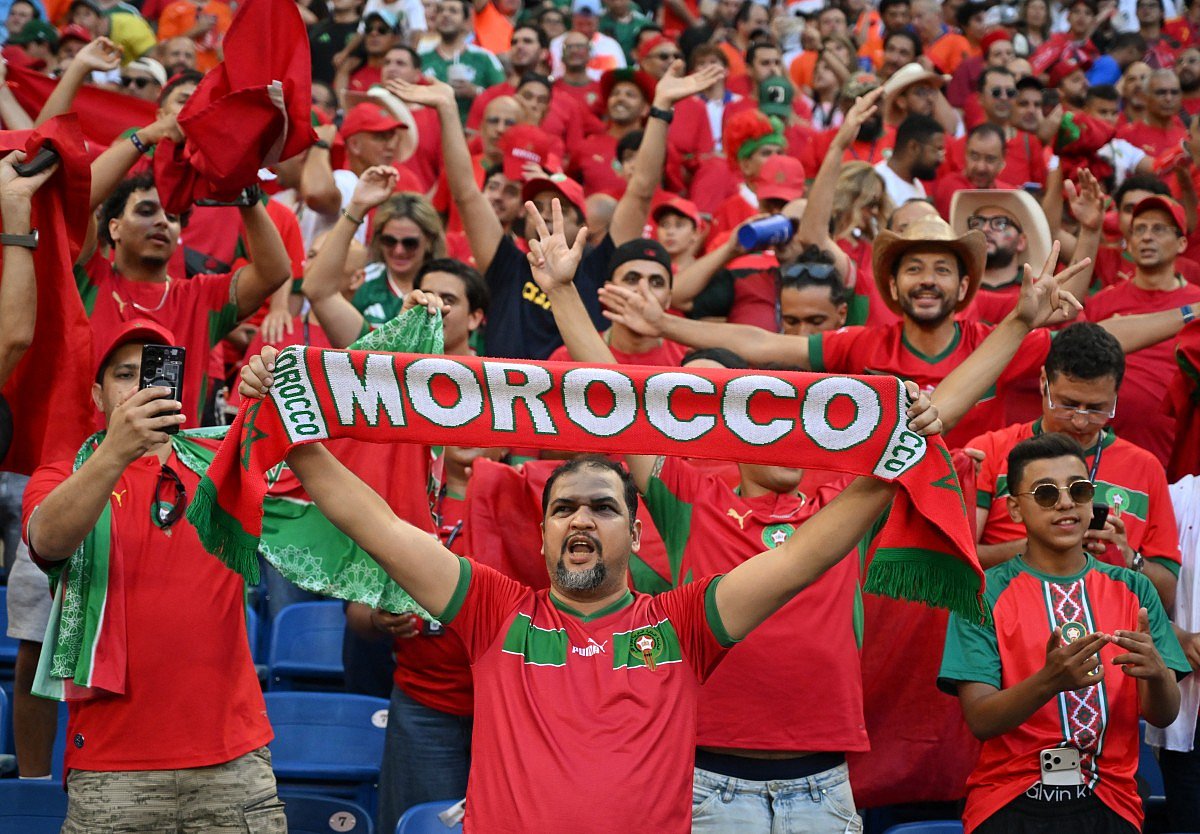
Morocco's fans cheer their team during the 2026 World Cup round of 32 football match between the Netherlands and Morocco at the Monterrey Stadium in Guadalupe on June 29, 2026.
AFP
Dubai: Just past midnight in Monterrey, Achraf Hakimi had already missed his penalty, and Morocco's World Cup looked like it might be sliding into another so-near-yet-so-far story. Then goalkeeper Yassine Bounou flung himself to his right, Crysencio Summerville's spot-kick was gone, and Ismael Saibari stepped up to thump in the winner.
Morocco had beaten the Netherlands on penalties. Another major European side undone from 12 yards, and across Africa and the Arab world, the same question grew louder. Can Morocco actually win the World Cup?
It is not a fanciful question anymore. No African nation has ever won the tournament, and before Morocco's run in 2022 none had even reached the semi-finals. Yet here they are again, deep into the knockouts and refusing to play the underdog.
A shootout to remember
A quick note on the format, because 2026 is different. This is the first World Cup with 48 teams rather than 32, which adds an extra knockout round, the last 32, before the competition reaches its more familiar stages.
After finishing second in Group C behind Brazil, drawing with the Brazilians and beating Scotland and Haiti, Morocco met the Netherlands in that last-32 tie. It looked to be slipping away when Cody Gakpo put the Dutch ahead on 72 minutes. It was an emotional goal for Gakpo, who had taken to the pitch just days after he and his partner shared the news that they had lost their unborn son.
Morocco celebrate after the match as Morocco progress to the semi finals in 2022
Morocco refused to fold. In the first minute of stoppage time, defender Issa Diop climbed highest to glance in an equaliser and drag the tie to extra time. Soufiane Rahimi nearly settled it there and then, only for Netherlands goalkeeper Bart Verbruggen to produce a stunning save at point-blank range.
So it went to penalties, and penalties have quietly become Morocco's speciality. They even missed two of their own, Neil El Aynaoui clipping the bar and Hakimi failing to convert, but Bounou's save from Summerville handed Saibari the chance to win it. He took it, 3-2. The whole thing echoed Qatar four years ago, when Morocco knocked out Spain in exactly the same nerveless fashion, with Bounou the hero then too.
How they finished fourth in Qatar
To understand why belief runs so high, you have to go back to 2022. That run remains the proudest chapter in African and Arab football history.
Under coach Walid Regragui, Morocco topped a tough group that included former finalists Croatia and a strong Belgium side. They drew 0-0 with Croatia, then beat Belgium 2-0 and Canada 2-1 to go through.
The knockouts turned them into a phenomenon. They beat Spain on penalties, then edged Cristiano Ronaldo's Portugal 1-0 thanks to a towering Youssef En-Nesyri header, becoming the first African or Arab team ever to reach a World Cup semi-final. France, the defending champions, ended the dream 2-0, and Croatia won the third-place play-off 2-1. Morocco finished fourth, and back home the scenes did not look like those of a beaten team.
Morocco's supporters celebrate after their team won the Qatar 2022 World Cup round 16 football match between Morocco and Spain, at the FIFA fan zone in Doha, on December 6, 2022.
New coach, same belief
The twist this time is the man in charge. Regragui, the architect of the Qatar miracle, stepped down in March 2026. In his place came Mohamed Ouahbi, previously the head coach of Morocco's under-23s and stepping into a senior role for the very first time.
The timing, just months before a World Cup, unsettled plenty of fans. The ambition, though, has not dimmed. "We have all the ingredients that we need to become the best nation," Ouahbi told reporters after the Haiti win, pushing his players to believe in the title itself rather than settle for another respectable run.
Morocco head coach Mohamed Ouahbi celebrates with fans after winning in the shootout during the 2026 World Cup round of 32 football match between the Netherlands and Morocco at the Monterrey Stadium in Guadalupe on June 29, 2026.
It is the same drum Regragui banged in Qatar, when he asked simply, "Why shouldn't we dream of winning the World Cup?"
The players carrying the dream
Every great run needs a talisman, and Morocco's is Hakimi. The captain plays his club football for Paris Saint-Germain, with whom he won the Champions League last season, and he is widely rated among the best right-backs on the planet. "I think we are capable of doing it," he told the talk show ABtalks before the Netherlands game, adding that an African winner would send the country "crazy with joy."
He is far from alone. Brahim Díaz, a gifted playmaker at Real Madrid who switched his international allegiance from Spain to Morocco, supplies much of the creativity. Saibari, a midfielder in superb form, arrived at the tournament with three group-stage goals and then buried the winning penalty. And in Bounou, Morocco have the shootout specialist that opponents have learned to dread.
Brahim Díaz #10 of Morocco challenges Casemiro #5 of Brazil during the FIFA World Cup 2026 Group C match between Brazil and Morocco at New York New Jersey Stadium on June 13, 2026 in East Rutherford, New Jersey.
A deeper bench this time
Perhaps the most important difference from 2022 is what sits on the bench. Tournaments are long and gruelling, and squads win them as much as starting elevens do.
Where Regragui leaned on a settled core, Ouahbi can summon genuine game-changers. Against the Netherlands it was the substitutes who turned the tie. Rahimi almost won it in extra time, and Chemsdine Talbi coolly scored his penalty in the shootout. Younger midfielders such as Ayyoub Bouaddi and El Aynaoui give the team fresh legs in the closing stages, something Morocco simply did not have last time.
Hakimi puts the team spirit down to something less tactical. "We have fun, dance, laugh, play cards," he said, describing a dressing room he calls one big family.
Next match
The reward for beating the Dutch is a last-16 meeting with co-hosts Canada in Houston on 4 July, with a place in the quarter-finals on the line. Facing one of the host nations means a partisan crowd and a little extra pressure, but it is a tie Morocco will fancy.
Beyond that, the tournament's heavyweights start to appear. Nobody in the Moroccan camp seems remotely fazed. "We came here for a reason," Ouahbi said. "We can play against anyone."
After Spain, after the Netherlands, after a fourth-place finish that once looked like the ceiling, fans are now hoping history will be made.
Network Links
GN StoreAbout Gulf NewsTerms & ConditionsReach by GNSitemapContact usPrivacy PolicyGN FocusHave your sayWork with usAdvertise with usGulf News epaperPrinting Services
Download our app
© Al Nisr Publishing LLC 2026. All rights reserved.