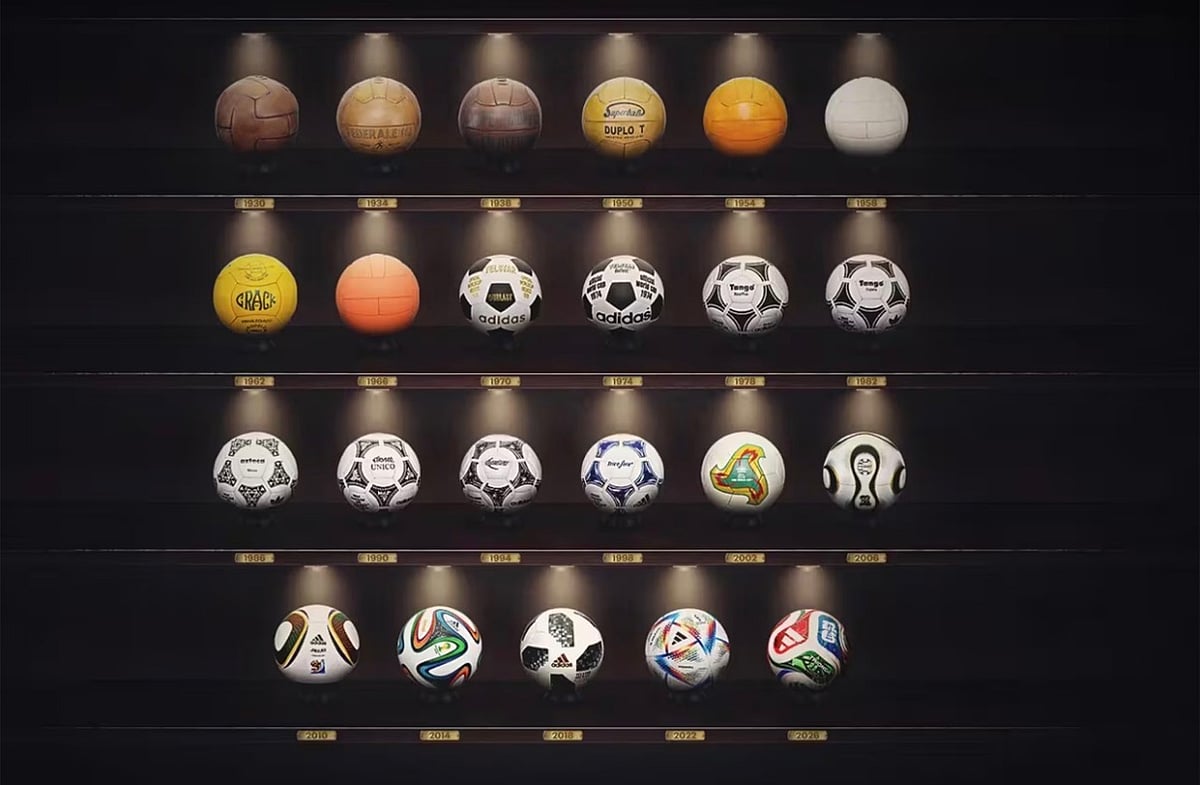
1930 Uruguay: The T-Model
Dubai: With the 2026 World Cup just days away, the world is gearing up for a month of jaw-dropping goals, tactical masterclasses, and unavoidable pub debates. But while we obsess over superstar lineups and tactical formations, the single most important player on the pitch often gets completely overlooked: the ball itself.
The tournament’s official match ball has undergone a wild evolution over the last century, transforming from heavy, waterlogged cowhide laced up by hand into a hyper-futuristic, sensor-packed sphere that literally has to be plugged into a wall to charge before kickoff. Ahead of the opening whistle in North America, let’s take a look back at the iconic history, design triumphs, and hilarious controversies of the World Cups’ most essential stars.
1. 1930 Uruguay: The T-Model
Heavy, brown cowhide leather featuring an unmistakable T-shaped panel pattern. It was laced up by hand and contained an inflatable bladder. There wasn't an 'official' ball yet, which caused an intense pre-match argument at the final. Argentina insisted on using their own ball, while Uruguay demanded theirs. To keep the peace, the referee flipped a coin: Argentina's ball was used in the first half (they led 2-1), and Uruguay's T-Model was used in the second half (Uruguay roared back to win 4-2).
2. 1934 Italy: Federale 102
1934 Italy: Federale 102
A 12-panel leather ball. It replaced the rough, heavy leather laces of the past with softer, cotton laces. Fun fact: Heading the old leather balls was already painful, but hitting the heavy leather laces of previous balls could literally cut a player's forehead. The Federale 102’s switch to cotton laces was a massive relief for players who dared to score diving headers.
4. 1950 Brazil: Superball Duplo T
1950 Brazil: Superball Duplo T
Premium leather, but with a massive technical breakthrough: it was the first World Cup ball to completely eliminate external laces. It utilized an internal valve for inflation instead.
5. 1954 Switzerland: Swiss World Champion
1954 Switzerland: Swiss World Champion
An 18-panel construction made of bright yellow/orange tanned leather, deviating from the traditional dark brown. This was the first time the World Cup ball was dyed a bright, vibrant yellow-orange color. The reason? It made the ball infinitely more visible to spectators in the stadium and for the early, grainy television broadcasts of the 1950s.
6. 1958 Sweden: Top Starc
1958 Sweden: Top Star
24-panel leather ball treated with a water-resistant sealant. Selected from over 100 unlabelled test balls submitted to FIFA officials in a completely anonymous test.
7. 1962 Chile: Crack
1962 Chile: Crack
An irregular 18-panel design that attempted to resemble a modern sphere but struggled with consistent quality control. The ball was a disaster. It absorbed water like a sponge, turned a dark, heavy mud color during rain, and frequently deflated mid-match. Most referees and players preferred alternative balls instead.
8. 1966 England: Challenge 4-Star
1966 England: Challenge 4-Star
High-grade leather consisting of 25 panels. It came in both distinct orange and yellow variants. This was the final leather ball used before sports giants took over production.
9. 1970 Mexico: Telstar
1970 Mexico: Telstar
Genuine leather treated with a 'Durlast' plastic coating to repel water. This was the debut of the iconic 32-panel black-and-white design. The name stood for 'Television Star' a nod to Mexico hosting the first globally televised World Cup. This is the most famous ball design in human history. Adidas created the 20 white hexagons and 12 black pentagons specifically so viewers watching at home on black-and-white television sets could actually track where the ball was on the pitch.
10. 1974 West Germany: Telstar Durlast
1974 West Germany: Telstar Durlast
Polyurethane-coated leather (Durlast), making it highly resistant to scuffs and water logged conditions and a continuation of the classic geometric design. The water-resistant coating worked so well that even when matches were played in torrential downpours, the ball retained its exact weight and shape
11. 1978 Argentina: Tango Durlast
1978 Argentina: Tango Durlast
32 leather panels coated in a glossy, water-repellent plastic film. The design was so wildly popular that it became the blueprint for football design for the next two decades.
12. 1982 Spain: Tango España
1982 Spain: Tango España
A mix of leather with revolutionary rubberized waterproof seams. Because the seams were sealed with rubber, it was technically the most waterproof ball ever made at the time
13. 1986 Mexico: Azteca
1986 Mexico: Azteca
The world's very first 100% fully synthetic match ball. No leather whatsoever. The intricate murals and geometric patterns printed on the ball were heavily inspired by ancient Aztec architecture and artwork. Going fully synthetic changed everything. Because it didn't absorb a single drop of water, it stayed incredibly light and fast.
14. 1990 Italy: Etrusco Unico
1990 Italy: Etrusco Unico
Synthetics paired with an internal layer of black polyurethane foam to give the ball high energy return. The triad designs on the ball featured three distinct Etruscan lion heads, honoring Italy's ancient pre-Roman history.
15. 1994 USA: Questra
1994 USA: Questra
Encased in five different layers, including a high-tech layer of polystyrene foam that made it softer to touch and much more aerodynamic. Decorated with star graphics and cosmic imagery, celebrating the 25th anniversary of the Apollo 11 moon landing and America's "quest for the stars."
16. 1998 France: Tricolore
1998 France: Tricolore
Syntex layers matrixed with micro-glass bubbles filled with gas to distribute impact energy perfectly. Moving away from traditional black and white, this was the first multi-colored World Cup ball, proudly sporting the blue, white, and red of the French national flag. The design broke a 28-year tradition of strictly black-and-white graphics. French fans took it as a good omen, and the host nation went on to win the entire tournament using their patriotic ball.
17. 2002 Korea/Japan: Fevernova
2002 Korea/Japan: Fevernova
Made with thick syntactic foam layer held together by a highly durable knitted three-layer matrix. It featured a bold, fiery Asian-inspired graphic that looked like a spinning shuriken or a flame, breaking away from the old Tango pattern completely.
18. 2006 Germany: Teamgeist
2006 Germany: Teamgeist
A drastic reduction to just 14 thermally bonded panels (no stitching at all), creating a near-perfectly smooth surface. The name translates to 'Team Spirit'.
19. 2010 South Africa: Jabulani
2010 South Africa: Jabulani
Cut down to just 8 thermally bonded 3D panels, featuring "Grip 'n' Groove" technology. "Jabulani" means "to celebrate" in isiZulu. The design featured 11 distinct colors, representing the 11 players on a pitch and the 11 official languages of South Africa.
20. 2014 Brazil: Brazuca
2014 Brazil: Brazuca
Just 6 identical interlocking panels. The name is an informal term for "Brazilian" or their way of life. The swirling multi-colored ribbons mirrored traditional Brazilian wish bracelets and the lively Amazon river.
21. 2018 Russia: Telstar 18
2018 Russia: Telstar 18
A modern, blocky reimagining of the original 1970 32-panel ball, built with a 6-panel metallic pixel layout. A retro tribute to the dawn of televised soccer, updated for the digital age with pixelated graphics. This was the first World Cup ball to feature an NFC (Near Field Communication) chip embedded inside. Fans who bought the ball could tap it with their smartphones to unlock exclusive digital content, player challenges, and location-based data.
22. 2022 Qatar: Al Rihla
2022 Qatar: Al Rihla
A record-breaking, ultra-minimalist 4-panel thermal design. It features deep, engineered seams and microscopic embossed textures for grip. "Al Rihla" translates to "The Journey." Its sharp, angular geometry was directly inspired by traditional Qatari dhow boats, local architecture, and the national flag. This ball literally had to be charged via a plug before matches! It contained a state-of-the-art 500Hz motion sensor suspended in the center that tracked location data 500 times a second, allowing VAR officials to instantly detect offsides and determine if a player touched the ball.
23.2026 Canada/Mexico/USA: Trionda
2026 Canada/Mexico/USA: Trionda
The name translates from Spanish as "Three Waves," celebrating the historic partnership of the three host nations. The graphics weave together Canada’s maple leaf, Mexico’s golden eagle, and the United States’ star into a central triangle.The Trionda features an upgraded, side-mounted tracking sensor that communicates seamlessly with stadium cameras to generate real-time 3D player avatars for instantaneous offside checks. To bring the tournament to the fans, a special digital partnership actually turns the universal soccer emoji into an animated Trionda ball inside WhatsApp chats throughout the tournament.
When the brand-new Trionda ball rolls out into the center circle this summer, it will carry the weight of three host nations and the highest-tech tracking sensors ever engineered. But whether a ball is a sensor-infused masterpiece or a heavy brown leather lace-up from 1930, the magic remains exactly the same. So, as you settle in to watch this year's tournament, give a little nod to the ball on your screen; after all, it’s the one piece of gear keeping the entire world on the edge of its seat.
Sign up for the Daily Briefing
Get the latest news and updates straight to your inbox
Network Links
GN StoreAbout Gulf NewsTerms & ConditionsReach by GNSitemapContact usPrivacy PolicyGN FocusHave your sayWork with usAdvertise with usGulf News epaperPrinting Services
Download our app
© Al Nisr Publishing LLC 2026. All rights reserved.