President Ferdinand "Bongbong" Marcos Jr and former President Rodrigo Duterte during happier times. Duterte is now in the Hague facing of charges of "crime against humanity" for his deadly "war on drugs" during his six-year watch (2016-2022). Marcos Jr is facing backlash of Duterte's daughter Sara, the current vice president. In the Philippines, political families convert social ties into votes.
How Manila elite kickbacks-driven development keeps the Philippines trapped
Development model and culture reinforce kinship politics, patronage, and selective justice
Last updated:
7 MIN READ
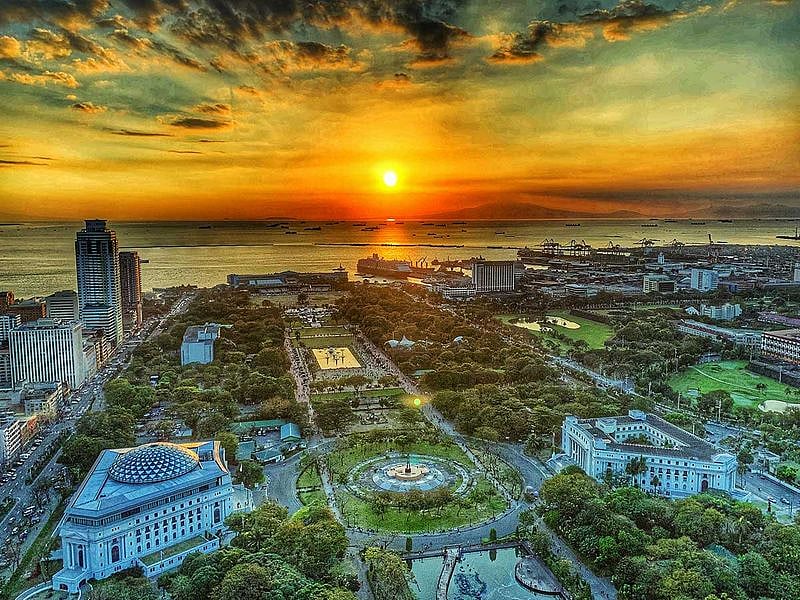
The Philippines is frequented by typhoons, floods, earthquakes. While these can be solved by engineers, there's a bigger disaster: the culture of kickbacks and impunity, a head-scratcher for many. Photo: An aerial view of the Luneta Park in Manila.
Shutterstock
Manila: During ex-President Rodrigo Duterte's term (2016-2022), Department of Public Works and Highways (DPWH) Secretary Mark Villar oversaw the Local Water Utilities Administration (LWUA), as DPWH supervised it.
PrimeWater Infrastructure Corp. — Villar family-owned — saw concessions explode from 7 to over 75 "joint venture agreements" (JVAs) with local water districts, amid allegations of elite capture, with no regulatory oversight.
Sprike in water rates: 'safe to drink'
Philippine utilities exemplify corporate capture inefficiency: Manila Water (Ayala-led) hiked rates 400+% post-privatisation.
As a result of the privatisation of water service (MWSS), water rates drastically increased by 414.4% for Manila Water and 357.6% for Maynilad in a span of only a decade, between August 1997 and January 2007, a water crisis report prepared by the UN Office of the High Commissioner on Human Rights.
Officially, the area around Manila has safe-to-drink tap water. Unofficially, the water filtration business has exploded everywhere.
PrimeWater mirrors this — murky water, 2-4 hour supply, delayed repairs, yet net income soared from ₱196M (2017) to ₱1.3B (2024), even as many of its joint ventures with local water districts faced financial difficulties and service issues, Reuters reported.
Probes highlight unfulfilled infrastructure amid consumer complaints, according to local media reports by GMA and Philippine Star.
Surprise move
Mark Villar, now Senator (whose sister Camille was also elected one of the country's also 24 senators) denies involvement, claiming no stake in deals.
On December 17, 2025, the Villar family sold 100% of PrimeWater to Lucio Co's Crystal Bridges Holding for undisclosed terms, divesting amid political backlash and Marcos-ordered LWUA probes into service failures.
House Resolution 22 (July 2025) seeks congressional inquiry into irregularities, as per Asian Journal.
The Philippines’ dominant development model — centralised, elite-driven, and clientelist — often runs headlong into the country’s deep historical, geographical and cultural realities.
Rather than aligning economic growth with broad-based institutional reform, this model reinforces old patterns of kinship politics, patronage, and selective enforcement.
Elite capture traits
The power situation is no different: Meralco, the Philippines' largest electric distributor, is primarily owned by a consortium of elite conglomerates. Beacon Electric Asset Holdings Inc. (controlled by Manuel V. "MVP" Pangilinan's First Pacific Group via Metro Pacific Investments Corp.) holds about 35%, while JG Summit (Gokongwei family) owns 30%, giving them combined control over 75%. San Miguel Corp. (Ramon Ang) recently acquired a 3.8% stake from Land Bank in July 2025, boosting its influence.
The Lopez family (owner of the powerful ABS-CBN nerwork) "Filipinised" Meralco in 1962, then sold most stakes (2009-2012) to Pangilinan and Gokongwei, entrenching oligarchic dominance.
As a regulated monopoly serving 8M+ customers in Metro Manila and its environs, it faces probes for excessive rates — amid complaints of overpricing and poor service. Profits hit ₱45.1B in 2024, projected higher for 2025, yet consumers bear high bills.
All these conspire to undermine a more "inclusive" development, as per the Journal of Government and Economics (ScienceDirect, 2022).
3 challenges
Three interlocking dynamics explain why:
Entrenched dynastic politics and deep tribalism;
Legal and institutional loopholes such as the Party-list and a tight unitary presidency that sidelines provinces;
Social and political culture that tolerates, and often forgives, elite corruption — leaving judicial rulings unimplemented.
Tribalism, clan-based politics
First, political “tribalism” or clan-based politics remains central here.
Families and local powerbrokers convert social ties into votes, monopolising local revenue streams, ringfencing public works contracts where kickbacks are the norm.
In many provinces, political dynasties are associated with worse development outcomes across Luzon, Visayas and Mindanao, where elite capture impedes business competition and public investment, as per Asia Society.
It's easy to see this: just drive down from the Manila (if you can brave the traffic), to check road conditions in the provinces of Quezon, Camarines Sur, Albay, Samar, Leyte. Virtually the rest of the country suffers from sub-par roads (with very few exceptions).
Research shows that the persistence of these contractor-dynasties means that development decisions tend to reflect family interests rather than long-term, whole-of-nation planning.
Centralised, patronage-driven model
Second, institutional features meant to broaden representation have been co-opted.
The party-list system — created to give marginalised sectors a voice — has been repeatedly hijacked by political operators, business interests and even fraternities who use party-list slots to expand patronage networks rather than advocate for the vulnerable.
At the same time, the Philippines’ unitary presidential system over-concentrates budgetary and political authority in Manila and at the national executive level.
For that, Filipinos must thank the framers of the 1987 Constitution.
But this poses a challenge: The Philippines, while small compared to the mighty Pacific, is actually a vast archipelago, and a highly mineralised one.
'Smallism'
The Asian nation seems mired in "smallism" mindset. Yet across the vast islands, there's evidence the nation sits on a literal pot of minerals the industrial world needs.
Mineral extraction entities based in the capital know this for decades.
Yet, for all its power under the 1987 Constitution, Manila can't keep an eye out on every development project everywhere in this nation of about 120 million.
The main island of Mindanao, the country's bread basket (land area: 104,000 km2) is bigger than the size of Switzerland and the Netherlands put together. Luzon island, where Manila us, could fit up to four Belgiums.
Yet in the 2026 budget, funding allocation earmarked for Mindanao agriculture is a pittance vs the budget earmarked for the National Capital Region (where malls and urbanisation have overtaken farms).
A weak party system magnifies this effect.
Result: local bosses remain the primary link between citizens and the state, perpetuating uneven service delivery (especially with the healthcare system tied to patronage-driven MAIFIP, aka $865-million "health pork" for 2026).
Chronic neglect of many provinces, public works kickbacks, sub-par infrastructure, MAIFIP-based healthcare, and vote-buying/selling form a vicious cycle.
'Soft', 'sabong' culture
Third, a culture of personalised politics and social forgiveness blunts accountability. Singapore's founding father Lee Kuan Yew, in his biography, had cited Filipino culture as a "soft" one.
It places high value on interpersonal loyalty, family solidarity, and reconciliation. While those norms can be constructive socially, it's also problematic: when they supplant institutional accountability.
Now, here's a wild one: one of the biggest, most enduring cultural relics here is "sabong" (cockfighting), a Php50-billion-a-year religion (that's pre-online sabong explosion).
People watch as a referee (sentenciador) officiates a cockfighting match at the San Pedro Coliseum in Laguna province on August 26, 2022.
Trivia: In the local sabong culture, the central bet-taker/bookie who stands with outstretched arms, is called the "Kristo" (Christ).
His job: collect bets and act as a trusted mediator between bettors and cockfight organisers. This require incredible memory and math skills.
Legal culture, dynamics
These dynamics intersect with a judiciary and enforcement apparatus that sometimes produces landmark rulings but fails at implementation.
High-profile examples include prosecutions and asset cases against members of ruling families where court orders are stalled, deferred, or only partially enforced.
This undermines public faith in the rule of law: it signals that elite transgressions carry limited consequences.
The deferred arrest and repeated legal manoeuvres surrounding the case of Imelda Marcos, for example, illustrate how convictions or legal actions do not always translate into effective enforcement.
This reinforces perceptions of impunity. Leading political families take turns. Result: large-scale corruption, and targetted killings, especially those pulled off by ruling families, go unpunished.
Development trap
Due to the above reasons, here's what it amounts to:
Philippines is locked in a development trap.
Basic engineering solutions to persistent problem (i.e. flood control), turn into eltie milking cow.
Patronage, not efficiency, is top priority in central policy, which is filtered through local power structures
Legal reforms are weakened by co-optation.
Judicial victories do not automatically produce accountability.
Shockingly, no amount of flooding or natural disaster seems to awaken Filipinos from their deep slumber.
Every election, marked by widespread vote-buying, only reinforces more of the same.
People, especially in the provinces, actually expect to get paid for their votes.
How to break the cycle?
Breaking the cycle requires institutional redesign (i.e. stronger party systems and more fiscal decentralisation), genuine reform of representation mechanisms like the Party-list, and tweaks that make judicial outcomes enforceable, rather than symbolic.
Easier said than done.
While there's a widespread clamour for a federal-style system of governance to replace the current centralised, unitary and presidential form, nothing came out of it.
There's hope: The Moros finally have their own autonomous government, in what is sometimes called a "sub-state."
There are faint stirrings of change, thanks to tech and changing demographics.
Millennials and GenZ, the Tik-Tok generation, are keenly aware of what works elsewhere, and are growing in numbers. There are signs they are change voting culture and patterns.
Amid the flood of corruption scandal, there are growing calls for a "reset", especially from retired military officers.
This is problematic, and could potentially push back the nation's had-won democratic gains.
Manila busy with its own woes
While Manila wrestles with its own daily soap opera — led by what is arguably the worst traffic on the planet — the rest of the country plays the role of long-suffering side character.
Provinces juggle rotating blackouts, chronic underinvestment in energy, electric cooperatives not known for efficiency, and electricity rates so high they feel personal.
Add to that corporate capture of utilities and the uniquely Filipino subplot of family-and-tribe-based “disappearances” of public funds, and you have a narrative that feels like a plan.
And yet — plot twist — Filipinos endure.
Resilience is not just a buzzword here; it’s a survival skill honed by practice.
This is a country that absorbs typhoons like calendar events, lives with earthquakes as background noise, coexists with active volcanoes, and somehow treats corruption as a weather condition: inconvenient, expected, and rarely surprising.
Perhaps that’s why Filipinos tend to thrive best when "exported".
Nearly 10 million live and work abroad, quietly excelling in hospitals, ships, homes, and offices around the world.
It’s one of the country’s most open secrets, and a top dollar generator: when removed from a dysfunctional system, Filipinos flourish.
Talent is not the problem
The problem isn’t talent. It never was.
The real boss battle: culture.
Not culture in the food-and-fiesta, elderly care or happiest-in-the-world Christmas sense — that part is world-class — but political culture.
Voter education remains thin and civic norms fragile.
The temptation to trade long-term public good for short-term patronage remains strong. Too often, elections are treated like family reunions, not job interviews.
Loyalty beats competence; surnames outperform resumes.
Until Filipinos collectively raise their standards — demanding service over favours, institutions over personalities, and accountability over ready forgiveness — the cycle will continue.
Development rarely does without homework. Pain. Sacrifice.
A key redeeming grace for the Asian nation: the military.
As an institution, the Armed Forces of the Philippines (AFP) have fought hard against decades of deadly communist rebellion, Moro separatism, numerous coups and, now, a growing threat from a resurgent neighbour over disputed islets.
Amidst these challenges of culture, it makes one wonder: Can a durable, more equitable development can really happen here?
Still, if there’s one thing Filipinos are good at, it’s surviving the impossible.
The question is whether survival will finally give way to self-respecting governance — or whether the nation will keep ignoring, smiling through the pain and self-inflicted wounds.
Sign up for the Daily Briefing
Get the latest news and updates straight to your inbox
Network Links
GN StoreAbout Gulf NewsTerms & ConditionsReach by GNSitemapContact usPrivacy PolicyGN FocusHave your sayWork with usAdvertise with usGulf News epaperPrinting Services
Download our app
© Al Nisr Publishing LLC 2026. All rights reserved.