Dubai’s new 80km road project explained: Route, traffic cuts and what’s being built
New Dubai highway to divert trucks, boost links with Sharjah and Abu Dhabi
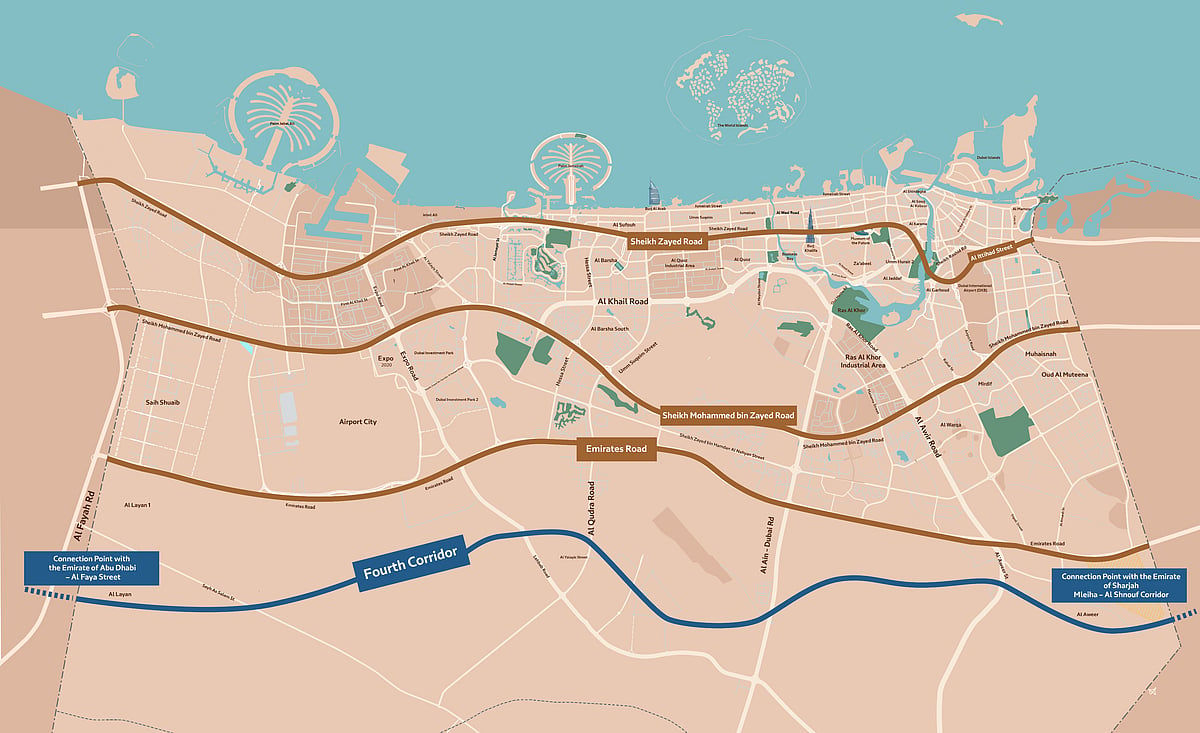
Dubai: Dubai’s planned New Fourth Corridor will stretch about 80km between Al Shanouf Road in Sharjah and Al Faya Road in Abu Dhabi, with the project designed to cut journey times, divert through traffic and strengthen road connections between the emirates.
The corridor will be built in two phases, with the first 30km section costing around Dh3.5 billion and extending from Al Shanouf Road in Sharjah to Dubai–Al Ain Road.
On parts of the route, motorists could see journey times cut by more than half. Phase 1 is expected to reduce a 35-minute journey to 14 minutes, while Phase 2 will cut another journey from 50 minutes to 24 minutes.
Where will Dubai’s Fourth Corridor run?
The New Fourth Corridor will connect Al Faya Road in Abu Dhabi with Al Shanouf Road in Sharjah, spanning approximately 80km through Dubai.
His Highness Sheikh Hamdan bin Mohammed bin Rashid Al Maktoum, Crown Prince of Dubai, Deputy Prime Minister and Minister of Defence of the UAE, and Chairman of The Executive Council of Dubai, approved the implementation of the project.
The corridor will be the fourth strategic corridor linking the UAE’s emirates, following Sheikh Zayed/Al Ittihad Road, Sheikh Mohammed bin Zayed Road and Emirates Road.
How will the project be built?
Given the scale of the project, the corridor will be divided into two main phases to accelerate implementation and ensure completion on schedule.
The overall project will include 72 bridges, 17 tunnels and 45 stormwater drainage culverts.
It will also support logistics traffic and pass through several key landmarks, including Al Maktoum International Airport, Al Marmoom Desert Conservation Reserve, Al Wohoosh Desert Conservation Reserve and the Etihad Rail route, as well as residential and development areas.
What will Phase 1 include?
Phase 1 will cover approximately 30km, running from Al Shanouf Road in Sharjah to Dubai–Al Ain Road.
The phase will include a 12-lane through corridor across both directions, with a capacity of up to 24,000 vehicles per hour in both directions. It is expected to serve around 600,000 people.
The project is expected to reduce journey times by 60 per cent, cutting one 35-minute journey to 14 minutes.
Phase 1 will also include:
Approximately 55 lane-kilometres of at-grade roads
2.5km of tunnels
21km of bridges and ramps
Widening Dubai–Al Ain Road from three to four lanes in each direction between Emirates Road and Lehbab Road
Upgrades to four major intersections
What will Phase 2 include?
Phase 2 will cover the remaining 50km, connecting Dubai–Al Ain Road with Al Faya Road in Abu Dhabi.
It will comprise roads with 12 lanes across both directions and have a capacity of 24,000 vehicles per hour.
This phase is expected to reduce journey times by 52 per cent, cutting a 50-minute journey to 24 minutes, and will serve around 3.1 million people.
It will include approximately:
190 lane-kilometres of at-grade roads
3.5km of tunnels
157km of bridges and ramps
How will the corridor reduce traffic?
A key purpose of the New Fourth Corridor is to divert through traffic, particularly trucks, away from urban areas.
This is intended to ease pressure on existing road corridors while improving traffic flow and road safety.
The corridor will also strengthen connections between Dubai and the other emirates and support integration between the road network and the wider transport system through links to major projects such as Al Maktoum International Airport and Etihad Rail.
The project is also intended to support logistics and commercial transport, keep pace with urban expansion in new areas and enable smoother traffic flow over the long term.
Network Links
GN StoreDownload our app
© Al Nisr Publishing LLC 2026. All rights reserved.