Pebbles, the 41-year-old pony in Ras Al Khaimah
Ras Al-Khaimah's horse rescuer: How one woman saved over 50 ailing horses and gave them a safe haven
Yasmin Sayyed tells us about her rescued horses choose how they live, heal and roam
Last updated:
11 MIN READ
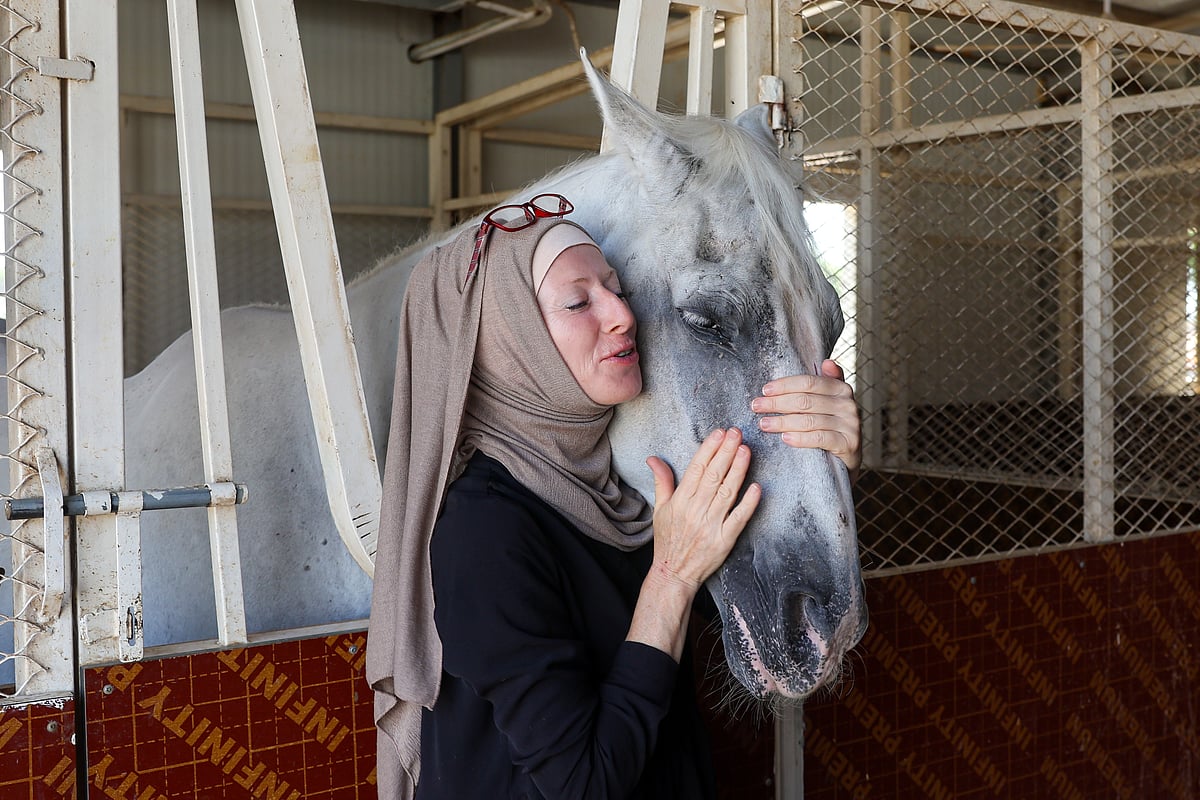
Yasmin Sayyed, founder of Ride to Rescue Animal Shelter in Ras Al Khaimah.
Photo: Virendra Saklani/Gulf News
In Ras Al-Khaimah, a series of winding roads lead to Yasmin Sayyed's little home for horses.
The road ends and the earthy smell of the horses begins.
We walk into the sanctuary and watch a couple of horses doing their morning trots, circling inside their stables. The people here point out Yasmin's stables are at the far end of the farm, and we walk past a glaring goat, a pile of cosy sleeping cats, and hear the sound of hooves.
One of the horses is waiting eagerly for Yasmin; he is a tad disappointed it's only us.
As we wait for Yasmin, we walk around the shelter she has spent the past nine years bringing to life, with the help of a dedicated staff, including Shankar. He acquaints us with Pebbles, a demure little 41-year-old pony trotting around on the sands. She just might be one of the oldest ponies in the UAE, he notes.
We watch another horse getting a bath as Shankar briefly explains that there are at least 35 horses in the stables; many rescued from illness and abandonment.
In this atmosphere of neighing and pawing horses, along comes Yasmin, bright, fresh and beaming, after feeding over several cats in her house as she explains.
"She will tell you everything," says Shankar.
She does.
'Horses are in your blood. You must continue'
Standing near a white horse who demands her attention by nibbling at her, Yasmin sketches out her story in brief. Born and raised in Germany, she has a Palestinian father and a Greek mother, and has lived in the UAE since 2004. "I came here because of fashion design, because that's what I studied," she says.
Yasmin, who speaks over eight languages, found her way to the racing stables and spent more than 10 years training in endurance riding. But after a series of accidents, she had to stop. As she grew older, she thought that she would stop with horses completely.
Yet, the horses were always on her mind. "I just missed the horses, and I said to my father on the phone, Baba, 'I miss the horses'. He came, and he always puts the pieces of Yasmin together," she says.
He told her, that horses were in her blood. She must continue.
Yasmin did, and began rescuing horses in 2014. In 2017, the shelter Ride to Rescue, was set up. Till date, she has saved over 50.
Horses inside Ride to Rescue Animal Shelter in Ras Al Khaimah.
Salambo, the first rescue
Her first rescue, Salambo, is a permanent fixture in her conversations. He is always present, even though he is in the past, and Yasmin remembers each detail about him like she just met him yesterday.
He was a big German horse with motor neurone disease whom she happened to come across at a stable where she was training private horses. "I fell in love with him," she says.
The horse was always lying down, and always tired. She started to reach out to the management and to the owners, and learnt the nature of his disease. And so, Yasmin fought to keep him alive and Salambo lived for around 10 years. "He was a dream horse, and he looked like one of the horses that I used to ride in Germany. It was like an arrow to my heart."
The horse was in pain, with people telling Yasmin that it was best to let him go, but she just couldn't turn away. "Some horses tell me 'don't pity me please'. I don't want your pity'."
As Yasmin says, the horse sensed her willpower and stubbornness to go against everyone and keep him alive. "Horses are very telepathic. They can read you before you enter the stable. They know you," she adds.
Horse getting a bath. Photo: Virendra Saklani/Gulf News
How one rescue became a mission
Word quickly spread after the case of Salambo.
People would take their horses to Yasmin, requesting her to 'fix' them. Overwhelmed, she was also facing a financial burden she wasn't prepared for.
Yet, it happened, 'little by little', as she says. One horse here, two horses there. There were four and then there were 10. "I don't remember how the numbers grew actually. I remember I had 19 horses at one point, and there was another horse suffering from severe lameness coming to us."
The horse was from her close friend, and Yasmin informed her: They were full, already. But, as she began to understand, she was feeding 19 anyway. Will 20 be too much? And then 21, and then it expanded to 35, which is the current number. "So, when people ask me about the number of horses I have, I have to write down every single name, so I remember."
Besides the horses, the shelter is home to four donkeys and over 60 cats. "We need around Dh3,000 a day to run this operation," she says, explaining that they have staff and registered as a business. There are numerous details to account for, and the expenses do get astronomical, as Dh3,000 a day amounts to over a million a year.
The horses find her
The natural question to ask is how she finds the horses. However, she answers blithely: The horses find her. She doesn't go from stable to stable looking for horses. But if she sees one in trouble, she may take it on. She has also learned the hard lesson of looking away, because otherwise, she says, she would have more than 200 horses.
Instead, people reach out to her. Sometimes they are tourists who happen to spot a horse that appears unwell or underweight. At other times, they are owners who have found themselves struggling to care for a horse with a serious illness or injury, or one that may need years of recovery before it can be ridden again, if it can be ridden at all.
But Yasmin is quick to point out that she does not take every horse that comes her way. She says she turns down around 30 or 40 horses a year, taking only one, two or three in a typical year. The cases she does accept tend to be the ones that stay with her, sometimes because she already knows the horse or remembers encountering it years earlier.
And then, she says, there are the cases that feel almost like fate. She may see a horse and have an instinct that it belongs with her, only for someone to contact her later asking if she can take it. "It happened like a magic," she says.
At this point in our conversation, she introduces us to Mr Nounou, who is tugging away at her, waiting for his slice of attention. "He just wants a massage from me," she says, laughing as she gives an impatient Mr Nounou a few rubs. "We have a very special language," says Yasmin as she cuddles the horse, who is now relatively soothed.
Yasmin Sayyed founder of Ride to Rescue Animal Shelter in Ras Al Khaimah. Photo: Virendra Saklani/Gulf News
Meeting the rest of the horses
Yasmin takes us around to see the rest of the horses in the stable. Each has a story, as distinct as their name. She has learned a different language for each horse as well. It's visible in every massage, cuddle, and conversation. We meet Pebbles, a shy pony, who isn't quite ready to meet people. She gets a good morning kiss from Yasmin, nevertheless.
As she strokes the pony, Yasmin says, "She is very old, but we are very proud to have her. I don't need like a fancy horse. If I have a 41 year old who looks still good, that makes me happy."
Further down, we meet an ex-show jumper who returned five years ago after developing colic and undergoing surgery. “It is a condition, where after the surgery, some horses lose their muscles.”
We pause at Qassim, a horse with only one eye. "Hello, our gorgeous Qassim," says Yasmin as she buries her face in the horse's mane. "Four years ago, we found him in the paddock, in the summer. I thought it was a carcass lying there, skin and bone in the middle of the day."
Horrified, she thought the horse was dead, till the groomer insisted not yet, but on the verge of death.
Yasmin had an iron-clad will, and wasn't going to walk away. She went to the horse, and found that he had no eye: It was just pus. So she told the owners that she was going to take the horse off their hands, took him to the hospital. He couldn't stand up and had a disease in his hooves, one that hasn't completely gone away.
"Just look how beautiful he is," says Yasmin patting him gently. "He is only around 13 or 14."
One horse, apparently unimpressed by the amount of attention she has received that morning, turns her back on Yasmin. Yasmin immediately goes over, gives her a few scrubs and cuddles, and peace is restored.
Yasmin Sayeed: "Every horse has a personality, and Yasmin seems to know exactly how to reach each one."
Meanwhile, one horse has broken free from its stable to meet its girlfriend in the one next door.
True love prevails.
Every horse has a personality, and Yasmin seems to know exactly how to reach each one. A Spanish horse knows the trick of lifting their legs, he needs 'payment' that involves a lot of scrubs, but then he obliges and doesn't let Yasmin down. He was also rescued from a riding school and is 'lovely' to ride as Yasmin notes, but she doesn't push him. "If you ride him today, then he will have at least a day or two off, and then after, again, I don't want my horses to become soulless robots for customers. I want them to be happy."
That may be why people come here to ride, she says. They enjoy the beauty of the horses in their own home and see that they have their own life.
After we walk past the Spanish horse, we meet another one, who had also come to Yasmin emaciated. "He came worse than this, and had fractured his leg," she says adding, that people tend to just abandon such injured horses, because they feel they're not of value anymore.
It's just the opposite for Yasmin. The horse is of highest value to her, she says, as she points out his calcified leg. "He has been with us for six years now, and no one rides him and he is still in such amazing condition."
Mr Nounou.
Giving them a choice
For Yasmin, a rescue does not end when a horse is out of danger. Keeping an animal alive is only the beginning; the harder, and the more complicated part, is giving the horse a new lease of life.
That begins with riding. The horses at the sanctuary are not ridden every day, and Yasmin climbs into the saddle only with those who are comfortable with it. "I ride sometimes, but horses love to be ridden, if you treat them well," she says.
But riding is not their only purpose. To Yasmin, the horses are "more like healers." Sometimes she just lets them wander. If a horse wants to leave its stable and explore, it can, and it always comes back, she says. The point is not to hold the horses back but to let them decide.
Let them be horses
This thinking extends to how the horses live together. Unlike a conventional stable, Yasmin says that she keeps her horses in herds. In the cooler months, they spend as much time as possible outdoors and in company. In summer, when the heat becomes punishing, many retreat indoors.
There are risks. Horses kick and bite, and they can hurt one another. Yasmin accepts that as the price of letting them live as horses. "Most people don't allow it, because they don't want injuries," she explains. "But this is part of their horse life."
Mr Qassim, a one-eyed horse.
More than what a horse can do
Many of the horses here are in their twenties. Some cannot be ridden, and some never will be again. For Yasmin, none of them is worth less for what they can no longer do.
She knows how to train a horse to be thoroughly tame, but she will not go so far that they lose what makes them themselves. “Sometimes you need to break their spirit, their personality,” she says. And, that exactly is what she wants to avoid. There are boundaries and rules, but she has no wish to turn a horse into an animal that obeys every command. As she puts it, “I like them to have a personality.”
That idea of responsibility extends beyond rescue. Another horse-lover and rescuer, Omnia Al Desoukie, who learnt to ride in Dubai as a child and has also taken on horses needing a second chance, says the growth of equestrianism has made the sport accessible to a much wider community.
“The work Yasmine is doing is very important, I admire her, not everyone can take that load on,” she says.
Desoukie remembers a time when equestrianism felt more exclusive and, in some ways, attracted people who were deeply committed to horses and their welfare. Today, she sees the sport's wider accessibility as a positive development, giving more people the opportunity to experience and care for horses. But she believes that growth also comes with greater responsibility.
“More people have the opportunity to experience the beauty of working with and caring for these incredible animals. But with that growth also comes a greater responsibility to make sure that horses are treated well and that new owners understand what responsible ownership entails.”
She has experienced that responsibility herself. Her horse Love was previously part of the riding school at a major equestrian club before Desoukie bought her from a breeder in Al Ruwayyah.
“I found it very difficult to think of her simply as a breeding horse and felt strongly that I wanted to give her a different life, so I brought her home,” she says.
She has since taken on another horse from someone who was leaving, and both experiences have made her think about how many horses end up needing a second chance.
“For me, responsible horse ownership is about much more than riding. It is about understanding the animal, providing proper care and knowing whether you have the time, resources and knowledge to look after a horse properly.”
Teaching people to listen
A similar philosophy shapes how Yasmin teaches riding. There are no spurs or whips, and the horses are ridden without martingales or nosebands. Riders learn basic and medium dressage, but the lesson starts long before they reach the saddle. They groom the horse, walk it and simply spend time with them.
This approach has not held her riders back. Children who have trained with Yasmin for years now compete in jumping and dressage. But competition is not where she begins.
First, she wants them to know the horse.
One of the horses inside Ride to Rescue Animal Shelter in Ras Al Khaimah. Photo: Virendra Saklani/Gulf News
Keeping it going
The arithmetic of a sanctuary is unforgiving. Riding brings in very little; one rider every few days is, in Yasmin's words, "like a drop of water on a hot stone" next to the cost of keeping the shelter going.
Much of the funding comes from people who discover her work on Instagram. Some donate regularly; others send money without being asked. Sometimes it is Dh1,000 or Dh2,000. Sometimes it is just Dh50.
So the sanctuary has found other ways to sustain itself, including fitness sessions involving horses. Yasmin is training as a personal trainer herself and has developed activities that let people benefit from time around horses without treating them as sporting equipment.
Perhaps that is the thread running through everything here. The horses came because of illness, injury, age or abandonment, or because they could no longer serve the purpose someone had wanted from them. Here, they are asked for very little.
And as Salambo would vouch from wherever he is, where there is life, there is still hope.
Network Links
GN StoreAbout Gulf NewsTerms & ConditionsReach by GNSitemapContact usPrivacy PolicyGN FocusHave your sayWork with usAdvertise with usGulf News epaperPrinting Services
Download our app
© Al Nisr Publishing LLC 2026. All rights reserved.