House of the Dragon Season 3 review: The Game of Thrones prequel finally roars in fire, blood and grief
The first four episodes promise a satisfying payoff to what fans have been waiting for
The House of the Targaryens have a legacy of madness.
But often, the madness has a name. It’s raw, fresh grief that never had the privilege to heal—each scar bleeds worse than the previous.
Unfortunately, we’ve only seen the women head down that road; the men’s tales are just whispered legends, at this point.
In Game of Thrones, Daenerys, who had been commanding armies and power for over seven seasons, succumbed to the madness, after she witnesses the death of her close friend Missandei. The transformation is too abrupt and jarring, as she burns down an entire city as well as the hope for a sensible finale. She is the descendant of the Mad King, after all, but she deserved more storytelling than she got.
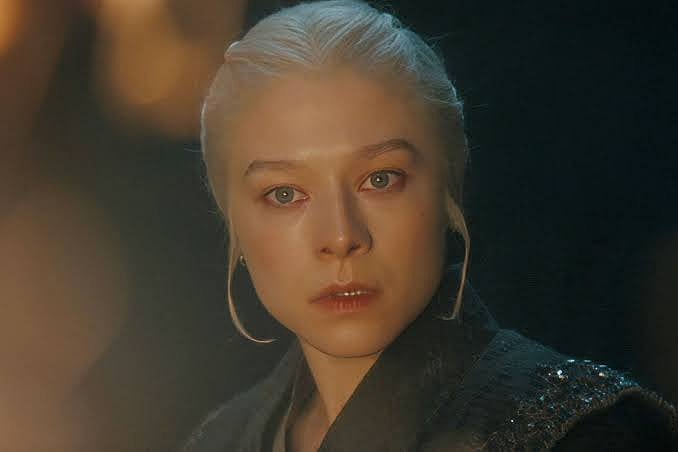
Nevetheless, in the prequel series, House of the Dragon, the unravelling of her ancestor Rhaenyra (Emma D’Arcy) appears to have begun. To grieve is a luxury, and Rhaenyra is rich in sorrow. In the third season—at least in the first four episodes, once again, she burns with another loss, as war rages on. Grief circles the new season and Emma D’Arcy is absolutely brilliant here, as she portrays a woman trying to desperately stitch herself together, but the knives of time and war keep ripping her efforts apart. The wracked sobs, the trembling and the shaking hands say enough, more than Rhaenyra needs to.
Rhaenyra's evolution or devolving, as the case may be, is a relief as compared to the previous two seasons, where D’Arcy, as scintillating as she is, remained constrained in the show’s storytelling of Rhaenyra. But, this season seemingly corrects it: We are witness to her psychological warfare, and the see the queen as she is: Fierce, yet, flailing, in her claim of the Iron Throne, and what is rightfully hers.
She is more harrowed than she was before; and yet, she is determined to keep fighting a war, where victory might be hers, but it never feels like a victory.
This sentiment colours the first four episodes at least. We pick up from the anti-climactic finale from Season 2, where Rhaenyra and her long-estranged friend and step-mom Alicent Hightower had entered into a pact: Help Rhaenyra secure the Iron Throne. Yet, how far can Alicent be trusted?
These are the riveting plot points of Season 3 till now, which, appears determined in reforming its earlier issues of momentum and pacing. War has broken out (at long last, after much dilly-dallying in Season 2). It’s time for the Battle of the Gullet, where naval forces, loyal to Rhaenyra and led by Corlys Velaryon, fight the fleet of allied city-states who promise to break Rhaenyra’s blockade on the Westerosi capital of King’s Landing.
The Battle of the Gullet may not evoke the suffocating chaos of the Battle of the Bastards or the haunting spectacle of Hardhome, but it firmly earns its place among House of the Dragon's most memorable war sequences. This is a battle fought at sea, with ships, soldiers and dragons colliding in brutal fashion. There are only a few outcomes: you're burned alive , or you are dragged beneath the waves.
Directed by Loni Peristere, the scenes are suffocating and relentless, accompanied by dragons and boat chases. Each human emotion is visible—for once, we’re watching a battle in the daylight. War has human cost and brings with immense devastation, and that, is what sears Rhaenyra, propelling her to make the choices she never would have made before. Matt Smith’s brilliant, shrewd Daemon, and Rhaenyra’s husband is as captivating as ever, and while the two to finally seem be on the same page, there are hints that this might not be permanent.
Yet, while all these are the memorable highlights from the much-awaited Season 3, House of the Dragon still has many faults: Too many characters that haven’t been fully developed properly—looking at you Ser Christon Cole, who still feels dramatically underutilised, spending much of his screen time brooding rather than driving the story forward.
The sexual violence towards women continues, perhaps less graphic than compared to the original series, and this criticism appears to always be met with: But those times….
Well the medieval times didn’t have dragons, either, but who’s arguing?
Nevertheless, then there are storylines from previous seasons that needed a payoff by now, and the lack of actual weight of politics that the original series had in the first few seasons at least. In Game of Thrones, every move felt political and had weight. HOTD is missing the fiery eloquence of Peter Dinklage’s Tyrion Lannister and Varys, sigh.
It’s still the first four episodes. The dragons still have the last roar.
House of the Dragon is exclusively available on OSN+. The first episode dropped on June 22.
Network Links
GN StoreDownload our app
© Al Nisr Publishing LLC 2026. All rights reserved.