Ciel Dubai Marina, the world's tallest hotel, recently opened in Dubai.
UAE hotels will hire again — but with leaner, tech-driven teams after renovations
Refurbishments and weak demand push hotels towards smaller, smarter teams
Last updated:
4 MIN READ
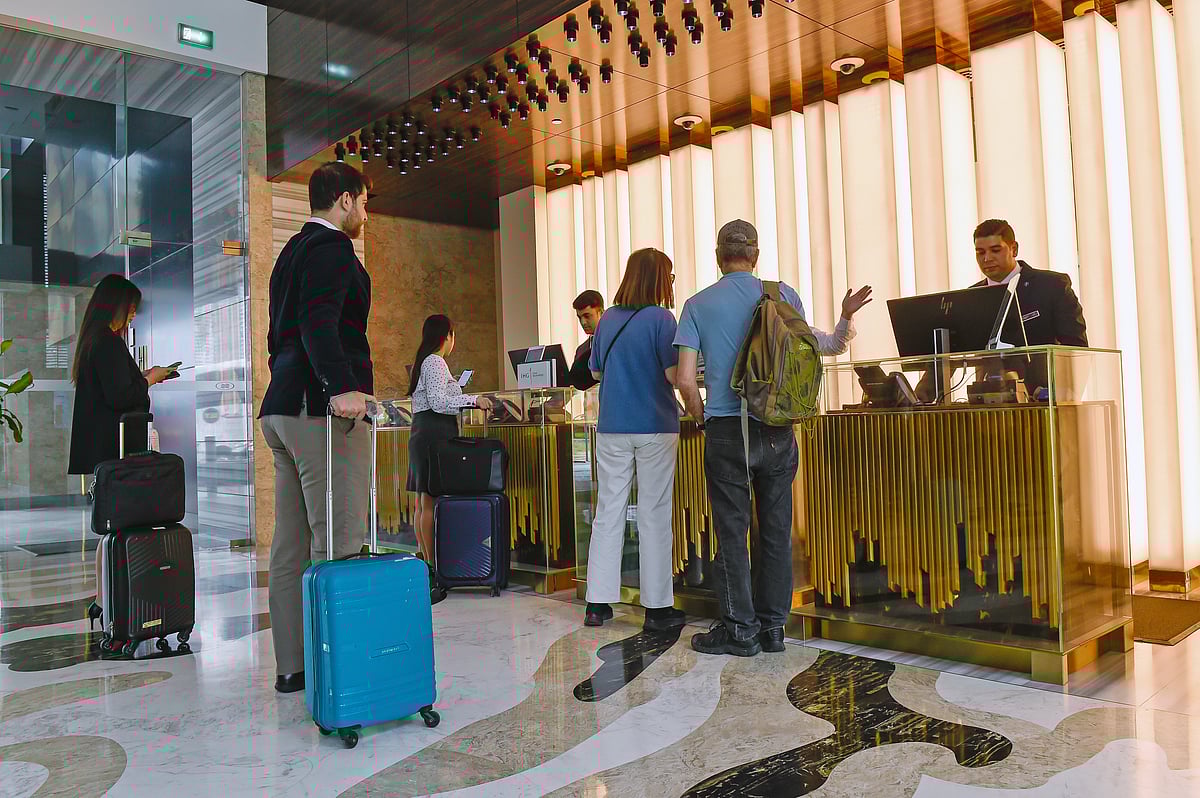
Tourists checking in at the Crown Plaza hotel in Dubai Marina. The picture is used for illustrative purposes only.
Virendra Saklani/Gulf News
Dubai: UAE hotels will start hiring again as a wave of refurbishments ends — but the jobs coming back will look very different, according to hoteliers and hospitality consultants.
UAE hotels are preparing to ramp up hiring once ongoing renovations wrap up, but industry executives say the next phase will favour efficiency over expansion.
Rather than returning to pre-existing staffing levels, hospitality groups are redesigning their workforce models — focusing on multi-skilled employees, tighter team structures and technology-led operations.
“We are seeing a short-term pause in momentum, but not a shift in direction,” said Klaus Assmann, CEO for the Middle East, India and Southeast Asia at United Hospitality Management.
“The fundamentals of the industry remain strong, but this period is pushing operators to become more data-driven and operationally efficient," he said.
What’s next?
So, what does rehiring look like when it returns? “Reopenings will bring hiring back, but not at the same scale,” according to Saurabh Tiwari, Area Director of Middle East and CIS hotels of Indian Hotels Company Limited –the Tata-owned brand which oversees Taj Hotels and its sister properties.
“The focus now is on building teams that are agile and commercially aware, not just increasing headcount,” he said.
“What has also changed is the type of talent hospitality companies are prioritising. There is now much greater value placed on adaptability, commercial awareness, crisis management, and leaders who can stay calm under pressure while keeping teams motivated," he said.
Businesses want people who can manage uncertainty, not just growth,” Tiwari explained.
The hospitality veteran said the market is undergoing a temporary phase of caution and recalibration, and long-term fundamentals remain strong. “In the immediate term, companies are hiring with more discipline and intention rather than scaling aggressively,” he explained.
Get updated faster and for FREE: Download the Gulf News app now - simply click here.
Renovations slow hiring
Across the UAE, several hotels have temporarily shut for upgrades, part of a broader push to reposition properties with stronger lifestyle, wellness and food and beverage offerings.
While these closures are strategic, they have slowed hiring in the short term, particularly in operational roles linked to room inventory.
“Many of these closures are not about contraction — they are about preparation,” Assmann said. “Operators are advancing renovation timelines to ensure their properties are fully optimised for when demand returns.”
With fewer rooms in operation, companies have tightened hiring, focusing only on essential roles while managing costs more closely.
No return to large teams
Instead of rebuilding large teams, operators are moving towards more flexible workforce models in which employees are expected to take on broader responsibilities.
“Reopenings will bring hiring back, but it will not look like before,” said Tiwari. “The focus now is on building teams that are agile, commercially aware and able to operate across functions, rather than expanding headcount across every department.”
This shift is also being driven by technology, with hotels increasingly using real-time data to monitor performance and determine staffing needs.
“At UHM, we can monitor performance in real time, from guest spend to operational metrics,” Assmann said. “This allows us to make informed decisions without compromising on people.”
Retention over layoffs
During the renovation period, most established operators have avoided large-scale job cuts, instead retaining staff and redeploying them across their portfolios.
“At UHM, our approach is consistent — we do not believe in redundancies as a response to short-term disruption,” Assmann said. “Stability in teams is directly linked to consistency in guest experience.”
Similarly, Taj has focused on retaining employees and managing internal workforce transitions.
“Across the industry, most hotel groups are trying to manage closures through retention and redeployment rather than workforce reductions,” Tiwari said. “Teams are being reassigned, cross-trained and supported through the transition.”
Employees have been moved to other properties, assigned temporary roles or encouraged to take leave, helping companies maintain continuity while hotels remain closed.
A more selective hiring rebound
As refurbished hotels return to the market, demand for talent will rise again — particularly as properties relaunch with upgraded concepts.
However, operators say the rebound will be measured.
“Demand for talent in hospitality does not disappear — it shifts,” Assmann said, pointing to new developments and evolving business models across the UAE.
Tiwari added that hiring will increasingly favour quality over quantity. “What we will see is a more balanced approach — growth driven by efficiency, adaptability and long-term sustainability, rather than aggressive expansion.”
Network Links
GN StoreAbout Gulf NewsTerms & ConditionsReach by GNSitemapContact usPrivacy PolicyGN FocusHave your sayWork with usAdvertise with usGulf News epaperPrinting Services
Download our app
© Al Nisr Publishing LLC 2026. All rights reserved.