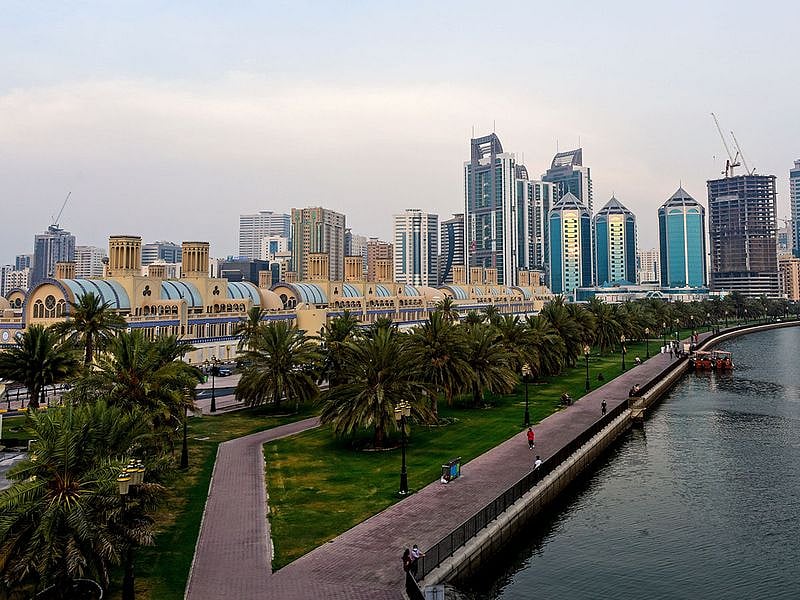
Dubai: Sharjah’s property market is seeing its strongest phase in years, with demand clustering around key community hubs such as Muwaileh, Al Zahia, Aljada and Masaar. New master-planned districts, connectivity to Dubai and competitive pricing have drawn a new profile of buyers and tenants, setting the stage for structural growth rather than a short-term cycle.
Families working in Dubai are increasingly selecting Sharjah for affordability and space, while investors are treating the emirate as a stable, value-growth market. This shift is most visible in the new community corridors that sit along strategic highways linking Sharjah to Dubai.
Pulkit Bhattia, Senior Sales Manager, Banke International Properties, said activity is being driven by strong end-user appetite. “Sharjah gives you far more per square foot than Dubai, without compromising on connectivity or community. Muwaileh has become a magnet for families and young professionals who work in Dubai but want affordability and a sense of stability.”
He added that the narrative around Sharjah has changed meaningfully. “Aljada, now considered Sharjah’s ‘city within a city’, has flipped the old narrative on its head. It is no longer the budget alternative; it is an aspirational address with solid infrastructure and a self-contained lifestyle offering.”
Record transaction growth and wider investor base
Property deals in Sharjah surged to Dh44.3 billion in the first nine months of 2025, a jump of 58.3% compared to the same period last year, according to the Sharjah Real Estate Registration Department. That already exceeds the total for full-year 2024 and marks the strongest performance on record for the emirate.
The number of transactions also climbed to 80,320, up 16.3% year-on-year. Residential, commercial and industrial assets all contributed to the uptick, underscoring broad-based confidence.
Investor participation widened sharply. Sharjah drew buyers from 121 nationalities, led by Emiratis with Dh21.1 billion across 28,561 deals. Foreign investors contributed Dh13.1 billion, Arab nationals Dh7.5 billion and GCC nationals Dh2.6 billion. The depth and diversity of capital now places Sharjah among the region’s most internationally-watched real estate stories.
Rental hotspots and steady price movement
Rental data points to a steady demand base. Bayut figures show Al Khan, Al Taawun, Al Majaz and Al Nahda remained among Sharjah’s highest rent districts, with Al Khan topping average rates and Al Taawun recording a 10.7% jump for studio units. Muwaileh maintained the highest average rent for one-bedroom apartments.
Analysts say this reflects a maturing market that has begun to balance supply with demand. “Sharjah is standing out not for headline-grabbing price hikes like Dubai, but for a strong value-upside play that is often overlooked,” Bhattia said.
He noted Sharjah’s average gross residential yield at around 4.95%, marginally above the UAE average of 4.87%. Dubai yields are higher, often in the mid-6 % range, but Sharjah’s appeal lies in its combination of returns and affordability.
“Investors are not choosing Sharjah because it offers the highest yield per se,” Bhattia said. “Sharjah offers smart yield plus growth optionality.”
Bhattia expects rental growth in the range of 8 to 12% in 2026, calling it a sustainable level driven by end-user demand, not speculative pressure. “Sharjah is about sustainable value-led growth, not rapid spikes, and that is a differentiator for clients looking beyond Dubai’s volatility.”
Master-planned districts reshape demographics
New master-planned communities are reshaping Sharjah’s urban economy. “Communities such as Aljada and Masaar are doing more than adding inventory. You are seeing more families, professionals relocating for lifestyle, and investors thinking long-term rather than purely cost-driven,” Bhattia said.
Developers are doubling down on this trend. Fourteen new projects were registered across eleven areas in 2025, including launches in Al Khan, Al Nahda and Tilal City. These follow infrastructure upgrades, new lifestyle retail clusters and enhanced public amenities.
The shift is also being supported by freer ownership laws. Sharjah’s gradual expansion of freehold zones has attracted deeper pockets and longer holding cycles, particularly from institutional and high-net-worth investors building diversified exposure across the Emirates.
Strong economic backdrop supports long-term cycle
Sharjah’s economy is projected to grow up to 7.5% in 2025, supported by foreign investment inflows and infrastructure programmes. Demand is broadening across apartments, villas and industrial plots, with more than 150 million square feet transacted across 239 areas.
With the UAE property market forecast to grow by about 8% this year, Sharjah’s double-digit trajectory places it among the region’s fastest-growing real estate markets.
Bhattia said Sharjah has transitioned into a new phase. “Sharjah’s surge is a structural shift. As freehold zones expand and infrastructure strengthens, we are seeing the emirate graduate from a ‘value play’ into a ‘growth play’.”
For buyers, the appeal remains space, community and relative affordability. For investors, it is stability, predictable income and potential upside. For developers, it is a chance to scale mixed-use and lifestyle-driven expansion.
The market has matured, observers say, into one where fundamentals rather than speculation sit at the core. Sharjah has begun to chart its own course, not in the shadow of Dubai, but as a market where long-term capital, end-users and master-planned delivery are aligning.
Sign up for the Daily Briefing
Get the latest news and updates straight to your inbox
Network Links
GN StoreDownload our app
© Al Nisr Publishing LLC 2026. All rights reserved.