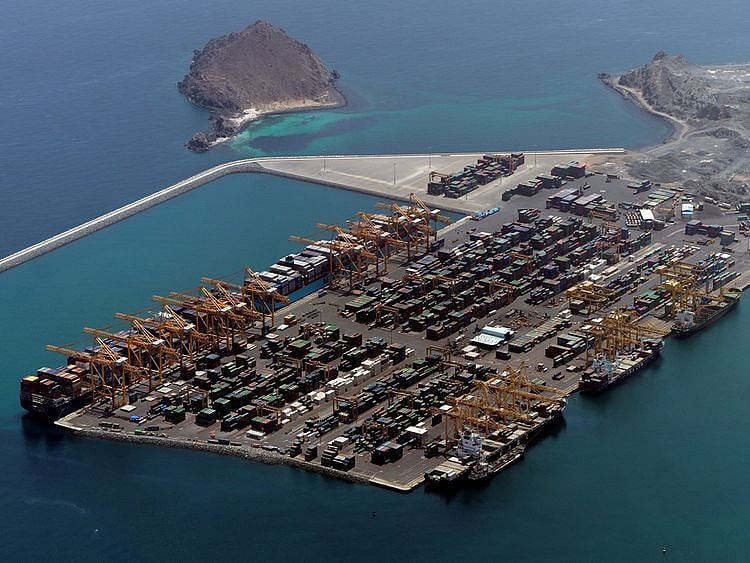
Dubai: Sharjah-based Gulftainer has unveiled a $2 billion strategy to expand from port operations into a wider global trade infrastructure platform, with Khorfakkan Port, inland logistics parks, maritime services and AI-powered supply chains forming the core of its next phase of growth.
The plan is aimed at linking ports, shipping, inland logistics, industrial zones and digital systems into one connected platform serving fast-growing trade corridors. It also positions Sharjah more firmly within global trade routes, including the India-Middle East-Europe Economic Corridor and China’s Belt and Road Initiative.
Get updated faster and for FREE: Download the Gulf News app now - simply click here.
Khorfakkan Port capacity to rise
The strategy includes the continuation of expansion works at Khorfakkan Port, where annual handling capacity is being increased from 3.5 million TEUs to 5 million TEUs. A longer-term master plan targets capacity of more than 10 million TEUs.
Future integration with Etihad Rail is expected to strengthen Khorfakkan Port’s role as a multimodal gateway connecting sea, road and rail transport.
Gulftainer also said Al Dhaid Logistics Park and Sajaa Logistics Park will together provide 2.3 million TEUs of annual inland logistics capacity, adding more depth to Sharjah’s warehousing, storage, distribution and cargo handling network.
Farid Belbouab, Group CEO of Gulftainer, said the strategy marks a new phase after nearly five decades of port connectivity, with the company now moving toward connecting economies.
He noted that customers are increasingly looking for integrated, intelligent and resilient supply chain solutions, with ports, shipping services, inland logistics and digital platforms working together to move cargo faster and with better visibility.
The New Gulftainer strategy restructures the company around four business platforms. These cover container terminals and maritime gateways, inland logistics and multimodal transport, logistics parks and industrial ecosystems, and regional maritime services linked to strategic trade corridors.
Sharjah’s dual-coast advantage
Sharjah’s port network gives companies access to both the Arabian Gulf and the Gulf of Oman, a factor that has gained importance as businesses look for more flexible supply chains and alternative cargo routes.
Also Read
Sharjah ports can help protect supply chain, reassures FDI Office chiefSaqr 2.0: Transforming Ras Al Khaimah into MENA’s deepest project cargo hubGulf's trade resilience in a volatile global landscapeGulftainer, a leading operator of regional ports and terminalsGulftainer facilitates successful rail cargo operation from Al Jubail to Al RiyadhIn an exclusive interview earlier with Gulf News, Mohamed Juma Al Musharrkh, CEO of the Sharjah FDI Office, Invest in Sharjah, said the emirate’s investor appeal is increasingly tied to operational resilience.
“Sharjah’s approach to protecting investor confidence is anchored in flexibility, connectivity, and operational continuity. The emirate’s access to both the Arabian Gulf and the Gulf of Oman, through Port Khalid, Hamriyah Port, and Khorfakkan Port, provides companies with multiple routes to regional and international markets,” he said.
That network is becoming more relevant as logistics costs, geopolitical pressure and supply-chain disruption make route flexibility a bigger part of investment decisions.
Investors focus on continuity
Al Musharrkh said investor conversations are now focused less on opportunity alone and more on whether companies can continue operating smoothly during disruption.
“Investor conversations today are less about identifying opportunity, and more about validating continuity at scale,” he said.
That view fits closely with Gulftainer’s new direction, which is built around cargo visibility, connected logistics infrastructure and trade corridors that can support companies facing cost pressure or changing market conditions.
Supply chains get more connected
Gulftainer said its strategy will help businesses build more resilient supply chains while supporting the UAE’s ambition to become one of the world’s leading trade and logistics hubs.
Mohammed Ibrahim Al Raisi, Director of Ports and Border Points Affairs at the Sharjah Ports, Customs and Free Zones Authority, said Sharjah’s maritime network across two coastlines gives partners and investors greater operational flexibility and more logistics options, improving the emirate’s ability to respond to changes in the global economy.
The partnership between Sharjah’s ports authority and Gulftainer is expected to support operational efficiency at Khorfakkan Port while helping build a broader logistics ecosystem around industrial zones, inland cargo capacity, multimodal transport and digital trade services.
The move also comes as Sharjah continues to position itself as a production and logistics base. The emirate accounts for around 40% of the UAE’s industrial establishments, while manufacturing remains one of its core investment drivers.
- With inputs from WAM.

Sign up for the Daily Briefing
Get the latest news and updates straight to your inbox
Network Links
GN StoreDownload our app
© Al Nisr Publishing LLC 2026. All rights reserved.