Gold scam in India: Is your 22k hallmarked jewellery really pure? How rhenium powder raises concerns
Gold scam raises questions on 22-karat purity and hallmarking reliability
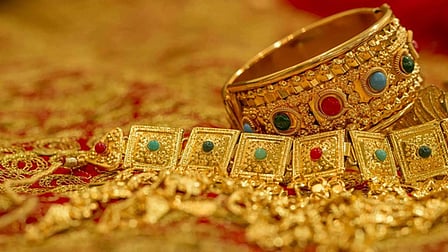
Buying gold jewellery in India often comes down to trust. Customers check the weight, look for the hallmark and rely on testing machines to confirm purity. But can jewellery marked as 22-karat gold contain significantly less gold than promised?
A newspaper investigation in Rajasthan has raised this question after reporting an alleged adulteration method involving rhenium, a rare and heavy metal. According to Dainik Bhaskar, investigators found that rhenium powder could be mixed with gold to increase its weight, while some commonly used testing machines continued to identify the mixture as high-purity gold.
Get updated faster and for FREE: Download the Gulf News app now - simply click here.
The investigation involved an experiment with a jeweller in Jodhpur, where an ornament reportedly received a 22-karat hallmark despite having a much lower actual gold content, according to the newspaper.
The findings have raised concerns about the reliability of certain gold-testing methods and the monitoring of hallmarking procedures in India. However, the reported experiment does not establish that rhenium adulteration is widespread or that all testing machines are unable to detect it.
Check the latest UAE gold rates, along with the latest updates on gold and silver prices, market trends and precious metal news.
Here is what the investigation found, how the alleged method works and what gold buyers should know.
What did the Rajasthan gold investigation find?
The Dainik Bhaskar investigation involved an experiment with a local jeweller in Jodhpur, Rajasthan.
According to the report, investigators contacted an agent linked to a company in Shenzhen, China, who allegedly claimed that his company manufactured rhenium powder and supplied it through dealers in several Indian cities.
The agent reportedly claimed that the powder could be mixed with gold in proportions of up to 25 per cent without being detected by commonly used testing methods. This claim has not been independently verified.
The investigators subsequently obtained a one-gram sample through a Mumbai-based dealer and used it in an experiment.
How was rhenium allegedly mixed with gold?
According to Dainik Bhaskar, the experiment involved the following steps:
Mixing the metals: One gram of rhenium powder was mixed with 7.83 grams of 24-karat gold, taking the combined weight to 8.83 grams.
Initial testing: The mixture reportedly continued to be identified as 24-karat gold.
Making jewellery: A jeweller added another metal to convert the mixture into a 22-karat ornament. The finished piece weighed 9.58 grams.
Hallmarking: The ornament reportedly received a 22-karat hallmark from a hallmarking centre.
Further testing: The jewellery was taken to several showrooms and testing centres, where it reportedly continued to be identified as 22-karat gold.
However, the investigation estimated that the finished ornament contained only around 81.73 per cent actual gold, equivalent to approximately 20-carat purity.
One showroom's testing machine reportedly showed 93.70 per cent gold, along with silver and copper, without identifying the presence of rhenium.
These findings relate to the sample used in the newspaper's experiment. They do not establish that all hallmarking centres or testing machines have the same limitations.
What is rhenium and why is it used?
Rhenium is a rare, heavy metal used in specialised industrial applications, including components designed to withstand extremely high temperatures.
It has a density of around 21 grams per cubic centimetre, compared with approximately 19.3 grams per cubic centimetre for pure gold.
Its high density means it can add significant weight when mixed with gold. This has raised concerns that it could be used as an adulterant to make jewellery appear heavier than its actual gold content.
The main concern is whether testing methods can accurately identify all the metals present in the mixture, rather than simply assessing its weight or surface composition.
Why might some gold-testing machines miss adulteration?
Many jewellery shops use X-ray fluorescence (XRF) machines, commonly known as karatmeters, to estimate the metal composition of gold ornaments.
These machines analyse material near the surface. Their results can depend on the equipment, calibration, testing conditions and composition of the sample.
Other commonly used methods also have limitations:
Acid tests: These examine how gold reacts to certain acids but may not identify every metal mixed into an ornament.
Touchstone tests: These assess the metal rubbed against a testing stone and may not reveal the full composition inside the jewellery.
XRF machines: These can identify several metals, but their accuracy depends on the equipment and testing method. Properly configured instruments may be able to detect rhenium.
More specialised laboratory analysis may be necessary when there is suspicion of sophisticated adulteration. Fire assay is a recognised method for determining gold content, while other analytical techniques can help identify additional metals.
Could gold buyers lose money?
If jewellery contains less gold than its declared purity, buyers could end up paying more than the actual value of the gold they receive.
For example, 22-karat gold should contain 91.6 per cent pure gold. A 10-gram ornament sold as 22-carat should therefore contain approximately 9.16 grams of gold.
If some of the gold is replaced with another metal, the actual gold content will be lower even if the total weight remains unchanged.
The financial loss depends on the actual purity, the price charged and the weight of the ornament.
In its investigation, Dainik Bhaskar estimated that the alleged adulteration could result in a loss of around ₹14,700 per tola (approximately 11.66 grams), based on an assumed gold price of ₹1.5 lakh.
Are other heavy metals being mixed with gold?
Concerns about gold adulteration are not limited to rhenium.
An earlier report by Mint highlighted concerns among jewellery traders in Indore's Sarafa market over the alleged use of heavy metals such as ruthenium, iridium and osmium to increase the weight of gold jewellery.
Traders reportedly said these metals could make conventional purity checks more difficult because of their high density.
The report also referred to a material described in some trading circles as 'gold powder'. Traders suspected that it was entering Indian markets through Maharashtra and West Bengal.
However, its origin, including claims of a possible Chinese connection, had not been independently established, Mint reported.
These concerns reflect allegations from sections of the jewellery trade and should not be taken as proof of widespread adulteration across India's gold market.
What does the CAG audit say about gold hallmarking?
The allegations have also brought attention to gaps in the monitoring of India's gold hallmarking system.
According to a draft report by the Comptroller and Auditor General (CAG), 81 per cent of registered jewellers were not inspected during 2024-25.
The audit also found that the Bureau of Indian Standards (BIS) fell short of its surveillance targets for recognised Assaying and Hallmarking Centres by 43.7 per cent.
BIS attributed the shortfall to staff shortages and difficulties in collecting samples from remote areas. The CAG rejected this explanation.
The findings have raised questions about the monitoring of jewellers and hallmarking centres, particularly as newer forms of alleged adulteration come under scrutiny.
How can gold buyers check jewellery purity?
The BIS hallmark remains an important check when purchasing gold jewellery in India. Buyers should look for three details:
BIS logo: Indicates that the jewellery carries the Bureau of Indian Standards hallmark.
Purity mark: Shows the declared gold purity. For example, 22K916 indicates 22-karat gold containing 91.6 per cent gold.
HUID number: A six-character Hallmark Unique Identification number assigned to the jewellery.
Buyers can use the BIS Care app and its 'Verify HUID' feature to check the details associated with the hallmark.
Other precautions include:
Buy jewellery from established sellers and check the hallmark before making a payment.
Ask for a detailed invoice showing the jewellery's weight, purity and price.
Keep the bill and supporting purchase documents.
Do not rely on magnet, vinegar or other home tests as proof of gold purity. These cannot establish the exact gold content.
If you have doubts, request testing at a BIS-recognised Assaying and Hallmarking Centre.
If the results are disputed, seek an appropriate laboratory test to establish the actual gold content and identify any suspected foreign metals.
What should gold buyers take away from the rhenium allegations?
The Jodhpur experiment has raised an important question: can a gold ornament pass routine purity checks and still contain less gold than its hallmark claims?
While the reported findings need independent verification, they highlight the importance of reliable testing and effective monitoring of India's gold hallmarking system.
For buyers, checking the BIS hallmark and HUID, purchasing from reputable jewellers and keeping a detailed invoice remain essential precautions. If there are doubts about an ornament's purity, a further assessment using an appropriate testing method may be necessary.
The investigation does not mean that all hallmarked gold is adulterated. But it is a reminder that gold purity should be established through reliable testing, not weight and appearance alone.
Sources: Agencies and Bureau of Indian Standards (BIS).
Network Links
GN StoreDownload our app
© Al Nisr Publishing LLC 2026. All rights reserved.