Even at record prices, here’s how retailers say you can buy gold
Record prices reshape jewellery choices as buyers focus on value and long-term security

Dubai: Dubai gold prices surged to record levels on Thursday, reshaping how residents approach jewellery purchases and investment decisions amid intense global market volatility and rising economic uncertainty.
By 8:55 am, 24-karat gold in Dubai stood at Dh664.75 per gram, sharply higher than Wednesday's Dh639.25. The 22-karat variety climbed to Dh615.50 from Dh591.75 a day earlier, pushing local prices to levels that many consumers had not anticipated so soon. (Check latest UAE gold prices here, alongside prices in Saudi Arabia, Oman, Qatar, Bahrain, Kuwait, and India.)
The rally mirrors a dramatic global move, with bullion surging above $5,500 an ounce as investors fled sovereign bonds and currencies amid a weaker dollar and thin market liquidity, Bloomberg reported. Spot gold has climbed about 28% this year, while silver has jumped roughly 65%, amplifying volatility across precious metals markets.
Two buyer segments emerge on the shop floor
Retailers across Dubai say the spike has brought a clearer split in buyer behaviour, though few describe it as panic-driven.
John Paul Alukkas, CEO of Joyalukkas International Operations, said customers are approaching purchases with distinct mindsets shaped by financial awareness. “Yes, we are seeing a clear distinction in buyer behaviour. On one side are price-sensitive customers who are carefully planning their purchases, optimising weight and value. On the other hand, some price-sensitive buyers plan their purchases based on price. This second group views gold as a long-term source of financial security and an enduring store of value. Their decisions are rooted in foresight rather than fear.”
There is increased interest in modular designs and timeless silhouettes that offer flexibility today and retain resale value over time. Customers are seeking jewellery that balances beauty, wearability, longevity and a long-term solid investment.

That view was echoed by Tawhid Abdulla, chairman of the Dubai Jewellery Group, who stressed that rational decision-making remains central. “We can not describe it as a fear-driven market. Instead, we see different buyer segments behaving rationally in line with their priorities. Some customers remain highly price-conscious and are adapting their buying patterns by choosing lighter designs. Others, particularly long-term buyers, are making confident purchases based on value appreciation rather than short-term price volatility.”
Designs shift as value takes centre stage
Higher prices are accelerating shifts in what customers choose to buy, with lighter, more versatile jewellery gaining traction across showrooms.
Alukkas said preferences have evolved in response to lifestyle and financial considerations. “We are seeing a growing demand for lighter, versatile and everyday-wear jewellery that fits seamlessly into modern lifestyles. Also there is increased interest in modular designs and timeless silhouettes that offer flexibility today and retain resale value over time. Customers are seeking jewellery that balances beauty, wearability, longevity and a long-term solid investment.”
A noticeable portion of today’s demand is certainly influenced by the belief that gold prices are on a long-term upward trajectory. However, it would be incorrect to say that jewellery buying is purely speculative.

Abdulla noted that the shift goes beyond price movements alone. “There is growing interest in lighter and versatile jewellery, as well as pieces that offer flexibility for everyday wear and long-term value retention. This is not just related to price volatility. It is also related to evolving tastes of consumers due to the influence of fashion, profession and lifestyle.”
Transparency becomes a buying priority
Retailers report a noticeable rise in detailed questions around making charges, exchange options and buy-back terms, reflecting a more informed customer base.
“Absolutely,” Alukkas said. “Customers today are more informed and financially aware than ever before. Conversations around making charges, exchange options, buy-back policies and long-term value retention have become more frequent and more detailed. This reflects a more mature approach to jewellery buying. Transparency and trust play a central role in the jewellery buyers decision-making process.”
There is growing interest in lighter and versatile jewellery, as well as pieces that offer flexibility for everyday wear and long-term value retention. This is not just related to price volatility. It is also related to evolving tastes of consumers due to the influence of fashion, profession and lifestyle.

Abdulla described the trend as healthy for the industry. “Customers today are more informed, more engaged, and clearer about their preferences. This is a direct outcome of a self-regulated, consumer driven market. It reflects a healthy ecosystem where trust and integrity are valued just as highly as product and price.”
Expectations of higher prices influence timing
Anil Dhanak, managing director of Kanz Jewels, said expectations of rising prices are influencing when customers buy, without undermining core demand. “A noticeable portion of today’s demand is certainly influenced by the belief that gold prices are on a long-term upward trajectory. However, it would be incorrect to say that jewellery buying is purely speculative.”
He added that cultural demand remains resilient. “In markets like the UAE and India, gold jewellery is deeply linked to life events—weddings, festivals, and family milestones—which continue regardless of price cycles.”
Chirag Vora, managing director of Bafleh Jewellers, estimates that expectations now play a significant role. “A significant portion of current jewellery demand—estimated at 40% to 50%—is clearly being driven by expectations of further price appreciation.”
How far can prices go before demand strains
While some consumers are advancing purchases, retailers caution against assuming an uninterrupted climb.
“Dh1,000 per gram is a very aggressive level and not something the market will reach casually or in the near term,” Dhanak said. “Gold does not move in straight lines. Periods of sharp appreciation are usually followed by consolidation or correction.”
Many consumers believe that if they do not buy at around Dh600 per gram, they may soon be paying Dh700 or more. As a result, demand for so-called “investment jewellery,” such as plain 22K chains, bangles, and coins, along with 24K gold bars, has surged.
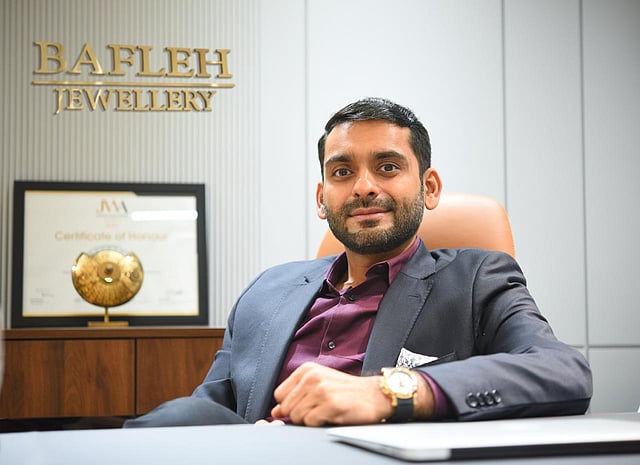
Vora offered a longer-term view, linking local prices to global dynamics. “From a technical and macroeconomic perspective, Dh1,000 per gram is not impossible, but it is certainly not imminent,” he said, adding that corrections remain inevitable.
Weddings and milestones hold firm
Despite record prices, wedding-related demand remains resilient, according to Malabar Gold and Diamonds.
“Despite the sharp rise in prices, footfall on the shop floor has remained steady,” said Shamlal Ahamed, managing director for international operations. “Many view gold not just as a piece of jewellery, but as a long-term store of value.”
He added that behaviour has adapted without weakening intent. “Customers are not walking away from purchases; instead, they are opting for smarter choices.”
On the wedding demand, Ahamed said timelines remain intact. “Weddings and milestone family purchases continue to be largely price-inelastic.”
While the immediate price is a consideration, many buyers see gold jewellery as an enduring asset that holds value over time, especially when paired with quality craftsmanship and trusted purity. At the same time, jewellery continues to serve as a symbol of relationships, milestones, and personal expression, making the purchase feel purposeful rather than purely transactional.

Global forces behind the rally
Globally, gold’s surge has been fuelled by a weaker dollar, geopolitical tensions and heavy central bank buying, with thin liquidity amplifying price moves, Bloomberg reported. Volatility has also been driven by technical factors such as option-related buying and investor flight from government bonds amid fiscal concerns.