Emirati art at the first Frieze Abu Dhabi: What five artists brought
A door, a telephone, and a sweet potato: stories from Emirati artists at Frieze
Abu Dhabi: A door from a Cincinnati restaurant, a telephone shared by four siblings, a sweet potato drawn for fifteen years.
Frieze Abu Dhabi, the first Frieze fair in the Region, brings artists from around the world to Manarat Al Saadiyat from 19 to 22 November. His Highness Sheikh Khaled bin Mohamed bin Zayed Al Nahyan, Crown Prince of Abu Dhabi and Chairman of the Abu Dhabi Executive Council, has opened the inaugural edition of Frieze Abu Dhabi, organised by the Department of Culture and Tourism – Abu Dhabi in partnership with Frieze.
Alongside the international galleries, it shows work by Emirati artists based in the UAE, from established names to those at their first fair. Gulf News spoke to five of them.
A conversation across generations
The idea is built into the fair’s flagship exhibition, In Dialogue, a new annual show that pairs an established UAE artist with an emerging one. The inaugural edition is curated by Dirwaza Curatorial Lab, the Abu Dhabi creative space founded by Munira Al Sayegh, with co-curators Hessa Al Nuaimi and Dania Al Tamimi. It brings together Mohammed Kazem, born in Dubai in 1969, and Alia Zaal, born in 1989.
Al Sayegh said the pairing grew from friendship and months of studio visits. "They are in constant conversation. They are constantly meeting at different points, whether it is conceptual or visual, or within the friendship that they have." What emerged was a shared fascination with light: how it moves, and how it falls on the UAE’s natural landscape, its built landscape and the idea of portraiture.
For Al Sayegh, the show makes a point as much as it tells a story.
"I hope they realize that the art scene has existed here for a very long time," she said. Many visitors arrive without knowing it. "There is a lot of individuals that come into the UAE and do not really get the chance to understand the depth of what the UAE has to offer." Showing at Frieze, she said, is welcome on those terms:"The more, the merrier."
Her hope for what comes next is specific. "That we see more grassroots-led initiatives connecting with the more institutional spaces."
The door
In the room, Kazem’s work shows why the exhibition revolves around light. He is clear that this is not a booth. It is "a parallel exhibition" to the fair, assembled over about seven months with Al Sayegh. It mixes painting, photo documentation, installation and experimental work, and some pieces date back decades. "The oldest painting is from ‘93," he said.
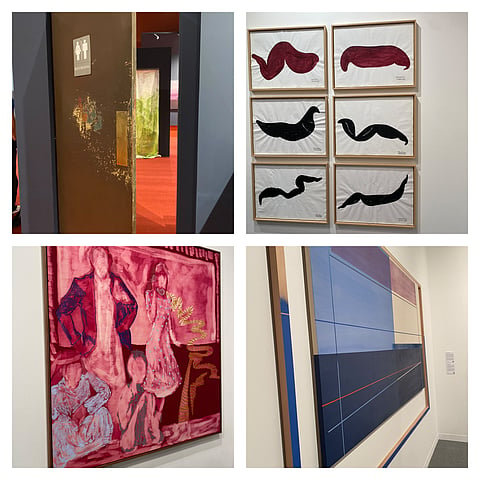
The piece people stop at is a door. Kazem found it in the restroom of an Italian restaurant in Cincinnati while on a residency and wanted it for years. "The door has been scratched by the people. You can see the traces of the people who pushed it over thirty years. This door is almost forty years old. How many people pushed it? Man, woman, child. We don’t know if they are still living or if they have died."
He persuaded the restaurant to let him have it bought a replacement at Home Depot on the spot. Now it stands in a built room where visitors can open it themselves. As they do, they find a series of scratch drawings, ten to fifteen of them, that he calls Sound of the Angles, because no two openings make the same angle.
He chose not to record the sound. "I keep it for the audience, to see the sun instead of listening to the sound,” he said. As the sun moves, the shadows on the scratches move too. The restaurant door is now an artwork. “Here I’m putting the door in the context of art. It was in a restaurant before. Now it has become artwork."
He is delighted by that freedom. "This is the beauty of visual art, that you can experiment with any media." In 1993, when a museum piece would not come together, he simply wrote it as text on the wall. "If you cannot make it, you can write it."
Lines, grids and letting go
Sarah Almehairi, born in Abu Dhabi in 1998, is showing two works, including her first sculpture. It hangs entirely off the wall, a piece from her Impulse series.
Her practice starts with structure. "A lot of the work is inspired by the grid, reconstructing it and creating systems that make sense to me through lines, language, forms and colour," she said. Her paintings begin on a screen, in compositions she pushes until they are spent. "Then once they are transferred onto the canvas, there are moments where I let go of control." She sees the result as a single line passing from one work to the next. "With one work it always leads to the next."
For Almehairi, Frieze’s arrival is both an honour and a continuation.
"The Abu Dhabi Art Fair has been very present for years. But to have a brand like Frieze, a very recognisable art fair, come through and transform it into something different, it has been special."
The foundation, she said, was already there. "The structure and the systems are already in place, and so it’s just amplifying the voices."
She hopes visitors take away two things. The first is "a sense of balance". The second is a wider view of the scene. "Every single artist makes up the ecosystem," she said. "It does not need to be rooted in one single place. Every single person’s ideas and ways of making and thinking allow this landscape to thrive and blend."
A telephone, and the Henna
For Dhabia Al Qubaisi, Frieze is a first on two counts: the first edition in Abu Dhabi, and her own first fair. "It is so big for Abu Dhabi to host Frieze, and it is such an honour and privilege to be among the artists that get to exhibit," she said. She is represented by Iris Gallery.
Her two works begin at home. One is about four siblings taking turns on the phone, from a time before everyone had a mobile. "The telephone was this communal, shared item that existed in the house," she said. The other follows three generations of women, her grandmother, her mother and herself, mixing henna together and applying it to their hair. "It is something I have done with the women in my family, and I wanted to reflect on it in my work."
Family archives and memories are where most of her work begins. "I look at the collective of a family, and how certain moments are very beautiful to reflect on and to showcase."
In Abu Dhabi, those private moments hang beside work from across the region and beyond. "My work tells a story of my own life, but it is put in dialogue with works from all across the region and across the world," she said.
"These are the moments where you find cultural exchanges happening, and you realise how important art is to remind us of our humanity, and to remind us of learning about one another."
One sweet potato, 15 years
Abdullah Al Saadi has spent fifteen years on a single everyday object. His Naked Sweet Potato series was first shown at the UAE National Pavilion at the 54th Venice Biennale in 2011, and he returned to the pavilion in 2024 for the 60th. At Frieze, Aisha Alabbar Gallery presents new works from the series in a solo presentation in Global Futures, curated by Tarini Malik.
The sweet potato has appeared in drawing, painting, sculpture, stone engraving and jewellery, alongside collected and archival material. In Abu Dhabi, the series shows up as paintings on stretched and rolled canvas and a group of ceramic sculptures of female figures called Goddesses of the Naked Sweet Potato, all made in 2025 and 2026. Al Saadi builds each piece through repetition and variation, so the work grows gradually rather than reaching a fixed conclusion.
The series is rooted in place. It draws on childhood, family and the land around Khor Fakkan, where he lives and works and where walking and collecting have long shaped his practice. It is less a study of a plant than a way of looking, one that turns something familiar into a source of memory and discovery.


