Abu Dhabi's old airport terminal becomes a gallery of the bold and the handmade
Handcrafted treasures and bold designs breathe life into an old terminal 1 through NOMAD
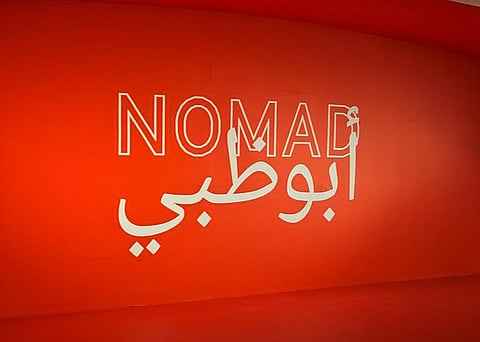
Abu Dhabi: A red glow washes down the corridors of Terminal 1, and for a moment the old airport feels as if it’s still waiting for its next flight. But nobody here is in a hurry. Visitors drift from booth to booth, pausing, leaning in, stepping back. Some spoke to each other. Others simply stand and wonder.
What holds them is the furniture: tables that read as sculpture, lamps that seem to argue with the chairs beside them, a collision of art, colour and vision. Minimalism, it seems, did not make the guest list.
The jewellery is no different. Behind the glass, these pieces are less accessories than stories, each carrying a country, a tradition, a culture.
Then I turn into an aisle bathed in yellow, at Galerie Gastou from Paris, where flower lamps stand side by side. Overhead, these lamps bloom like giant tulips from some mythical land.
This was the second edition of NOMAD Abu Dhabi, where the departures board is long gone but the sense of arrival is unmistakable. The boarding pass was given at the entrance of the exhibition with more than 50 exhibitors across collectable design, contemporary art, jewellery and craft.
The building as the main attraction
Designed by Paul Andreu and opened in 1982, the terminal is as much a draw as anything inside it. Four former private gates have been taken over and named as A2Z, Nilufar, Gallery FUMI and Galerie Gastou.
“As I walked in, I still remember the days when I used the airport for transit flights, the spot where I stopped for a bite, walking through the corridor that once connected to the circle of kiosks and shops,” said Adhil Shafeer, a student and resident of Abu Dhabi.
Walking through the different displays, the first thing the eye registers is a single column that flares upward into the ceiling like a funnel, or an upside-down cone. It had a honeycomb of hexagons that in itself looks like it is a part of the exhibition.
“They have kept the ambience alive, even when bringing the event together with cultures and arts from different parts of the world,” he added.
At the Naba debs, or the collectors lounge, visitors stopped at the windowpane, that captured the dome, the name of the old airport, still printed there, its lettering untouched. Past it the runway stretches out.
Lost in the Terminal, Happily
For Silvia, an Italian jewellery designer who moved to the UAE six years ago, the most interesting part of the event is that visitors are surprised. “They’re amazed that we still do things by hand,” she says, and people often ask why she makes her work by hand in an era when so many use AI-generated art. Her answer is that the speed is beside the point. AI can make it faster. But her gouache technique, an antique, mostly European method of rendering jewellery, is “to express the luxury of the handmade.”
The necklace took nine days at eight hours a day, and even a simple ring can take two to four hours. “You really need to take the time to paint every stone one by one,” she says.
Asked what she liked most about the fair, she points upstairs, to furniture that is “beautifully designed, very balanced, very edgy. Not minimalist at all.” What she admires is the nerve: “I love the courage of the artists. It’s kind of like, I don’t care, I’m just going to do what I like.”
She likes the building too. “This space is being recycled and used again to exhibit different types of art,” she says. “This place is now used wisely.”
For 25-year-old Wahiba, an Etihad cabin crew member from France, the terminal itself is the draw. She said she never got to work from the old terminal as she joined three years ago, just as the new airport opened.
She welcomed the chance to discover it. “It was a way for us to discover the previous terminal, because we’ve never been to it,” she says.
She missed last year’s edition because of her days off and had been looking forward to this one. What stayed with her was the variety of work on show.
“Each pod was very different, giving different feelings and emotions,” she says. “It was very nourishing for me and my friends.”
Momi Mizrahi, who lives in Dubai and designs luxury tableware with his wife Esther, drove to Abu Dhabi with a practical aim: to find collaborators. “We want to make some cooperation here with some artist or company,” he says.
His favourite was the first stage he came to, “the AP room”.
From hypercars to pearls at a terminal
The most photographed object is likely to be the YANGWANG U9, the electric hypercar that set a production-car speed record of 496.22 km/h in September 2025. Here it is paired with the work of Dubai-based artist Ibrahim Zaki, in a project that sets the machine beside his approach to Arabic calligraphy.
Others stopped at the collection of sculptures from Mexican artists at Alkimista, the first platform dedicated to Mexican art and craftsmanship in the Middle East. Some sat through the sessions with experts talking about art in the contemporary world.
I stopped at the pod MATTAR that said, nature created the pearl before Humanity learned to recognise all that it held. The exhibits spoke of the different jewelleries they made with pearl at its core.
The idea was to give back credits to the nature and how humankind gained its knowledge and for the gulf, it became a part of the culture of the sea.
An airport is a space designed to be left. However, these pieces were designed to be stayed with, and in the hollow of the old terminal, they take over. Where today’s minimalist interiors keep things quiet and clear, these rooms are full, and the old airport’s emptiness only makes them louder.


