Giorgio Turri, Managing Director, Ferrari Middle East, said that the company plans to introduce “four new models on average every year between 2026 and 2030.
EXCLUSIVE
Ferrari resumes Middle East deliveries after war disrupts logistics
Not one order cancelled since conflict began, says Ferrari Middle East MD Giorgio Turri
Last updated:
5 MIN READ
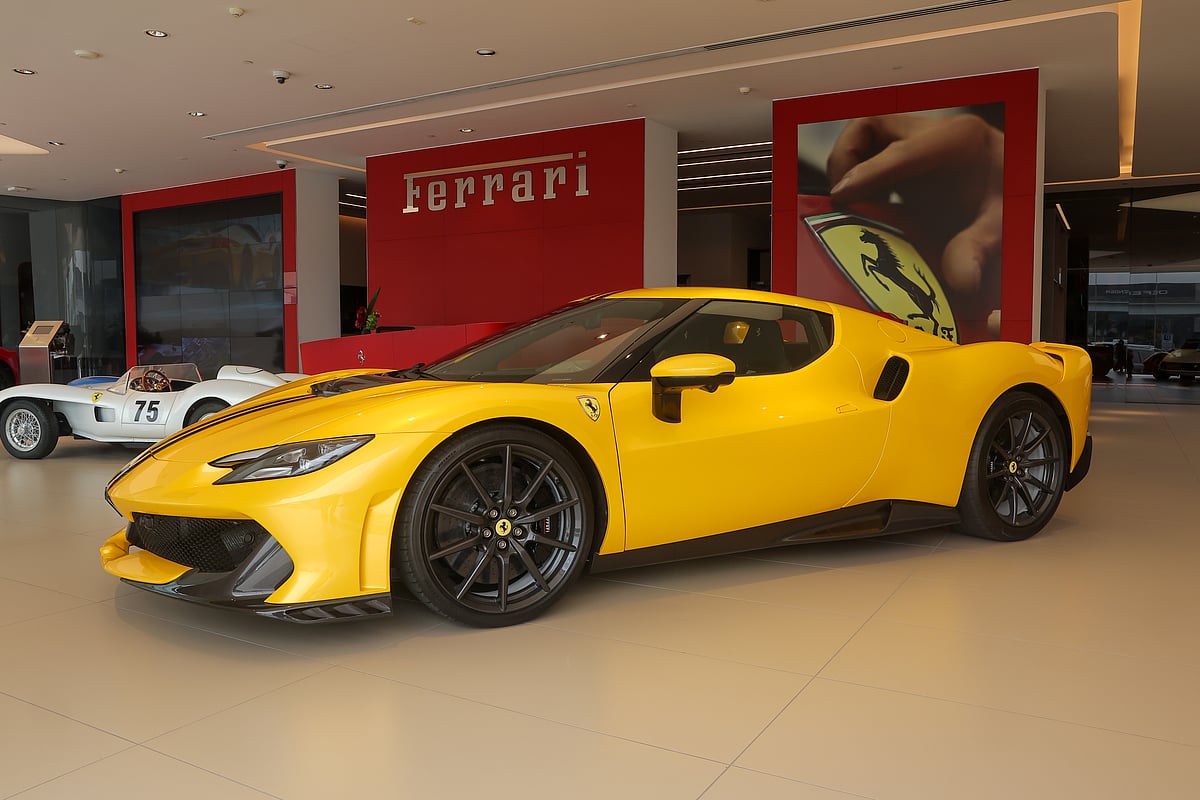
Ferrari's retail and service operations have remained fully functional throughout the crisis.
Virendra Saklani/Gulf News
Dubai: Luxury carmaker Ferrari has resumed deliveries to the Middle East following a period of logistical disruption caused by the ongoing US-Israel war on Iran, the Italian marque revealed exclusively to Gulf News on Thursday, March 26.
Giorgio Turri, Managing Director of Ferrari Middle East, confirmed that shipments are set to resume “in the coming days”, ending a halt triggered by disruptions to maritime routes and airspace closures linked to the ongoing conflict.
He said: “There has been disruption in the logistic processes… with transportation, maritime transportation on the one hand, and air freight on the other.”
Stay updated: Get the latest faster by downloading the Gulf News app - it's completely free. Click here for Apple or here for Android. You can also find it on the Huawei AppGallery.
To overcome this, Ferrari introduced contingency measures. Turri said, “Solutions are in place, and as we speak, we are planning for shipments… after experiencing some temporary delays, we are restarting with shipments and deliveries.”
“Solutions include the rerouting of sea freight and the use of air freight whenever and wherever needed,” he said, adding that the company adapted with “maximum level of flexibility”.
Logistics solutions
Disruptions to the Strait of Hormuz and the closure of regional airspace had constrained the movement of vehicles to Gulf markets.
The disruption is not unique to Ferrari. For example, port authorities in Kenya confirmed that over 4,000 luxury vehicles destined for Dubai were rerouted to Lamu Port due to disruptions caused by the war in Iran.
Turri said the issue doesn’t depend on single companies or shipping companies. “The issue depends on the current situation and the conflict. Shipping companies have to reroute some of the shipments in order to cope with this,” he added.
“Challenges are embedded. We don't stop when there is a challenge — we try to overcome it. Every challenge is an opportunity to learn. At the moment, we are learning a lot about logistics,” he said.
Zero cancellations
Despite the disruption, Ferrari has not lost a single confirmed order. "We are not experiencing cancellations," Turri stated plainly. He attributed this resilience in part to the deeply personal nature of the purchase decision, given owning a Ferrari is the ultimate dream come true for autophiles.
“It’s not a need — it’s a dream. You don’t take decisions based on the mood of the day. The dream is never a short-term decision."
Turri added that demand had, if anything, remained robust through the crisis. "The demand is stable, and I would say it remains strong. We see new clients coming in this period of time — that has not stopped at all."
He noted that between 30 and 40 per cent of all new car deliveries in the region go to customers who have never owned a Ferrari before, a figure that rises to over 50 per cent for pre-owned sales.
Ferrari has not lost a single confirmed order, says Turri.
Ferrari in the region
Ferrari's relationship with the Middle East stretches back more than three decades. "Ferrari, at the retail level, has been in this region for over 30 years, and we have been directly represented with our regional office for almost 20 years," Turri said.
The milestone was marked in February 2024 when the marque staged a record-breaking parade of 204 Ferraris on the Abu Dhabi racetrack, celebrating the 30th anniversary of its presence in the region.
Over those three decades, the Middle East has emerged as one of the brand’s fastest-growing markets globally, with double-digit year-on-year growth in the past five years, Turri said, citing order portfolios, new car sales, and pre-owned sales as key indicators.
The company has also committed to introducing an average of four new models per year between 2026 and 2030 — a pipeline that Turri said is a direct source of confidence for the Middle East market.
The Ferrari family
Ferrari has maintained its full slate of client and community activities throughout the conflict. Showrooms — which Turri describes as "clubhouses" rather than retail spaces — have remained open across the region.
A track event for Ferrari lovers is scheduled for April 4 and 5 at Dubai Autodrome, bringing together both road cars and racing cars on the circuit. "We, together with our importer here, at Al Tayer Motors, thought it is important to have an opportunity to reconnect with our clients, reunite our Ferrari family," Turri said.
"The long term remains positive… this is a region of opportunity," says Turri.
What’s next?
In the short term, Ferrari is focused on restoring continuity of shipments. Production at Maranello, Italy — the sole manufacturing site for every Ferrari — has not been affected by the regional conflict. "There has been no disruption on the production side," Turri confirmed.
However, Ferrari's strategic posture in the Middle East has always been anchored in the long game, Turri said, and the current disruption does not change that.
Turri credited the growth of the luxury market in the region to the rising number of high-net-worth individuals — both locally based and internationally attracted — and to the demographic profile of the Gulf, where the median age in the GCC is around 30 years and only 5 per cent of the population is over 65.
"Our clients in the Middle East are on average five to seven years younger than the worldwide average," Turri noted. "This means we can build long-lasting relationships with clients who are at the beginning of their journey with the brand and who are eager to become the collectors of the future."
Turri also pointed to the enduring physical value of Ferraris. Since its founding in 1947, Ferrari has produced approximately 330,000 road cars — over 90 per cent of which still exist. "These are not just motorcars," he said. "These are art pieces, and they have a very special value — for the people who want them and for the world."
Network Links
GN StoreAbout Gulf NewsTerms & ConditionsReach by GNSitemapContact usPrivacy PolicyGN FocusHave your sayWork with usAdvertise with usGulf News epaperPrinting Services
Download our app
© Al Nisr Publishing LLC 2026. All rights reserved.