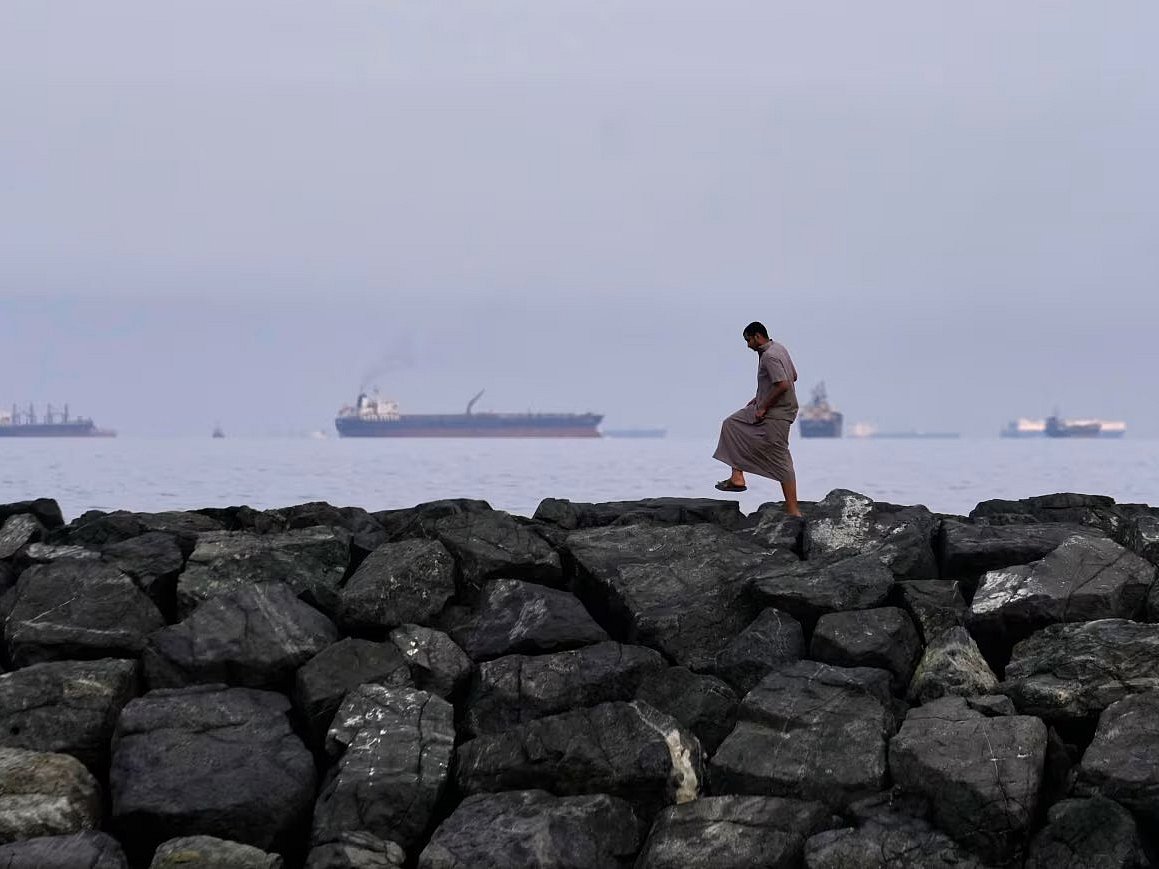
Dubai: The disruption to shipping through the Strait of Hormuz is exposing a structural constraint in global energy markets: alternatives exist, but were they ever designed to fully replace the corridor?
Get updated faster and for FREE: Download the Gulf News app now - simply click here.
The strait is not just another transit route. It is the only maritime exit from the Arabian Gulf to open seas. The United Nations Conference on Trade and Development estimates that roughly 20%–25% of global seaborne oil and about 20% of liquefied natural gas pass through it each day. That concentration of flows explains why disruptions quickly translate into global price volatility.
The International Energy Agency has described the current outage as the largest oil supply disruption in history. Its Executive Director Fatih Birol said recently that it amounts to the “biggest energy crisis in history,” according to Reuters. Crude prices also surged as markets began pricing in prolonged supply disruption from the Gulf.
Saudi Arabia: Only large-scale diversion
Saudi Arabia’s East–West pipeline is the only system in the region built with enough scale to meaningfully reroute exports.
The 1,200-km pipeline links the kingdom’s eastern oilfields to the Red Sea port of Yanbu. It can carry up to 7 million barrels per day (bpd), although effective export capacity is closer to 4.5 million bpd due to terminal constraints, according to Reuters.
This route shifts exports away from the Gulf entirely. Tankers from Yanbu can move toward Europe via the Suez Canal or toward Asian markets via the Bab el-Mandeb. That creates a second chokepoint. Security risks in the Red Sea corridor, including tanker attacks linked to regional conflicts, mean the diversion reduces exposure to Hormuz but does not eliminate it.
Bloomberg reported that Saudi Arabia has increased utilisation of the pipeline since the disruption began, highlighting its role as the primary shock absorber in the system.
UAE pipeline offers geographic advantage
The UAE bypasses the chokepoint geographically rather than reroute across the peninsula. The Habshan–Fujairah pipeline, operated by ADNOC, carries crude from inland fields to Fujairah on the Gulf of Oman. With capacity of about 1.5–1.8 million bpd, it allows exports to avoid Hormuz entirely, Reuters reported.
Fujairah has evolved into a major global storage and bunkering hub, reinforcing its role in supply continuity. But capacity remains limited relative to Gulf export volumes, and infrastructure at the port has recently been affected by drone attacks since the conflict escalated, official media confirmed.
The UAE model shows how geography can reduce reliance on chokepoints, but not remove systemic vulnerability.
Iraq: Diversification via multiple smaller routes
Iraq’s export structure reflects a different constraint — limited pipeline redundancy. The Kirkuk–Ceyhan pipeline to Turkey provides a northern outlet to the Mediterranean. Current flows stand at about 170,000 bpd, with plans to increase to 250,000 bpd. Even at full utilisation, that represents a small fraction of Iraq’s export capacity.
Faced with disruptions in Gulf shipping, Iraq has also turned to overland exports via Syria, according to Reuters. That shift increases transport costs and operational complexity, underlining how alternatives often come with economic trade-offs.
Rather than a single large bypass, Iraq relies on multiple smaller routes, none of which materially change its exposure to Hormuz.
Iran: Partial bypass without full functionality
Iran has attempted to build its own workaround through the Goreh–Jask pipeline, designed to carry around 1 million bpd to terminals on the Gulf of Oman.
The IEA said the Jask terminal is not fully complete, and according to Reuters, this limits its ability to offset disruptions despite a test shipment in 2024.
That leaves Iran in a transitional position — with infrastructure in place, but not yet capable of fully offsetting disruptions.
Alternatives constrained by cost, politics, time
Several proposed routes aim to reduce long-term dependence on Hormuz, but none address immediate supply risks.
Iraq has revived plans for a pipeline from Basra to Oman’s port of Duqm, which would provide direct access to the Indian Ocean. Reuters reported that the project remains at an early conceptual stage, with route options still under study.
A separate Iraq–Jordan pipeline to Aqaba has been under discussion for decades. Despite in-principle approval, it remains stalled due to financing, security concerns and political coordination challenges.
More ambitious proposals, including a canal linking the Gulf to the Arabian Sea, remain theoretical. Engineering constraints — including mountainous terrain — and costs running into hundreds of billions of dollars make such projects long-term possibilities at best.
Constraint is structural, not temporary
The core issue is not the absence of alternatives, but their scale. Around 20 million bpd of crude and refined products typically flows through Hormuz, far exceeding the combined capacity of existing bypass pipelines, according to data from the IEA.
The agency has also said there are no alternative routes for large volumes of LNG that transit the strait. This imbalance explains the market reaction. Bloomberg reported that oil price volatility has increased as traders factor in sustained supply tightness and elevated geopolitical risk.
Why Hormuz remains indispensable
The region’s infrastructure allows for partial rerouting. It does not provide redundancy at system level.
Saudi Arabia can divert significant volumes. The UAE can bypass the strait for part of its exports. Iraq and Iran can shift limited flows through secondary routes. None of these options replace the throughput of Hormuz.
That leaves global energy markets exposed to a single chokepoint. As Reuters’ route-by-route assessment and IEA data indicate, any prolonged disruption is likely to tighten supply, increase transport risk and sustain price pressure well beyond the region.

Sign up for the Daily Briefing
Get the latest news and updates straight to your inbox
Network Links
GN StoreDownload our app
© Al Nisr Publishing LLC 2026. All rights reserved.