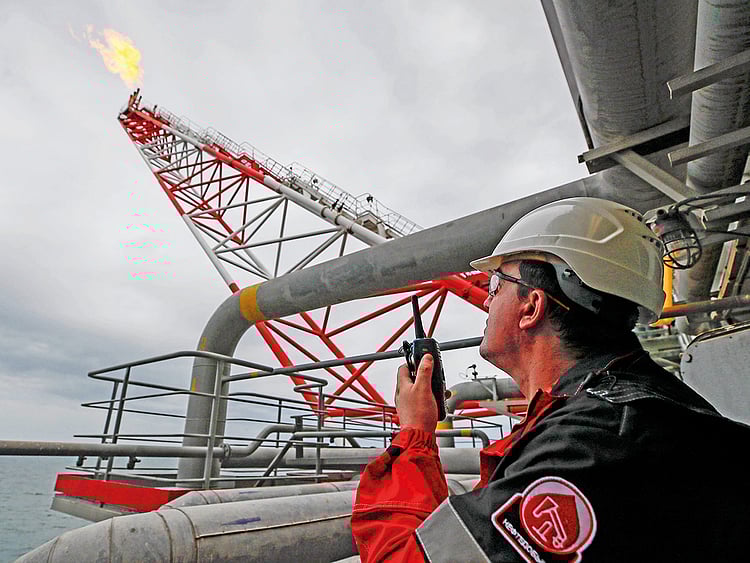
Ukraine revealed Thursday that its long-range drones targetted a key offshore oil platform in the Caspian Sea earlier this week.
The previously secret mission marks a major escalation in Kyiv's campaign to disrupt Russia's energy revenues fuelling the war, CNN reported.
A Security Service of Ukraine source said this was Ukraine’s first strike on Russian Caspian oil infrastructure.
The Filanovsky platform, Lukoil's largest in the Russian Caspian sector, was hit.
“All its enterprises working for the war are legitimate targets,” the source said.
Escalating energy eampaign
Ukraine ramped up deep strikes on Russian energy sites in early 2024.
Since August, attacks have intensified, hitting refineries, export terminals, pipelines, tankers, and now offshore rigs.
Sanctions commissioner Vladyslav Vlasiuk calls it “long-range sanctions” on Moscow's financial lifeline.
November recorded the most strikes yet, per ACLED data and CNN analysis.
Strategic timing
The moves come amid stalled US-led peace talks and Russian frontline gains. A global oil glut limits price spikes, gaining Western ally support for Ukraine's efforts.
In November, Russia's oil export revenues dropped to their lowest monthly level since Moscow invaded Ukraine in 2022, the International Energy Agency (IEA) said Thursday.
Russia is the world's third largest oil producer and income from fossil fuels is vital for its state finances, under pressure from meagre economic growth and the mounting impact of sanctions and Ukrainian attacks on its energy sites.
Both volumes and prices have fallen, "dragging export revenues to their lowest since Russia's invasion of Ukraine in February 2022," the IEA said.
Total revenue in November of $11 billion was $3.6 billion below last year's figure.
The Russian finance ministry reported oil and gas revenues were down 22% in the first nine months of the year to a total of $88 billion.
'Shadow fleet'
Ukrainian attacks on Russia's sanctions-busting "shadow fleet" and marine oil facilities have slashed almost half from Russia's November seaborne oil exports through the Black Sea, the energy agency added.
"After weathering significant unplanned refinery outages in November, tightness in refined product markets has eased, but sanctions in 1Q26 will provide fresh challenges," the IEA said.
US sanctions
In October, the United States unveiled some of the harshest measures yet on Russia's energy sector, sanctioning its two biggest oil producers, Rosneft and Lukoil, in an attempt to force Moscow to end the nearly four-year war in Ukraine.
This comes as Ukraine had intensified attacks on Russian refineries over the summer and early autumn, causing domestic petrol prices to spike and forcing some Russian regions to introduce fuel rationing.
A mix of high military spending, entrenched inflation and lower oil revenues has stretched the Russian budget.
Moscow is expected to post a $50 billion deficit this year, equivalent to around three percent of GDP, and is raising taxes on consumers and businesses next year to try to reduce the gap.
Sign up for the Daily Briefing
Get the latest news and updates straight to your inbox
Network Links
GN StoreDownload our app
© Al Nisr Publishing LLC 2026. All rights reserved.