Photo shows an electronics assembly and testing facility in the Philippines.
EXPLAINER
Philippines: How new rail, ports, power, digital links could reshape Luzon’s economy
Luzon corridor: Up to $47.4 billion in private funds pouring into infrastructure
Last updated:
6 MIN READ
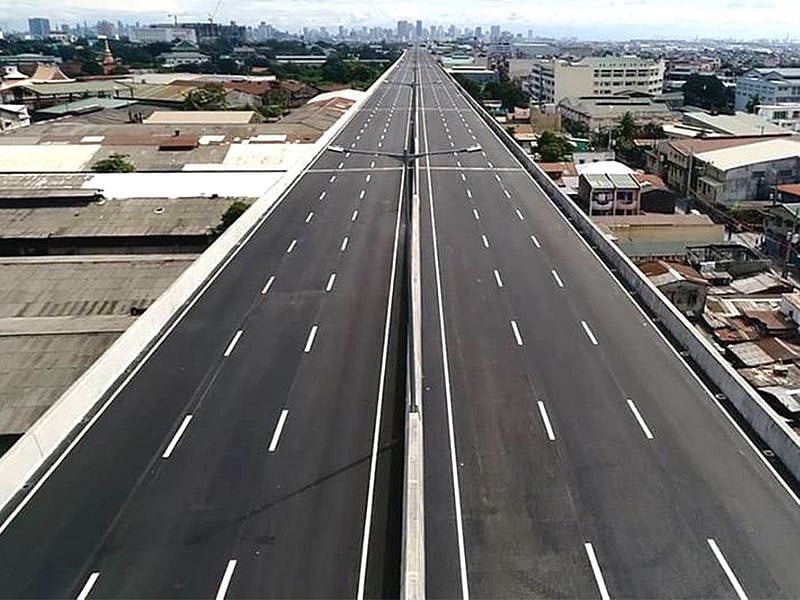
A new overhead road access unveiled in Manila, linking the port to the main north-bound superhighway linking the Philippine capital to the rest of Northern Luzon.
Facebook
Manila: A sweeping network of railways, ports, bridges, power projects and digital infrastructure across Luzon is emerging as one of the Philippines’ most ambitious economic transformation efforts in decades.
At the centre of the push is the Luzon Economic Corridor (LEC), a trilateral initiative launched by the Philippines, the US and Japan in 2024 under the G7-backed Partnership for Global Infrastructure and Investment.
Get updated faster and for FREE: Download the Gulf News app now - simply click here.
The corridor links the country’s most economically critical zones — Subic, Clark, Metro Manila and Batangas — through integrated transport, energy and digital systems.
Philippine officials say this forms part of a bigger strategy.
The bigger aim: solve one of the country’s longest-standing economic weaknesses — the high cost and slow movement of goods caused by fragmented infrastructure, bureaucratic red tape and Metro Manila congestion.
More support
The corridor now includes additional support from the following countries:
Australia
Britain
France
Italy
South Korea
Sweden
Denmark.
The expansion has broadened its financing and strategic reach, too.
Officials and investors are betting that improved connectivity could turn the island into a regional manufacturing, logistics and tech hub.
In a way, it already is, though the Philippines tends to get embroiled in domestic issues rooted in strong tribalism, and deep-seated bureaucratic inefficiencies.
What critics say
Critics have increasingly framed the emerging “Pax Silica” vision — a technology-and-minerals-driven push linking semiconductor supply chains, digital infrastructure and strategic resources across the Philippines — as a form of modern-day “recolonisation.”
But that narrative oversimplifies the far more complex geopolitical chessboard now unfolding across the Indo-Pacific.
The Philippines — a mineral-rich Pacific island archipelago whose land area is more than thrice the size of The Netherlands and Belgium combined — is not operating in a vacuum.
It sits at the intersection of intensifying strategic competition among the United States, China and key regional allies seeking to secure access to critical minerals, semiconductors, clean-energy inputs and strategic maritime routes.
Manpower resources
The Philippines (population: 116 million) also has more than 1,970 universities and colleges spread across the archipelago and a highly-trainable English-speaking workforce.
Dr Dan Lachica, president of the Semiconductor and Electronics Industries in the Philippines Foundation Inc. (SEIPI), cites the country already produces nearly $50 billion worth of electronics exports annually, more than OFW remittances.
“It’s possible to increase this number,” Dr Lachica told the Philippine Star.
Key drivers in this increase: demand from AI and Industry 4.0, as well as from vehicles and devices. “The overall demand in the world is increasing,” Lachica told the Manila dailyl.
Lachina knows what he's talking about: he more than 40 years of management experience in manufacturing, with stints at Iomega, HP, Motorola, American Microsystems, including 16 years in front-end wafer manufacturing in Silicon Valley.
An industry study cites that, given the right conditions, including improved infrastructure, ports and power system, Philippine electronics exports could hit $110 billion by 2030.
The stakes have risen sharply as governments and corporations race to diversify supply chains away from excessive dependence on China following years of trade wars, pandemic disruptions and security tensions in the South China Sea, according to the Centre for Strategic International Studies (CSIS).
That scramble has transformed countries like the Philippines into highly contested strategic terrain — not simply because of geography, but because of their deposits of nickel, copper and other minerals essential to electric vehicles, batteries and advanced electronics.
The Philippines is already among the world’s top nickel producers, a position that has drawn increasing interest from American, Japanese, South Korean and Chinese investors alike, as per the International Energy Agency (IEA).
Why it matters
The corridor covers the Philippines’ most productive region, which accounts for about half of national output.
An under-construction station of the North-South Commuter Railway Project (NSCR). The trains, running at up to 130 km/h, will serve three highly populated regions covering a distance of 147 km: Central Luzon, Metro Manila, and Calabarzon.
Backers say coordinated investments in transport, energy, digital connectivity and advanced manufacturing will expand markets for Filipino and foreign firms, strengthen regional supply chains and attract private-sector capital.
The LEC is a small part of the Luzon (composed of a group of islands). The Luzon mainland itself (land area: about 109,000 sqkm), a highly mineralised tropical island, is nearly thrice the size of The Netherlands — so has plenty of room to grow, not counting the islands like mineral-rich islands of Mindoro and Palawan.
What’s planned
Officials describe the corridor as a platform for high-impact public and private investments aimed at three broad goals:
Create jobs and attract investment by making Luzon a more competitive economic hub.
Improve connectivity for people and goods to lower logistics and energy costs and support sectors such as semiconductors.
Strengthen supply-chain resilience for critical technologies and diversify sources of inputs.
The Luzon Economic Corridor (LEC) spans about 21,470 sqkm, which is roughly the size of the Central Luzon region. As a broader economic zone, it covers an area spanning Metro Manila, CALABARZON, and Central Luzon, with core development anchored by massive projects like the 4,000-acre (16.19 sqkm) Economic Security Zone under "Pax Silica".
Key projects and programs
Energy
Civil nuclear: Under a U.S.-Philippine “123” cooperation agreement, partners have launched studies and training to prepare the Philippines to integrate small modular reactors by 2032. US funding includes a $2.7 million feasibility study and support for a reactor control-room simulator, academic partnerships and workforce programs.
Grid and storage: The US has expanded the Energy Secure Philippines program with more than $24 million to harden military and civilian power systems, support microgrids and help grid planning for potential nuclear integration.
Fuel logistics: A proposed 45-mile pipeline linking Subic Bay to Clark and New Clark City is under study, backed by the Bases Conversion and Development Authority BCDA) and private investors. Philippine Coastal Storage & Pipeline Corp., a major fuel terminal operator, was acquired by a US private-equity firm and is positioned to serve Metro Manila and North Luzon.
Hydropower inventory: The Japan International Cooperation Agency funded a national survey to map large pumped-storage and hydropower potential.
Filipino tycoons backing under PPP scheme: Major Filipino tycoons and conglomerates, including Sabin Aboitiz, Enrique Razon Jr., and Manuel V. Pangilinan, are driving massive hydropower and renewable energy initiatives under Public-Private Partnership (PPP) and state-privatisation frameworks, with individual investments scaling from billions to hundreds of billions of pesos.
Location map of Lima Estate, as it intersects the Luzon Economic Corridor (LEC), which represents the Philippines’ largest economic "engine", accounting for approximately 50% of GDP. The LEC offers a compelling platform for economic growth, supported by targeted fiscal and non-fiscal incentives, a skilled, English-proficient workforce, and opportunities to integrate into regional and global supply chains.
Transport and logistics
Subic–Clark–Manila–Batangas freight rail. Technical assistance from the U.S. and Sweden is supporting a proposed 132-mile freight line to connect major ports, ease congestion and decentralize cargo activity.
North–South Commuter Railway. Japan is a lead partner on the Malolos–Tutuban passenger line and feasibility work to extend the line to Tarlac, plus a 30-year rail master plan for the greater Manila area.
Airports and ports. U.S. technical support is backing Sangley Point International Airport planning and resilience work at the Port of Batangas to boost competitiveness.
Cold chain. Private investments have expanded cold-storage capacity to improve distribution for food and medical supplies.
Up to $47.4 billion in private funds are pouring into Philippine infrastructure. Foreign direct investments are coming in following legislative reforms allowing for 100% foreign ownership of power generation. This applies to renewable energy projects and other non-utility power generation facilities.
Digital connectivity
Submarine cables and internet exchanges. U.S. technical assistance and Japanese bank support are improving the commercial attractiveness and security of undersea fiber and local landing stations.
5G and internet access. Grants and feasibility studies support wider 5G rollout and improved internet service, including projects targeting underserved communities.
Open RAN and AI. Japan is aiding pilot deployments of Open RAN technologies; cooperation programs aim to build an AI ecosystem and human-capacity development.
Advanced manufacturing
An envisaged 4,000-acre industrial hub would focus on allied manufacturing and AI-native investment under the Pax Silica Initiative.
New investments and expansions in shipbuilding and aerospace manufacturing are under way in Subic and Batangas.
Reforms
Philippine legislative reforms improving the business climate
Officials and investors say recent Philippine laws are lowering barriers for foreign and local capital:
CREATE MORE Act: Extends fiscal and non-fiscal incentives up to 40 years for strategic, priority-sector investments.
Public-Private Partnership Code: Strengthens rules for private-sector roles in infrastructure delivery and long-term projects.
Investors’ Lease Act: Extends lease terms to 99 years, providing longer-term tenure certainty.
Accelerated Right-of-Way Act: Speeds land acquisition and reduces delays for infrastructure projects.
Capital Markets Efficiency Act: Cuts the stock transaction tax from 0.6% to 0.1% to align with regional peers.
What’s next
US, Japanese and Philippine officials plan to co-host the first Luzon Economic Corridor Investor Forum in September 2026 to showcase projects and attract private finance.
Backers say the combination of infrastructure projects, digital upgrades and recent reforms will make Luzon more attractive to investors and strengthen the Philippines’ role in regional supply chains.
Sign up for the Daily Briefing
Get the latest news and updates straight to your inbox
Network Links
GN StoreAbout Gulf NewsTerms & ConditionsReach by GNSitemapContact usPrivacy PolicyGN FocusHave your sayWork with usAdvertise with usGulf News epaperPrinting Services
Download our app
© Al Nisr Publishing LLC 2026. All rights reserved.